
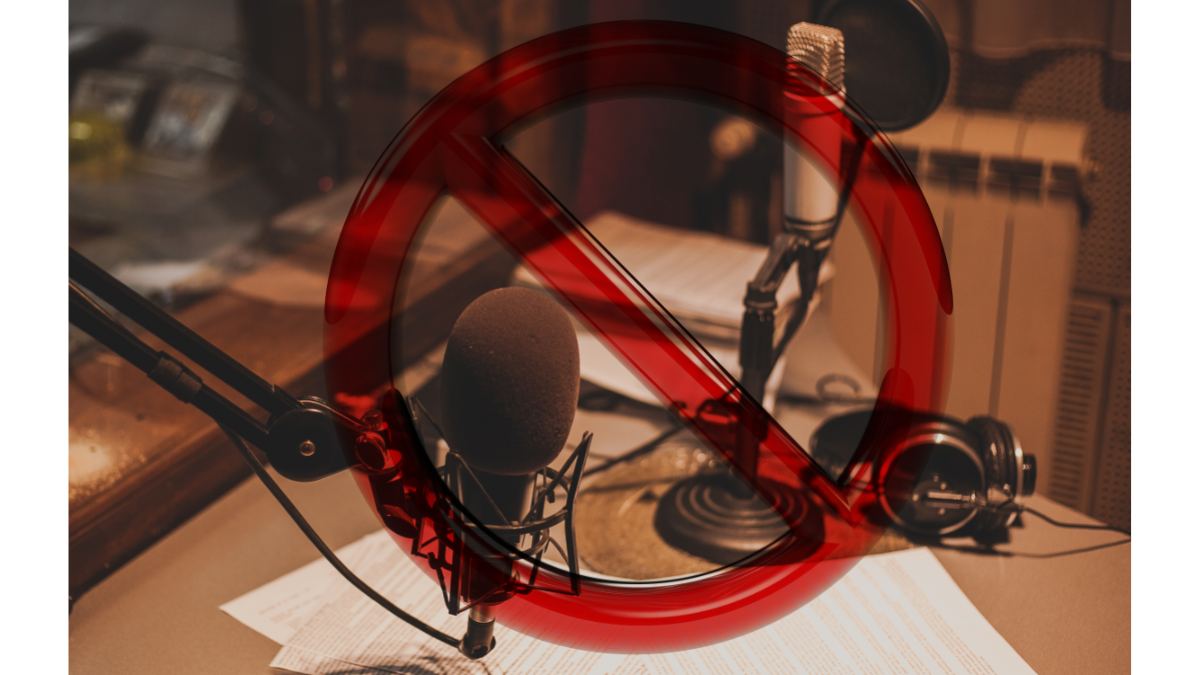
Venezuela. According to Venezuela's National Union of Press Workers (SNTP), by the end of last October, his country's La Comisión Nacional de Telecomunicaciones , known as Conatel, had shut down 95 different stations.
This information, which since the middle of this year has had repercussions in different international media and even in the National College of Journalists, has pointed critically to the responsibility of the State in this systematic closure of stations, as a way of restricting freedom of the press.
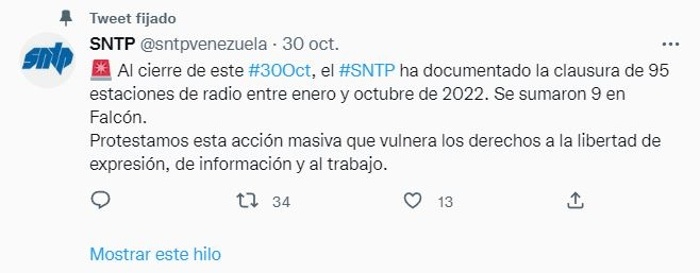
In its official Twitter account @sntpvenezuela, the union said that "In all cases, the instruction was given by telephone by Conatel monitors, people from the same municipality who work for the agency. The closed stations were community with at least seven years on the air and fifty workers, including announcers and operators. "
Specifically in a thread published on October 28, this organization explains that between January and October 2022 it was able to document the closure of 79 radio stations, so it established an average of 8 stations per month. "Except for one case in the state of Bolívar, in the rest of the reported incidents Conatel appears as responsible."
This publication has as an annex a link where a document is hosted that collects the complete information of this follow-up. Of the most relevant data of this publication, it stands out that these closures affect 66.6% of the national territory; in more than 80% of cases "Conatel issues instructions by telephone"; But above all it points to an arbitrariness
"In relation to the forms and arguments used by Conatel to order the closure, in all cases the absence of due process and the right to defense is evident. There are no written documents, subpoenas, or orders specifying the instruction or detailing the reasons."
Situation that has the support of Delvalle Canelón, the general secretary of the National College of Journalists (CNP), who explained to the international news agency EFE that these closures, executed by Conatel, in addition to including the exit of the air of the stations, include the seizure of transmission equipment, a situation that she described as theft.
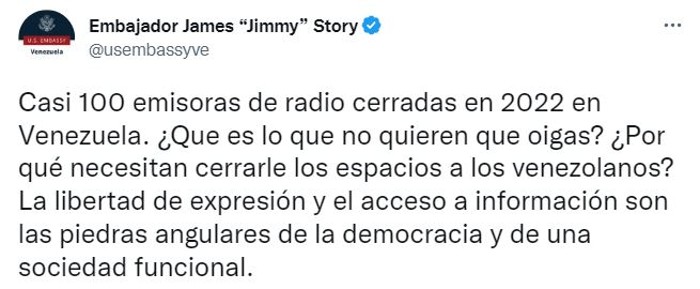
To this situation of discontent was added James Story, ambassador of the United States in Venezuelan territory, who published his opinion of the situation on his Twitter account.
In this same order of ideas, it should be highlighted a statement published on October 27 by the NGO Espacio Público, called "Conatel must guarantee pluralism and diversity", signed by around 40 different organizations, where the actions of the regulatory entity were rejected and pointed out the inconvenience of the new legal provisions.
"We warn our concern about the new regulation of general telecommunications routes since it unnecessarily increases the requirements to request access to a frequency. These new requirements are illegal because they are not contemplated in the Organic Law of Telecommunications, and also complicate the management in the midst of the current administrative disorder. "
Finally, and in contrast, on the website of the National Telecommunications Commission there is no more information about it and they do not refer to any opinion on their social networks.