
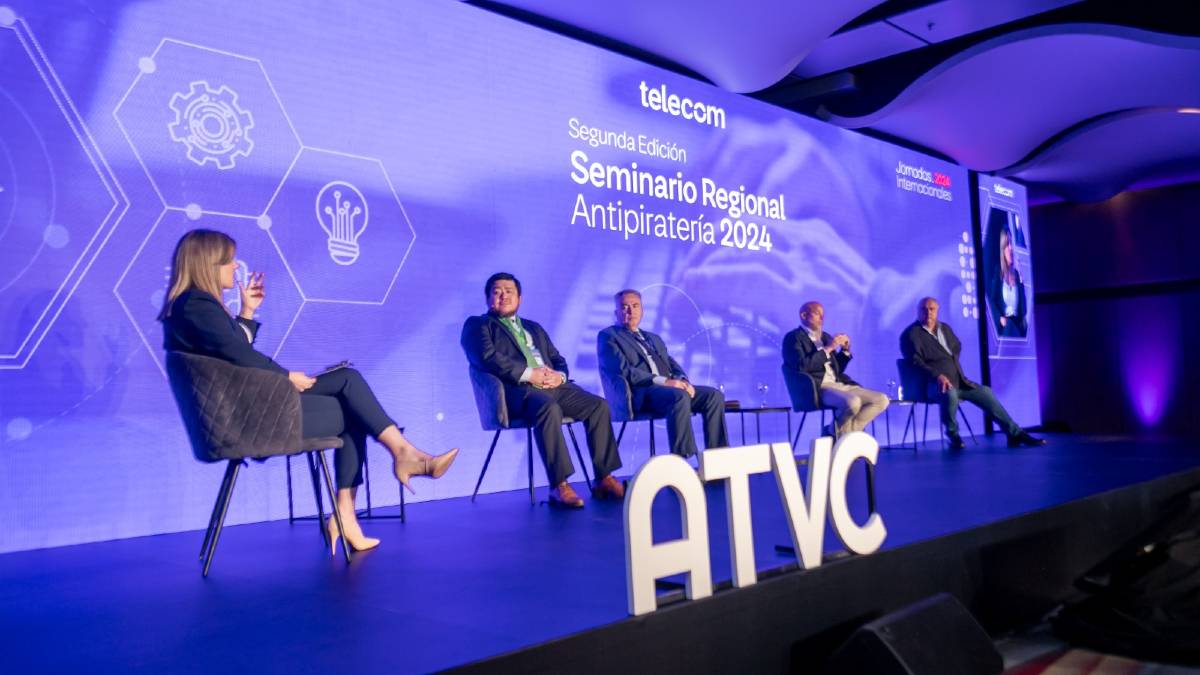
Argentina. Within the framework of the "II Regional Anti-Piracy Seminar", which opened the 2024 International Conference, it was revealed that currently, the industry loses US$258 million, which could be used in investments, while piracy invoices more than US$100 million.
During the panel "Dimension and impact of piracy in Argentina and Latin America", Pablo García de Castro, Regional Director for the Southern Cone of ASIET, indicated that in Argentina "the number of unique users who consult live content has tripled in recent years," according to a study carried out by the organization. "In 2020 we had found more than 5 million users consuming live content piracy. Today it exceeds 14 million, mostly from sporting events, especially football."
In addition, there was "an increase in the number of clicks to access the content, which has gone from four to seven clicks. This implies a growth of the business, of the advertisers who pay to be on these sites. This results in the risk of privacy and security of users."
In turn, "70 percent of ads correspond to sports betting, that is, gambling advertising supports piracy, and this is a growing risk." According to García de Castro, "piracy is a concentrated and articulated business. These illegal sites have relevance throughout the Latin American region."
Later, in the panel "Piracy: how it affects business in the digital age", Sergio Piris, Manager of Criminal Affairs, Technological Crimes, Anti-Piracy and Judicial Requirements of Telecom Argentina, said that the company works "in an interdisciplinary way to address anti-piracy, it does so at a preventive level by cancelling the different platforms and very actively when making criminal complaints."
"Any illegal mention of the Flow and Personal brand is immediately removed with appropriate tools. These are intellectual property infringements, and sanctions must be more forceful. The blockades must be judicially ordered."
In turn, Carlos del Campo Colas, Deputy Director to the Presidency of LALiga commented: "The tools for accessing illegal content have been greatly simplified. For us, LALiga, it directly affects income. Spain is the fourth country in terms of piracy consumption with more than 30 percent. And a chilling figure. In Europe we are in the lead."
For Nilton Navarrete, Sr. Legal Manager – Business and Legal Affairs at Paramount, it is necessary to "raise awareness of the negative effect caused by piracy. They minimize it, but they must understand that nothing is free."
Francisco Berdaguer, Consulting Attorney at Red Intercable said: "Last year we emphasized the applications, this year the boxes, naturalized as something legal, are sold in retail chains. The reality of the cable operator in the interior is terrible in the face of piracy. If something goes viral in a small town, no one wants to consume by paying. The smaller the economic unit, the greater the negative impact."
Later, in the panel "Challenges to Prevent and Attack this Scourge," Ignacio Estrada, LACNIC's Strategic Relations Manager, said that blocking sites is "complex" and "is not an effective way to combat piracy, given that there are other ways to access it immediately."
Then, Mike Caruso, Manager Research and Development of Telecom Argentina, said that for two years they have been working with a cybersecurity tool that allows them to collaborate with anti-piracy. "Through technology we identify, process, classify and report illegal access. In this way, we can define how to move forward with the blockades."
For his part, Claudio Leyer, Mr. Technology Manager of Telecom Argentina added: "Illegal accesses attack our Content Delivery Networks content and saturate the services. This affects users. We are developing palliative tools. The definitive solution would be concurrency control, which is not yet used in the world. For now it is unfeasible."
For Diego Alberto Stofella, Regional Head of Investigations at Vrio, "it is essential to have coordination with police forces, prosecutors' offices and other members of the industry. Anyone can make a report and inform us of the crime. When we have had to intervene, with the collaboration of other actors, and an anti-piracy raid has been reached, 100% of the results were positive."
Adrian Luengo, Manager of Corporate Security, Fraud Control and Investigations Southern Cone of Vrio reviewed two other cases and their repercussions, and explained that the people involved "are young people with certain technical knowledge, which are being perfected."
In the final panel of the Anti-Piracy Seminar, called "Tools of Justice to Combat Piracy", Horacio Azzolin, Attorney General of UFECI, stressed that "there are legal tools that are still lacking. Argentina has been characterized by very good intellectual property laws, but there are elements that we lack. There is a complicated regulatory issue, and an investigative one that is missing."
In turn, Fernando Couto, Founding Partner of Estudio Couto, said that Uruguay's regulatory unit (URSEC) has generated a working group that allows for more agile management in the fight against piracy. "We have two types of blockades, one for 30 days and another reserved for live events," he added.
For his part, Heber Martínez, Chief Executive Officer of CERTAL USA, said that "the damage of USD 29 billion generated by piracy also generates damages to States due to the tax impact. CERTAL is a young organization that works with the justice system in an arduous task of raising awareness about the damage or economic damage of piracy at the international level," he concluded.