
 Mexico. On Friday, November 22, the plenary session of the Chamber of Deputies approved in general and in particular, the Budget of Expenditures of the Federation corresponding to the year 2020. The reallocation of 20,607 million pesos to the initial project sent by the federal executive stands out, which implied a significant cut in the resources budgeted to autonomous organizations.
For the most part, this item was designated for social programs, in line with the policy announced by the current administration of increasing support and greater well-being of the most vulnerable population. Thus, the Secretariat of Welfare obtained an additional expense of 8 thousand 365 million pesos, in addition to the 173 mmp. initially budgeted, equivalent to an increase of 5% over the original project.
The government budget, rather than an accounting entry, is an instrument for the promotion of economic growth, development, equity and social inclusion. Hence the importance of its allocation being sufficient for the realization of public policy projects, as well as its implementation is effective in achieving these ends.
Economic Package 2020
At the beginning of September 2019, the Executive Branch sent to the Legislature the Economic Package corresponding to the year 2020 in which the Draft Budget of Expenditures of the Federation (PPEF) was included, among other documents. This document was adopted on November 22.
In a recessionary context of the Mexican economy and with low prospects for the coming years, the Executive designated a government expenditure of $6.1 trillion pesos, equivalent to an increase, in real terms, of 1% over the previous year and 8% of GDP in 2018. However, several of the autonomous bodies recorded significant cuts in projected spending, including Mexico's telecommunications regulator, by reallocating these items to social welfare programs.
PEF 2020: Cut to Autonomous Bodies
When analyzing the allocations proposed in PPEF and what was approved in the PEF, the contraction registered by the budget allocated to the Federal Telecommunications Institute (IFT) stands out, which amounts to 10.9%, being the autonomous body with the greatest difference between the amount projected in the PPEF and the one actually designated in the PEF.
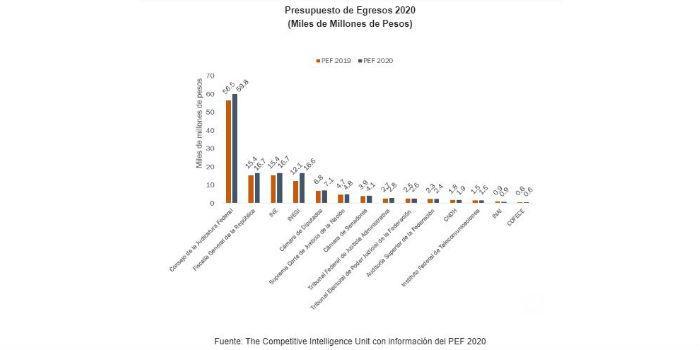
Compared to the PEF of 2019, these resources increased only by 2.7%, equivalent to 41.2 million pesos. This places the IFT in the penultimate place in terms of monetary resources designated to these bodies, only ahead of the National Institute of Transparency, Access to Information and Protection of Personal Data (INAI) and the Federal Commission of Economic Competition (COFECE).
In general terms, the Council of the Federal Judiciary is the body with the largest amount of resources allocated, with 59.8 thousand million pesos, equivalent to an increase of 6.0% over the previous year. This amount is almost four times higher than that of the following autonomous bodies: the Attorney General's Office, the National Electoral Institute (INE) and the National Institute of Statistics and Geography (INEGI). These bodies have a designation of 16.7, 16.6 and 16.5 mmp., respectively. These amounts are equivalent to an increase of 8.8%, 8.4% and 36.6% over the previous year.
The annual increase in expenditures for INEGI is explained by the census that will take place in the country during 2020, as it requires a greater amount of resources to be carried out. In turn, the amount allocated for this body did not undergo changes in the PPEF as in the PEF.
After the aforementioned bodies, it is followed by the Chamber of Deputies, the Supreme Court of Justice of the Nation (SCJN) and the Chamber of Senators, which will have 7.0, 5.0 and 4.0 mmp., respectively. In this allocation, the three institutions register annual increases in a range of between 3% and 5%. This places them above the annual increase that the IFT budget will receive (2.7%).
The Electoral Tribunal of the Judicial Power of the Federation (TEPJF), the Superior Audit Office of the Federation (ASF) and the National Human Rights Commission (CNDH) follow the aforementioned autonomous bodies with 2.7, 2.3 and 1.9 mmp. These bodies also record annual increases in their budgeted resources of between 3 and 5 per cent.
Finally, INAI and COFECE will have 0.9 and 0.6 mmp. in 2020, an annual decrease of 2.5% and 0.3%, respectively.
Budget for Telecommunications Regulation
The low competition and competitive reconcentration, the development and deployment of 5G, the connectivity deficit and the digital divide registered in Mexico are matters of importance for the achievement of the budgetary objectives of economic development and growth, equity and social inclusion.
Therefore, the budget granted to the IFT becomes relevant as it is the institution in charge of promoting and promoting optimal conditions for universal access to telecommunications and broadcasting technologies and services in order to maximize social welfare.
Therefore, it will be important to make the effort to allocate more resources to the gestation of projects to fulfill this task, after registering a contraction compared to what was originally budgeted. The efficient development of the ICT sector is necessary to tend towards equal opportunities in digital access and to direct efforts to reduce regional gaps that lead to higher levels of well-being for all Mexicans.
Text written by Radamés Camargo of The Competitive Intelligence Unit.