
 Mexico. The Federal Institute of Telecommunications, IFT, presents the first edition of the document forecasts of Telecommunications Services, an exercise in the analysis of the economic relations between the main variables that affect the evolution of services and a review of the trends, catalysts and challenges experienced by fixed and mobile services in the telecommunications sector in Mexico.
The study arises with the need to carry out a systematic analysis of the evolution of the lines and accesses of mobile and fixed telecommunications services, in order to understand their dynamics, explained from the historical information provided by the available public data, and the relationship that the lines or accesses have with other explanatory variables that are generally used to forecast the availability of the aforementioned services.
The variables to be forecast for this first analysis were: lines of the mobile internet access service, lines of the mobile telephone service, lines of the fixed telephone service, accesses of the fixed internet service and accesses of the restricted television service, which were subjected to a sieve of methodologies for the estimation of their value at the end of 2020, contrasting the results of each model.
It should be noted that the nature of the forecasts presented is indicative and consistent with the global trends identified. It is a benchmark that, together with other economic and sector indicators, complements the wealth of information available to participants in the telecommunications sector.
Among the main forecasts are the following:
It is estimated that the lines of the mobile Internet access service will increase 12% in the period between 2018 and 2020, reaching 98.8 million lines, which would imply a teledensity of 77 lines per 100 inhabitants.
Mobile telephone service lines could add 123.4 million lines by the end of 2020, which would represent a growth rate of 3% compared to the end of 2018 and a teledensity of 97 lines per 100 inhabitants.
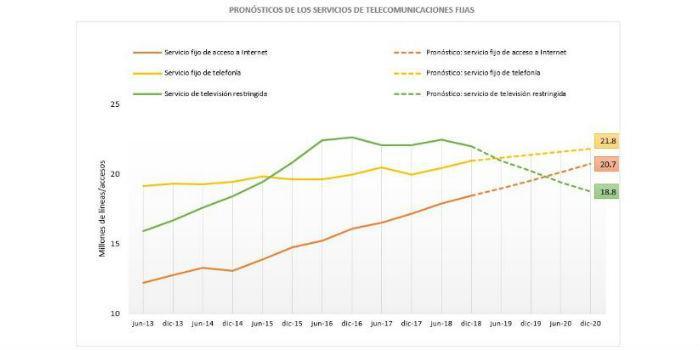
Fixed Internet service accesses will total approximately 20.7 million by the end of 2020, which would represent a growth rate of 12% compared to 2018.
Fixed telephone service lines will grow 4% between 2018 and 2020, reaching approximately 21.8 million lines.
On the other hand, it is estimated a reduction in access to the restricted television service for 2020, standing at 18.8 million accesses, which would represent a decrease of 15% compared to 2018.
The forecasts presented in the document will help in the construction of future scenarios that allow reducing uncertainty in decision-making in the industry; establish an analysis of general trends on the future of access or lines for the different telecommunications services; and provide clues about the statistical relationship of various variables and potential economic patterns for further analysis. The document can be consulted at: http://www.ift.org.mx/estadisticas/pronosticos-de-los-servicios-de-telecomunicaciones.