
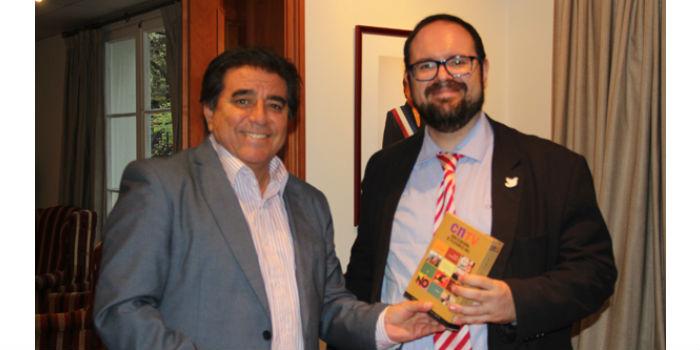
 Chile. Two new agreements that contribute to academic training and exchange of information with the regulatory bodies of the Audiovisual of Ibero-America, agreed the president of PRAI and the CNTV, Oscar Reyes, together with the Minister of Communication and Information of UNESCO, Gilherme Canela, during his meeting with the Chilean authority.
The first agreement will be the constitution of a public-private partnership to offer all audiovisual regulatory bodies access to a postgraduate level free of charge in a Virtual Academy that will be taught by the University of Texas, United States, in conjunction with the CNTV of Chile and UNESCO. The second is the formation of a summer school that will promote agreements and study programs.
On the occasion, the head of PRAI and President of the CNTV, Oscar Reyes, reiterated the importance of the exchange, especially in terms of studies on the television phenomenon and said that "the regulation of the audiovisual involves dealing with many challenges, especially those generated by the process of technological convergence. The new possibilities of connectivity and interaction, and the new ways of using and consuming, call into question the limits that traditionally exist between media. For this reason, it is especially important to acquire new knowledge to face the challenges of the future".
For his part, Guilherme Canela valued PRAI's initiative to strengthen agreements and exchanges. "We as Unesco open the window of opportunity to offer a vision adapted to the needs of audiovisual regulators. We can collaborate on two fronts; one with the University of Texas to create a virtual space within the ranks of Freedom of Expression, for all of Ibero-America and, on the other hand, the summer school for officials of regulatory bodies," he emphasized.
The Virtual Academy will be aimed at officials of the regulatory bodies partners of the Platform of Regulators of Ibero-America, PRAI, who obtain a scholarship to study virtually at the University of Texas.
The course, which will be taught remotely in Spanish, English and Portuguese, will identify the principles of regulation of audiovisual content that emerge from Ibero-American integration initiatives; to know the structure and order that make up the existing organizations in the Ibero-American countries and to verify the principles that sustain the regulation of the audiovisual sector, with emphasis on the regulation of audiovisual content.