
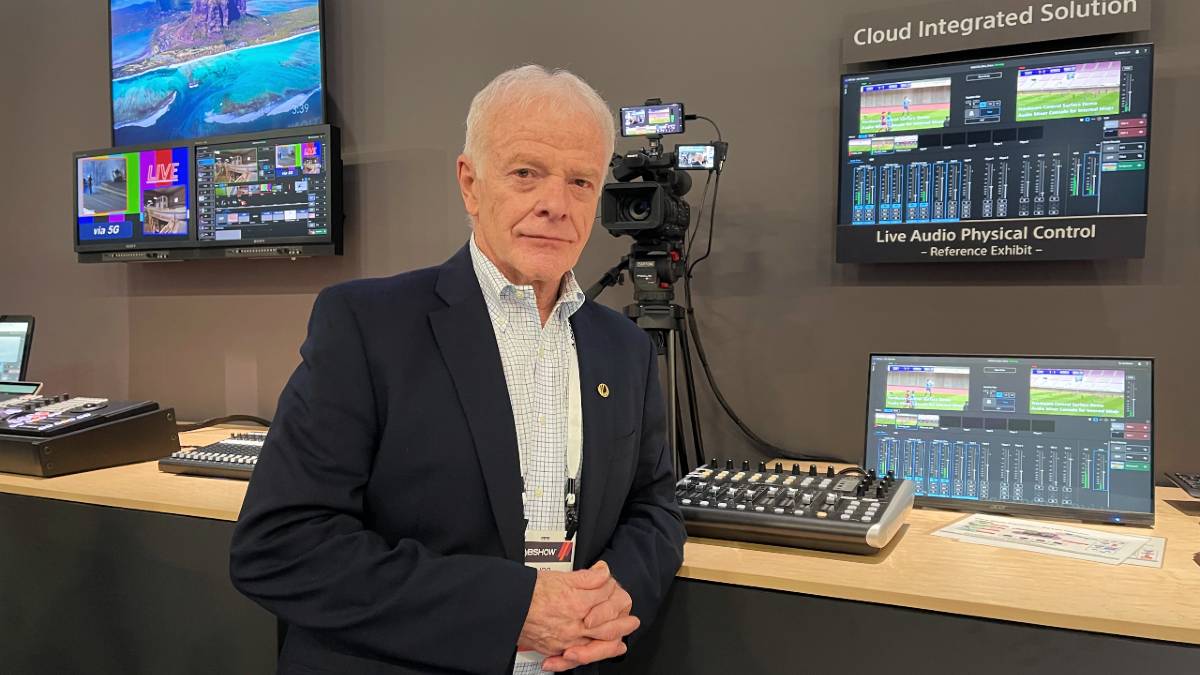
In conversation with TVyVideo+Radio, Hugo Gaggioni talks about the challenges that the broadcast industry has when it comes to migrating its systems from hardware to software.
Richard Santa
In an industry in constant technological evolution such as broadcasting, from time to time trends arise that manufacturers bet on. In some cases they work and are standardised and in others they simply do not find acceptance in the day-to-day work.
Among the many technological proposals that we are experiencing today, there is one that several manufacturers have joined, and that is to migrate from traditionally hardware-based solutions to virtualize them through software, known in English as Software Defined Broadcasting or Dynamic Media Facility.
To better understand this panorama, its benefits and implications, TVyVideo+Radio spoke with Hugo Gaggioni, Chief Technology Officer of Sony. He explained that "The industry is trying to continue pushing for all media functions to be carried out in software, with the expectation that it will be cheaper, more scalable, more flexible, more dynamic. Nowadays my study is news, the next day it can be novels, because everything is modifiable by changing the software. That's what the industry perceives. And there is an international discussion of what is needed to get there."
What has been proposed is a layered structure. The top layer is the interface of the human being. The layer below is the infrastructure layer. And there are a number of processing layers.
"There are companies like Nvidia or Intel, which are positioning themselves to offer that processing on generic servers, which you can easily buy and can run the software. That is developing. But, what is being tried to solve is how are manufacturers going to enter that processing platform? Is the interface open or proprietary? I think it is common knowledge that there are manufacturers who say that they are open, but the customer is encapsulated with a series of very limited processing. One of the most important points is that the API is open and that everyone can interoperate," he added.
And he gave the design of IP 2110 as an example. Being an IP over wired design, there was a lot more to it than that. What they call NMOS, Network Media Open Specification, which Sony made in order to achieve interoperability. But not everyone accepted it. For this reason, today it is technologies from various companies that are behind this communication layer. "We have been trying to move forward in 2110 for 10 years. Without that technology the software will not work, that is the prerequisite, to have 2110 before moving to software."
R+D and support
One of the challenges that must be overcome in this technological proposal is the economic model. There is a belief that since you don't have a physical computer in between, the software should be cheaper. But behind it is a whole process of research and development, as well as support and updating, which must be funded.
In this regard, Hugo Gaggioni commented "the customer does not simply buy the product and the manufacturer separates. There is a relationship of service. For example, if the machine broke down, I repair it. If it is software, it is expected to be much more efficient, with a much cheaper cost. So, the manufacturer is going to say, do I have a 24-7 service platform to support a software package in case something goes wrong? Who pays for that? It is already a business reasoning. When you have something that is living, every month I have to upgrade you software. Or you want new functionality. What is the economic relationship like to maintain that environment?"
He explained that manufacturers must have a large team of engineers developing code to keep that software alive, which can end up being much more expensive than creating a hardware platform and selling it.
System Security
Another aspect to take into account and that has not yet been resolved between manufacturers is the issue of security. Although the IT industry has made significant progress in terms of security, computer hijacking and information theft are also frequent. In this regard, Hugo Gaggioni mentioned that it is an issue that has not yet been addressed, because they are still discussing interoperability between manufacturers. And the discussion goes step by step.
"That is another of the unknowns that has not yet been resolved. If there is a security breach and the television plant goes down, who responds? Whose fault is it? The manufacturer or the user who has already manipulated the software and suddenly opened a window and got in there? If you sell interoperation modules right now that you are going to virtualize in a virtual machine and they are all working talking, if something fails, who do you call?" he added
But security is not only about system violations, it is also related to stability in its operation. For many channels and operators, who already have installed, robust, and proven hardware infrastructures, migrating to software could represent a risk.
A possible solution, Hugo Gaggioni explained, would be a hybrid operation. "An operator that prefers to have a solid, proven, pure hardware infrastructure can opt for what they call Hybrid Operation, that is, the cloud and hardware cooperating."
The role of Latin America
As already mentioned, the main requirement for a channel to be able to migrate its operation to software is to be 100% IP. If this panorama were to land in Latin America, things would not be so easy.
The Sony expert explained that "In our region, in some parts they are still analogue, there are few actors who have the economic resources to completely change the infrastructure, the SDI to IP transition has not been fully fulfilled. And if you don't have IP, you can't go any higher."
He added that there will be three or four large broadcasters in South America that may face that situation. With the economic capacity to invest and the possibilities of reaching manufacturers to promote development and move the industry in that direction.
"Brazilians have a fantastic technological infrastructure and have the economic means. But this software distribution thing, unless the big broadcasters go, the big ones in the region are not going to get in, because people are going to distrust how serious that software platform is. And because the user needs to integrate and mix more economical operations, it requires interoperability that doesn't yet exist. We are cautious to see if it really starts," he said.
Sony attentive to evolution
At the end of the conversation with Hugo Gaggioni, it is clear that this is a prototype that is in research and development, but it presents many challenges for all the players in the industry to be able to move forward and be commercially adopted. Above all, for channels and production companies, which already have an infrastructure and have to be completely digital to be able to start using this.
"We are vigilant, to see how the industry goes, because many proposals are presented in the market, there is that news, but it does not really penetrate society. Then two or three years pass after the bustle and disappears. We are monitoring to see if this really enters the industry and if the number of users who are going to adopt this proposal merits putting the economic resources into research to do so. Because if you tell me, only one broadcaster in the world is going to take this proposal, maybe one will say no," he concluded.