
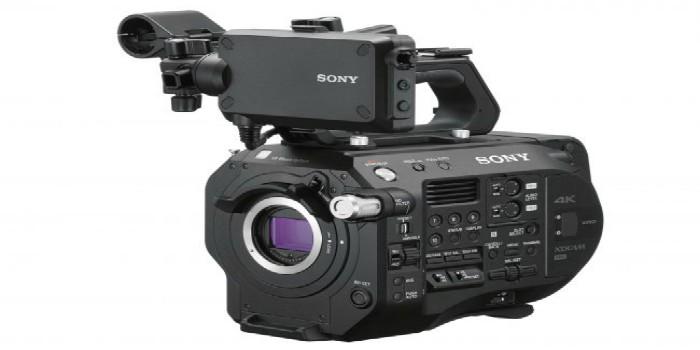
 Latin America. Sony has expanded its professional family of the FS Super 35 mm series with the addition of the new FS7 II camcorder. The new model builds on the strengths of the original FS7 by adding advanced features such as variable neutral density technology, an E-mount with locking lever, and a new mechanical design that allows for faster and easier setup.
Since its introduction in 2014, the FS7 has become one of the most widely used cameras in a wide range of production applications, and the original model remains part of Sony's range. The new FS7 II now offers creative professionals a wider range of creative tools, with new features all based on the demands of end users.
The new FS7 II camcorder is designed for long-form recording and production applications, in particular documentaries and independent film. Among the many improvements described below, the FS7 II can record in the BT2020 color space, making it perfect for 4K broadcast productions.
Electronic variable neutral density technology
The camcorder's electronic variable neutral density filter system, combined with its large sensor, provides greater exposure control, with the option to use predefined or variable operating modes. The variable neutral density mode (clarifies + 2~7 range steps, in a smooth step transition up to 1/128) allows the user to vary the density of the neutral density filter during capture and make a completely smooth transition between the steps. In this way, by maintaining the desired shutter speed, optimal movement is also guaranteed.
The camera's extended neutral density functions offer precise exposure adjustment, allowing the iris to adjust the depth of field, avoid the smooth focus caused by diffraction, as well as the chromatic changes resulting from the grouping of several external ND filters.
The camera is able to compensate for the fluctuation in exposure caused by iris control while adjusting the depth of field. Users can adjust the exposure and maintain the same "bokeh" effect when changing recording environment or lighting.
The predefined mode allows users to assign three neutral density settings to the ND filter turret, which is very useful when selecting the most appropriate filtration range, e.g. in changing lighting conditions. An automatic neutral density mode is also available, allowing you to set the exposure level while adjusting the depth of field with iris control.
E-mount (with locking lever) for professional recording
The FS7 II has taken up the E-mount (with locking lever) to give users the ability to switch lenses by turning the ring instead of the lens itself. This means that, in most cases, there is no need to remove the support rings from the lenses, saving time during production. The new E-mount is designed for the demanding applications of today's professional environment, and adapts to any E-mount lens on the market and to lenses with another type of mount using an adapter. Sony's new FS7 II camcorder is also compatible with Sony's α mount system, which includes more than 70 lenses.
Mechanical design improvements
Like its FS series counterparts, the FS7 and FS5 models, the new FS7 II includes several design and ergonomic enhancements to offer comfort of use and functionality in the field. These new features have been based on customer feedback on the FS7.
The FS7 II's "tool-free" mechanical design allows users to make on-the-fly changes to camera setup and operation. For example, no tools are needed to adjust the position of the smart grip or viewfinder.
The detachable eye visor, which includes a removable sunshade, offers a third stabilizer point of contact during handheld recording. Sturdy square-section rods and lever clamps on the LCD panel and camera body provide simple and precise longitudinal viewfinder adjustment, while maintaining level positioning.
New Sony G 18-110mm lens
Sony has also introduced a new E-mount Super 35mm lens, specifically designed for documentary and film production.
The new lens, the E PZ 18-110mm F4 G OSS, covers the Super 35mm and APS-C sensors. Compact and lightweight, 1.1 kg (2.4 lb), with a focal range of 18 to 110 (6x zoom), uses a new fully switchable system with mechanical/servo zoom, and instant zoom capability with absolutely no lag. The focal range is optimized for Super 35 and APS-C sensors.
The lens is compatible with Sony's α-mount cameras, including the α7 series of cameras with interchangeable lenses and professional 4K Super 35mm camcorders, such as the FS7 or FS5. While perfect for photographic capture, it will be the filmmakers who will fully appreciate its expanded creative capabilities for recording moving images.
The lens features Sony's SMO (Smooth Motion Optics) design, developed to optimize performance during video recording. This lens design eliminates unwanted elements and artifacts that do not affect photo capture, but can greatly limit the usefulness of a lens for video recording. These are, among others:
• Acceleration: F steps are gradually reduced as the zoom is adjusted
• Focus is not maintained during zoom use
• Variation of the angle of view during zoom use
• Offset the optical axis (the image scrolls in the frame when zooming)
*Due to a change in the specifications of the SELP18110G, it is no longer compatible with the SEL14TC and SEL20TC telephoto lenses.
XQD Cards
The FS7 II supports the XQD memory card format, designed for capturing and transferring high-resolution files at high bandwidths. Sony's latest XQD card, the QD-G256E, with a capacity of 256 GB, seen for the first time in the industry, allows you to enjoy a 4K recording time of approximately 45 minutes at 60P and 2K of 3.5 hours at 30P. Combined with 440 Mbps read speed and 400 Mbps write speed, users can record for longer without needing to switch media cards.
The FS7 II is expected to be available in January 2017.