
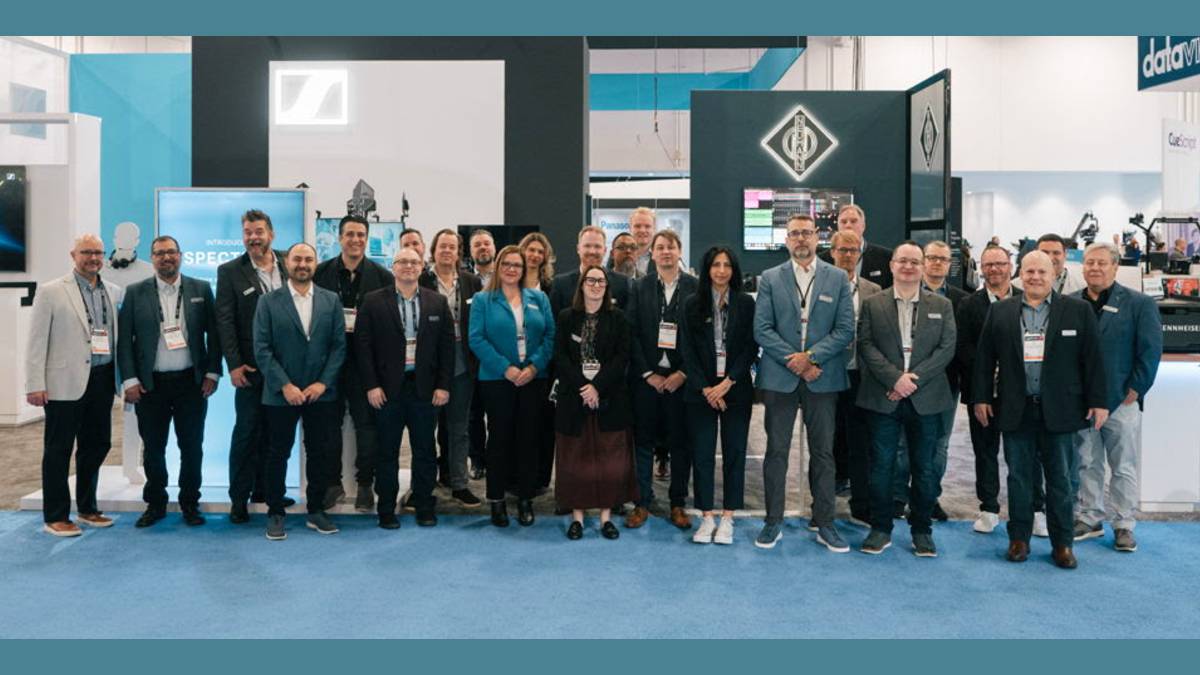
NAB. The company Sennheiser will take advantage of the NAB Show 2026 to present its solutions aimed at broadcasters, studios, streaming platforms and creators.
The booth, divided into three areas – Trusted Integration, Connection and Future, and Innovation – will guide visitors through their workflow. From content capture, enrichment and monitoring with solutions from Sennheiser, Neumann and Merging, to integration and connection, where your partner SoundBase will showcase the new features of your RF planning and control application, compatible with any brand.
The tour culminates in the Future and Innovation area, where the AMBEO Zone, the Spectera exhibition and the Spectera Laboratory are located.
Latest Spectera news at NAB 2026
With the latest Spectera firmware update (v 1.3.0), the OpenAPI 17.0 specification for the Spectera base station has been released. The Spectera API enables deeper integration, new workflows, and partner-driven innovation. Now, engineering teams, system integrators, automation specialists, and enthusiasts can integrate Spectera into their own control systems, monitoring panels, and production workflows using the secure HTTPS-based SSCv2 interface for remote access.
"API access is not an extra, but an essential feature for an ecosystem that seeks to thrive in user environments and workflows," said Benedikt Euen, Senior Product Manager at Spectera. "It opens up Spectera to all those resourceful operators and automation enthusiasts who want to create custom workflows, manufacturers looking for integration with their own devices, and programmers who create audio plugins or other software."
Taiwan and Brazil are already licensed for Spectera
Spectera now offers activation licenses for Taiwan (License Zone 15), China (trial, License Zone 17) and Brazil (License Zone 16), where Anatel is already certified. In addition, the frequencies allowed in the 1.4 GHz band for License Area 1 (EU, EFTA, UK, Turkey) have been extended, now including 1492-1525 MHz, in addition to 1350-1400 MHz. "This expansion makes Spectera 1.4 GHz even more attractive to users," says Euen, "especially in the face of saturation and scarcity of UHF resources."
Immersive Workflows for Broadcasting and OTT
The AMBEO Zone allows broadcasters, OTT platforms and content creators to discover how to enhance audience interaction through advanced immersive audio technologies that enhance content played on non-immersive systems, both in real-time broadcasts and file-based VOD productions.
"Currently, content playback is most often done on stereo devices, especially mobile devices," explains Kai Detlefsen, director of AMBEO, the immersive audio initiative of the Sennheiser Group. "Our immersive and adaptable workflows help professionals deliver consistent, reliable, and high-quality audio experiences that strengthen viewers' emotional connection while preserving creative intent."
The AMBEO 2-Channel Spatial Audio Renderer is introduced, a post-production solution optimized for VOD and catalog content, file-based and available for both local use and cloud processing. This workflow allows immersive mixes to be automatically rendered in a captivating 2-channel AMBEO experience, while giving engineers full access to parameters to make creative adjustments when needed.
Inspired by the same principles, the AMBEO 2-Channel Spatial Audio Broadcast Renderer encodes immersive, immersive audio tracks into a dynamic AMBEO 2.0 stream in real-time. In this way, the renderer offers an immediate path to an audience-ready immersion, without the need for listeners to make any changes.
At NAB, AMBEO shows how the renderer can be implemented on compact professional devices such as the Neumann MT 48, allowing easy integration into existing AES67, ST 2110 or Dante environments. Last but not least, the AMBEO Zone presents the Neumann VIS visionOS app, which shows how immersive productions can be created and perfected in context using spatial computing devices such as the Apple Vision Pro.
By visualizing elements of the spatial mix within the actual playback environment, audio professionals gain an intuitive understanding of location, depth, and motion, streamlining creative decisions and accelerating iteration cycles.