

Brazil. Globo's broadcast at this year's Rio Carnival featured a technological innovation that promises to elevate the quality and efficiency of live broadcasts: the use of a private 5G network in conjunction with cutting-edge equipment from Sony. This initiative represents a decisive step towards the future of transmissions, combining mobility, image quality and operational efficiency.
The great proof that the project was a success is the fact that almost half of the total broadcast time of the event was "on the air" with signals from cameras connected through the 5G network. Globo's adoption of this technology in the production of the Rio Carnival demonstrates a continued commitment to innovation and excellence in the transmission of Brazil's most important cultural event, ensuring that audiences, both local and global, enjoy a visual experience of the highest quality.
Featured devices include the CBK-RPU7 encoder and NXL-ME80 decoder, both of which are integrated with Sony's advanced ultra-low-latency HEVC codec. The CBK-RPU7 is a Remote Production Unit that incorporates a codec chip developed by Sony, using QoS technology and HEVC codec to achieve high compression and high-quality video transmission up to 4K 60p with low latency. For its part, the NXL-ME80 is a Media Edge processor capable of handling two HD or 4K channels. This device acts as an efficient bridge between LAN and WAN networks, maximizing the bandwidth available for video streaming and remote production. With ultra-low latency and high image quality, the NXL-ME80 is ideal for productions that require efficiency and reliability, such as large-scale live events.
 The Sony HEVC codec used in these devices can reach latencies of up to 2 frames (not counting the latency of the 5G network used for video transmission), with transmission rates ranging from 25 to 50 Mbps for HD videos and between 50 and 100 Mbps for 4K streams. This capability enables the delivery of video with exceptional quality and extremely reduced response times, ensuring a smoother and more immersive experience for audiences.
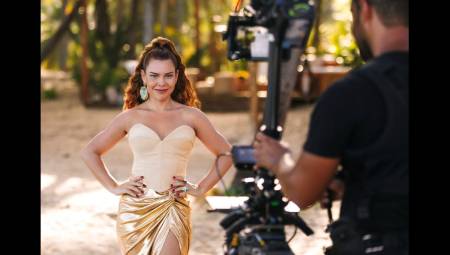
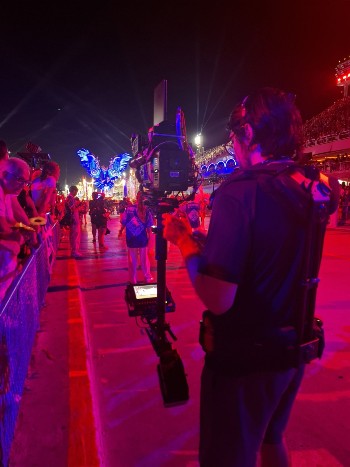
In addition, for the Carnival project, Globo promoted together with Sony the development of additional resources that further improved the remote control operation of 5G cameras. Among them, the support for video return to the cameraman stands out, allowing operators to have instant feedback on the images captured, even in a wireless environment. Another important advance was the implementation of remote video adjustment, which makes it possible to operate video remotely, allowing fine adjustments of the image in real time without the need for a face-to-face operator. Finally, the Tally functionality was developed, an essential resource for operation in broadcast environments.
The combination of this equipment with the 5G private network provides an operation similar to that of cameras connected by fiber optics, guaranteeing high image quality and low latency. This configuration not only improves the viewer's experience, but also offers greater flexibility and mobility to production teams, allowing more dynamic and complete coverage of the Carnival parades and events, both on the broadcast of Open TV and on the Globoplay platform.