
Latin America. GatesAir took its wireless spectrum expertise into new territory with a live demo held at IBC, showcasing 5G streaming of live TV content to mobile devices.
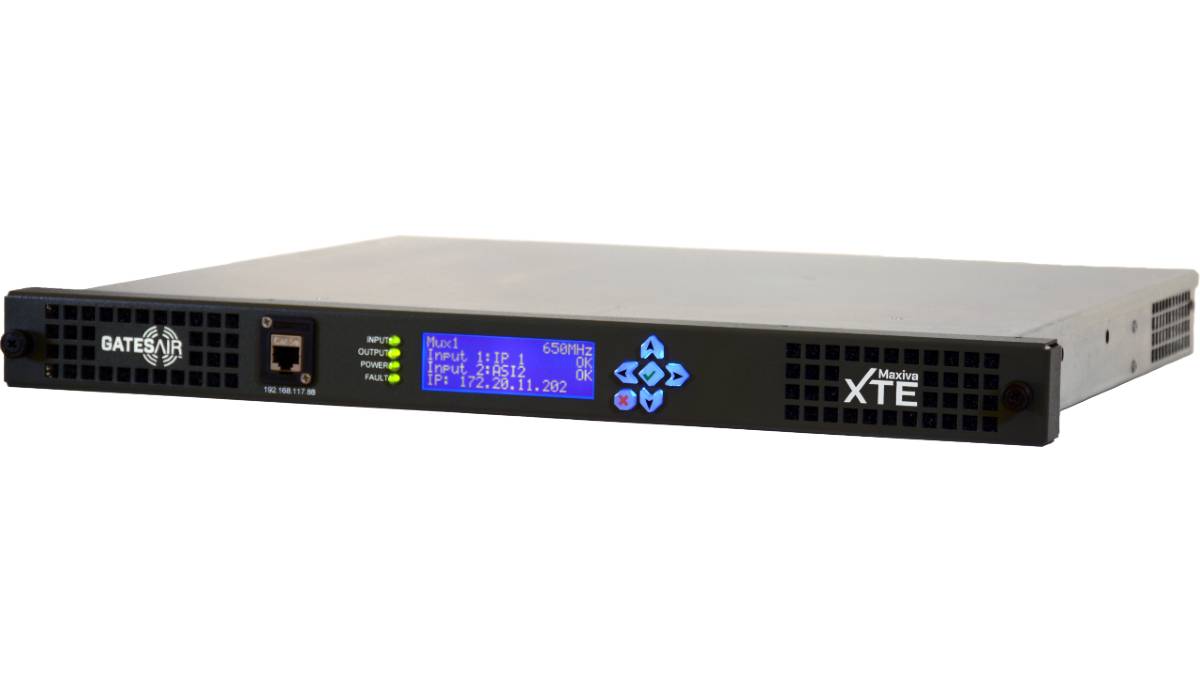
GatesAir employed 5G modulation within its Maxiva XTE exciter to send live video content to a smartphone via the 5G waveform. The new modulation technique will effectively extend the delivery range of GatesAir's Maxiva ULXTE, UAXTE and OP liquid-cooled and air-cooled UHF transmitters to mobile audiences.
To meet a growing need for 5G transmission support in Europe and Asia, GatesAir's provision of 5G transmission over UHF channels not only ensures 5G exclusivity for voice and mobile cellular use, but also gives broadcasters the ability to adopt 5G transmission without needing to replace their existing transmitters.
"Although most broadcast transmitters are designed for terrestrial digital waveforms such as ATSC 3.0 and DVB-T/T2, there is a growing need for broadcasters across Europe and Asia to support 5G waveforms for content distribution," said Keyur Parikh, vice president of engineering at GatesAir.
"Our Maxiva transmission products are designed for standard-independent transmission. As broadcasters are considering the potential impact of 5G for terrestrial TV, GatesAir is poised to help our customers make the most of their UHF spectrum for wireless content distribution," he added.
Since traditional 5G frequencies are reserved as a high-priced product for voice and mobile telephony, broadcasters are already evaluating the possibility of downloading broadcast content to a UHF frequency. The adoption of UHF frequency allows broadcasters to avoid using valuable mobile spectrum and also means that consumers can receive, decode and watch content on the same mobile devices they already use.
"The ability to send streaming content to a phone without congesting the mobile frequencies reserved for mobile voice and data gives our customers more options," added Parikh. "It gives them the ability to send exclusive content over 5G channels or simply send the same content to more devices. Crucially, it allows them to do so as long as the transmission infrastructure is upgraded without having to invest in new transmission equipment."