
Mexico. The Federal Institute of Telecommunications, IFT, presented the new edition of the document "Forecasts of Telecommunications Services", an exercise in the analysis of the economic relations between the main variables that affect the evolution of services and a review of the trends, catalysts and challenges experienced by fixed and mobile services in the telecommunications sector in Mexico.
The document is divided into three sections that explain the elements taken into account for the identification and implementation of the predictive models used in this new edition:
Comparison between the estimates made in 2019 and the data observed in the market at the end of 2020.
Technological trends and incidents presented as a result of the COVID-19 pandemic.
Forecasts of fixed and mobile telecommunications services.
These new forecasts are based on significant events such as:
- The COVID-19 pandemic that has accelerated the development of the digital transformation process. According to data from the International Telecommunication Union, infrastructure deployment, expanded access and provision of content and services have accelerated, progressing faster in a month than in a year before the pandemic.
- The COVID-19 health emergency has shown the fundamental role of telecommunications in keeping businesses, governments and societies connected and up and running. It has also kept connected people around the world who rely on technology for information, both for social distancing and for working from home. However, for the Inter-American Development Bank, despite the increase in broadband networks in the Latin American and Caribbean region, there are still few activities that can be carried out remotely due to the absence of connectivity of a significant number of people or the difficulty that different users find to accelerate their digital transformation.
- In Mexico, most telecommunications service operators have been able to cope with the increase in demand and have adapted to the needs of their customers. In this sense, having reliable and resilient telecommunications infrastructure along with a high level of digitalization are crucial to keep the economy running in pandemic conditions where the demand for digital tools increases.
- This new report accompanies the punctual data of the forecast in each service with the international facts and trends that contextualize and support the result.
The historical data of each service also constitute a fundamental piece of information, which is why each forecast is accompanied by a systematic analysis of the evolution of the lines and accesses of mobile and fixed telecommunications services.
It should be noted that the nature of the forecasts presented is indicative and consistent with the global trends identified. It is a benchmark that, together with other economic and sector indicators, complements the wealth of information available to decision-makers and stakeholders in the telecommunications sector.
Below are the results of the mobile and fixed forecasts:
Regarding mobile services, an annual growth rate of 2.3% is forecast in internet access lines in 2022, reaching 105.6 million lines, which would imply a teledensity of 82 lines per 100 inhabitants at the end of this year.
While mobile telephone service lines could add 127.5 million lines by the end of 2022, which would represent an average annual growth rate of 2.1%, and a teledensity of 98 lines per 100 inhabitants.
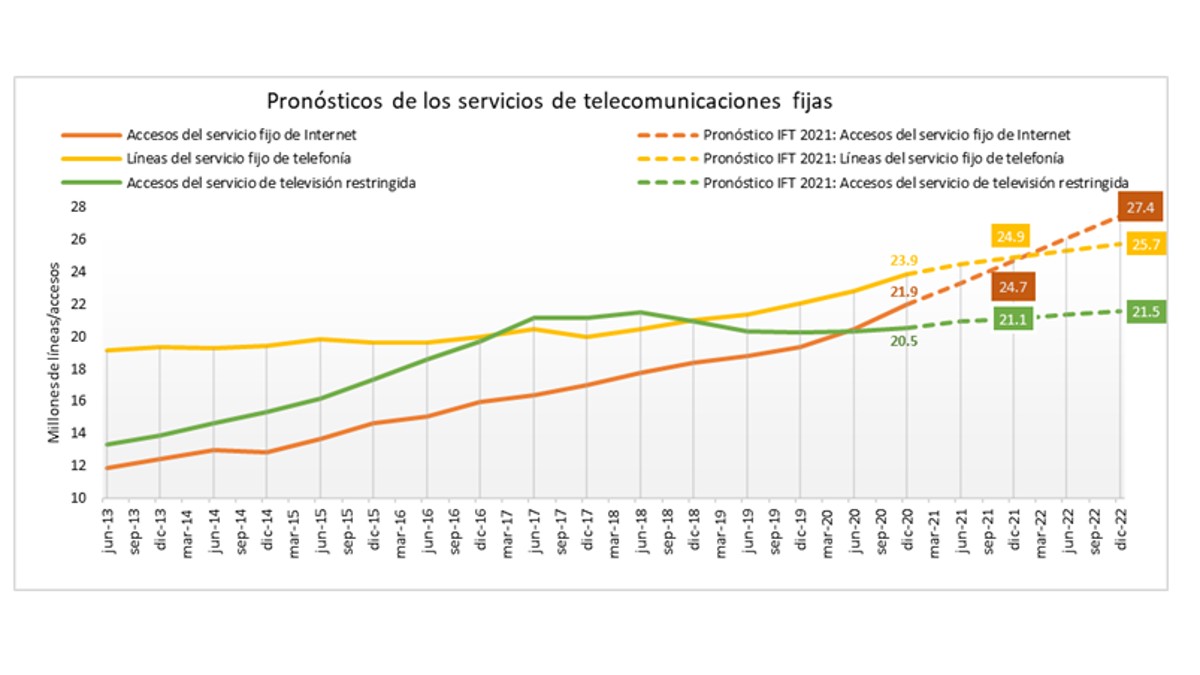
As for fixed services (internet, telephony and restricted television), the expected annual growth of 10.9% in 2022 for access to fixed internet service stands out, a high rate in relation to the dynamics shown by the rest of the telecommunications services, motivated by the need for fixed connectivity in homes under social distancing measures to mitigate the effects of COVID-19. It is estimated that this type of access will add approximately 27.4 million by the end of 2022.
On the other hand, the lines of the fixed telephone service could grow 3.3% per year at the end of 2022, reaching approximately 25.7 million lines at the end of this year. The accesses of the restricted television service, on the other hand, could be located at 21.5 million accesses by the end of 2022, which would represent an annual growth rate of 2.2%.
In summary, this document presents a prospective analysis based on subscribers or lines of the five telecommunications services regulated by the IFT, based on the Main Component Analysis technique, time series models and Machine Learning algorithms.
The full document and methodological framework are available by clicking here.