
 Latin America. The telecommunications markets in Latin America share characteristics that allow them to be studied together. Despite this, it is possible to segment them subregionally to identify trends in the consumption of specific services, as well as a differentiation between countries. Thus, the subregional grouping Central America (Costa Rica, El Salvador, Guatemala, Honduras, Nicaragua and Panama) and the Andes (Bolivia, Colombia, Ecuador and Peru) can be analyzed in a unique way.
Revenue Dynamics
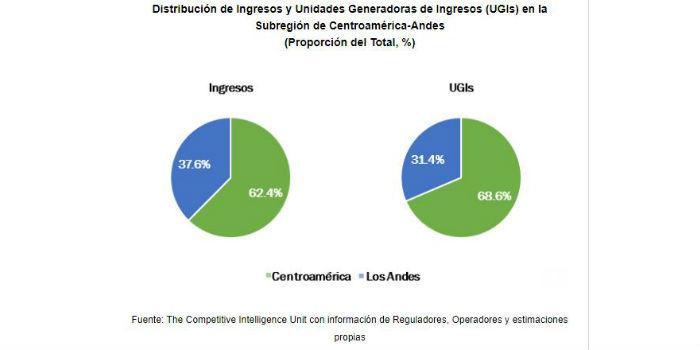
In 2017, this group of countries accumulated revenues of $30.3 billion dollars, such that they represent a quarter of the amount generated by telecommunications companies in the provision of Mobile Telephony, Restricted Television, Telephony and Fixed Broadband in the Latin American region as a whole.
The Andes subregion alone accounts on average for almost two-thirds of the income between the countries of Central America and the Andes. However, the former registered greater dynamism in the last triennium. This is attributable to a recovery in income after the economic recession in 2015. The annual growth registered in 2017 for Central America was 7.1%, while for the Andes countries it was 4.0%.
Subscription Trends
On the other hand, the subregion accounted for a total of 232.4 million Revenue Generating Units (UGIs) at the end of 2017, 13.4% of the Latin American total. The proportion in UGIs of the Andes within the subregional total is close to the vicinity of 7 out of 10. Newmene, the annual growth in UGIs of Central America is higher, registering a coefficient of 6.1%, while for the Andes it was 3.7%.
As a whole, the countries of the Central America-Andes conglomerate registered an upward trajectory, both in UGIs and revenues, with the exception of Ecuador. Among the countries that stand out for the marked dynamism in the contracting and consumption of services are Bolivia, Colombia, Nicaragua and Panama.
Contracting of Services
For three of these four countries, the main driver of growth in users was the growing contracting of Fixed Broadband, registering growth ratios above 30.0%, in the case of Bolivia and Panama. This effect was seconded by the Restricted and Mobile Television segments. Fixed Telephony remained the service with the greatest setback in its contracting in all cases. It is worth noting that the mobile segment largely explains the positive dynamism for the Central American markets. In both Nicaragua and Panama, this market was the second fastest growing in UGIs and revenues during 2017.
When analyzing the growth of UGIs by market, a loss of the dynamism registered by Restricted Television is shown, as well as a recovery of the Fixed Broadband segment. Fixed Telephony maintains its downward trend, generalized in the rest of the countries of Latin America.
Consumption of Services
Regarding telecommunications consumption in the subregion, measured through the ratio of income per UGI in each market, a higher level is identified in the case of Central America with an expenditure of $156.2 dollars per year, compared to $118.7 dollars in the Andes.
However, both show a downward trend in the last three years. This trajectory is explained by technological advancement, the packaging of services and the evolution of consumption habits that result in greater affordability of services for end users.
These market conditions have made it difficult to recover the income of all countries in the different markets, although there are signs of a renewal in dynamism towards the end of 2017. The Restricted Television service stands out as the most resilient to the difficult regional macroeconomic environment.
In summary, the Central America-Andes subregion registers a generalized trend in the growth dynamics of UGIs and incomes. Macroeconomic and general industry conditions have impacted domestic industries in similar ways. However, although the Central American and Andean markets show signs of recovery, the growth momentum by segment is dissimilar.
In the case of Central America, the recovery in growth is largely attributable to the dynamics of the mobile market. This responds to new regulatory and market conditions, such as measures that facilitate mobile portability, as well as new investment projects. Despite this, this subset of countries faces difficulties in offering new generation services.
For its part, in the Central America-Andes conglomerate and in other subregions of Latin America, the Fixed Broadband segment is the irrefutable engine of recovery of sectoral growth.
Text written by Javier Medina and Radamés Camargo of The Competitive Intelligence Unit.