
 Latin America. Radio spectrum frequencies below 1 GHz, also known as "low bands", have been gaining increasing importance for the wireless telecommunications industry in recent years.
With mobile services consolidating in Latin America as one of the main accesses to high-speed Internet since the late 2000s, and especially in the last decade, it is clear that cellular networks play an irreplaceable role for Internet access for a wide sector of the population and in a variety of use situations.
Against this background, the low bands play a decisive role, given that, due to their technical characteristics of signal propagation, they become the main option for the deployment of networks and services in a cost-efficient way in areas far from large urban centers and in places of low density or population dispersion, according to the document "Status of the radio spectrum bands of 600 MHz and 700 MHz in Latin America" published by 5G Americas last May.
In Latin America, the two main bands of this type are 700 MHz and 600 MHz, now available for mobile services on an international scale thanks to the migration processes to digital TV in recent years.
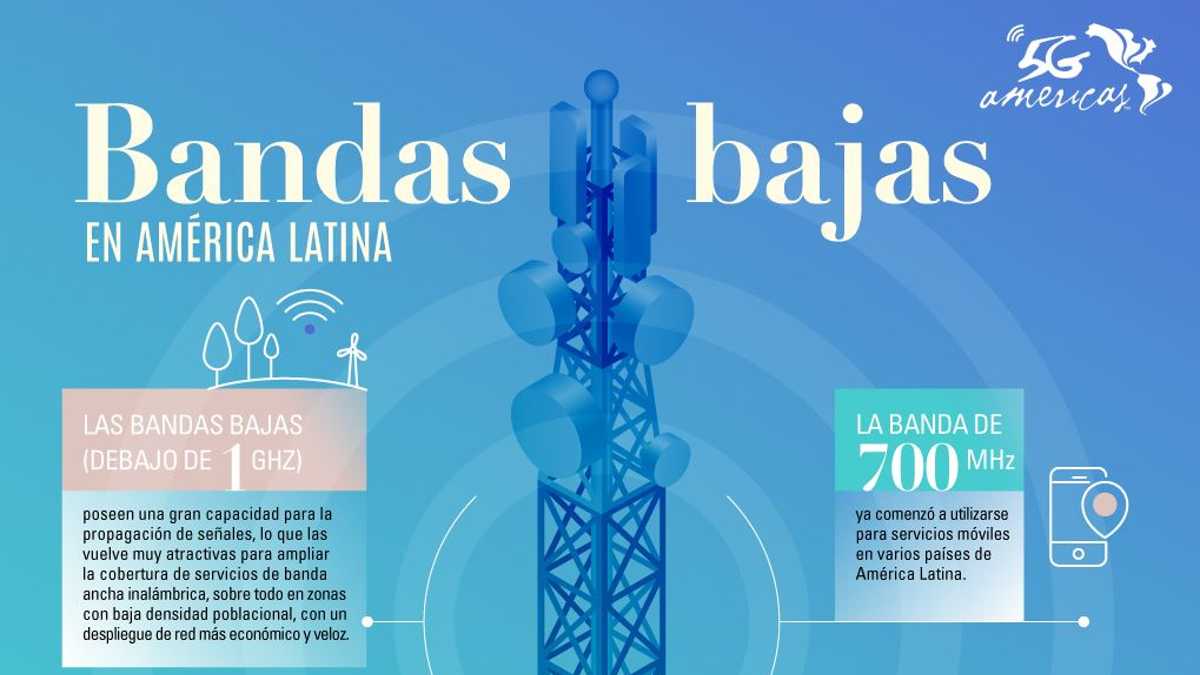
The 700 MHz band – also known as "digital dividend", for example, is already allocated for mobile services and assigned to mobile telecommunications service operators for use, according to the infographic Low Bands in Latin America, prepared by 5G Americas. Twelve countries, out of a total of 18 analyzed, have already assigned this frequency and there is also an allocation process underway in the Dominican Republic that should conclude by the fourth quarter of this year.
The 600 Mhz band – called the "second digital dividend" – has meanwhile been allocated for mobile services in eight countries analyzed, but so far no allocation procedures have been carried out for its commercial exploitation.
"The concession of radio spectrum blocks in the so-called low bands is extremely positive for the mobile industry, as it will facilitate the laying of networks in a cost-efficient way for both the deployment and maintenance of infrastructure, which will contribute to providing communities with access to broadband Internet on favorable terms, "- said José Otero, Vice President for Latin America and the Caribbean of 5G Americas.
To access the 5G Americas infographic, click here.