
 Latin America. Stargate Studios, an award-winning visual effects company, has used several of its products to create ThruView, a cutting-edge system exclusively for real-time virtual productions.
Sam Nicholson (A.S.C.), founder of Stargate known for his work with visual effects, developed the concept of real-time compositions in the early 2000s, when all productions were halted due to the attacks of September 11, 2001. "You couldn't travel to film in other places," Nicholson explained. So, we wondered if there was any compelling way to set series like "ER" in Chicago, "CSI" and "Ugly Betty" in New York or "Grey's Anatomy" in Seattle without leaving Los Angeles.
Thanks to an ingenious design, the recording of base images and the use of green backgrounds, Nicholson's team managed to carry out a virtual production of the television programs with which the company collaborated. "We started with Stargate Virtual Backlot, shooting images of various cities in 360 degrees and high resolution," Nicholson said. Today, the company's virtual fund library is the largest in the world and features more than 300,000 clips.
But the solution was not ideal, given that the exclusive use of green funds limited the ability of actors to interact with the environment. In turn, it was difficult for cinematographers to match the lighting to something they couldn't see. On the other hand, more time and money was needed to compose the scenes during post-production. Consequently, Nicholson wondered if there wouldn't be a better way to accomplish this and if it would be possible to do it instantly, on set.
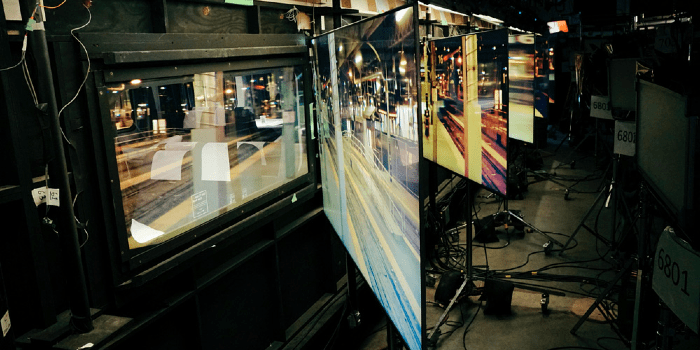
Nicholson's team took advantage of all this experience in the production of "Run," hbo's new series. Despite the fact that, according to the plot, the main characters take a train trip through the United States, filming was to take place in Toronto. "During the pre-production stage, we demonstrated that with several Blackmagic Design DeckLink 8K Pro cards we could stream 10 simultaneous channels of 8K recorded footage to Epic's Unreal Engine gaming engine, to be played back in real time on 40 4K monitors in a 45-meter-long set that simulated a train."
Using a customized tracking and lighting tool developed by the company, the system managed to create a photorealistic image that was seen through the windows of the train, with a composition in which it was possible to match the light with the background in real time. "This system, which we used throughout the production of the series, is now called ThruView."
This platform is based on various innovative technologies that have been developed and transformed into solid and reliable tools, both exclusive and easily accessible. "At Stargate, we have created a wireless camera lighting and tracking system, with pixel mapping and RGBW DMX controllers. Recording images in 8K is now possible thanks to Blackmagic Design's products and the color grading features that DaVinci Resolve Studio offers," said Nicholson. Economical 4K monitors, increasingly fine graininess, modular LED panels, NVidia graphics processors powered by the use of the GPU and Epic's Unreal Engine game engine combine with Blackmagic Design tools to make it possible to use the ThruView system. "The challenge is to bring all these solutions together and make them reliable and durable when it comes to live multi-camera productions."
"On the set of 'Run,' we used three simultaneous systems with DaVinci Resolve Studio," Nicholson said. "We rely on them to coordinate all the elements and reproduce them. The program's performance in real-time color grading, editing and effects composition with Fusion was essential to handle a large amount of material recorded in high resolution with the dynamism of such a production."
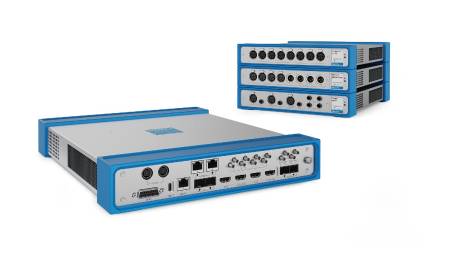
In addition to the DeckLink 8K Pro cards, various Blackmagic Design products make up the core of the system. These include several Smart VideoHub 12G arrays, DaVinci Resolve Micro Panel and UltraStudio 4K Extreme devices, a Teranex converter, multiple Mini Converter units, and an ATEM Constellation 8K mixer. All these equipment are essential for the processing of images in high resolution.