

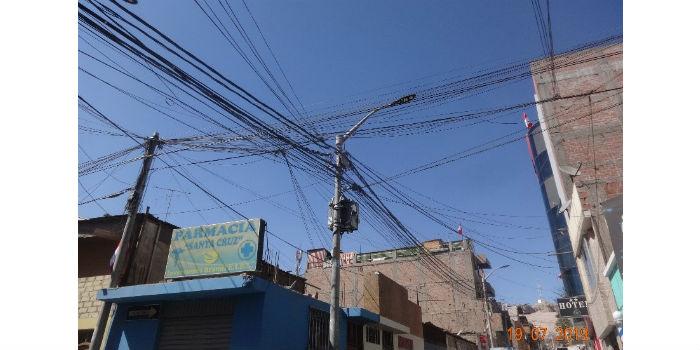
 Peru. The Supervisory Agency for Private Investment in Telecommunications, Osiptel, recommended that the country's municipalities manage the ordering of the aerial wiring of public telecommunications services that affect the decoration of cities and generate possible security risks.
Although Osiptel does not have the power to supervise or sanction operating companies for the deficient installation of overhead telecommunications cables, in 2018, on its own initiative, the regulator entity appointed a working committee in order to identify obstacles and possible solutions to the problem in question.
This committee detected that the existing regulations, National Building Regulations, National Electricity Code, Law that regulates the execution of public service works, among others, need to be updated and complemented, in order to establish adequate criteria to solve the problem of disorderly growth of wiring.
Thus, Osiptel shared with the municipalities of the country a document that contains the general guidelines that will help address the problem and stop the disorderly installation of overhead telecommunications cables (the document can be consulted at the following link: https://www.osiptel.gob.pe/repositorioaps/data/1/1/1/par/inf-001-problemarica-cableado-aereo-peru/Informe001-comitemun-2020.PDF), and was made available to local governments for any consultation or coordination, within the framework of the collaboration that governs between the entities of the State.
It should be noted that the Organic Law of Municipalities, the Law for the Strengthening of the Expansion of Infrastructure in Telecommunications and the Law that regulates the execution of public service works authorized by municipalities in areas of public domain, establish that it is the district governments that are competent to supervise, supervise and sanction the companies that provide the installation of cables on public roads when the urban heritage is damaged, cultural, tourist and landscape or endangers the safety of third parties or neighboring buildings.
Recommendations
The document reached to the municipalities recommends that in areas of high density of cables local governments demand a comprehensive reorganization that includes the increase of poles, terminal boxes, splitters, etc. according to the technologies involved; the option of underground laying or a combination of the above solutions.
It also proposes that the deployment of wiring on the roofs of buildings or homes be prohibited and that operating companies be forced to carry out underground laying when buildings or multifamily homes exceed eight overhead cables.
It also points out that municipalities must impose on operating companies the obligation to identify their overhead cables through the use of signs or colors in their supports.
Finally, the Osiptel proposes some technical definitions, such as disused aerial wiring and aerial wiring that affects the ornament, and recommends that municipalities establish deadlines for operating companies to propose a work schedule for their removal.