

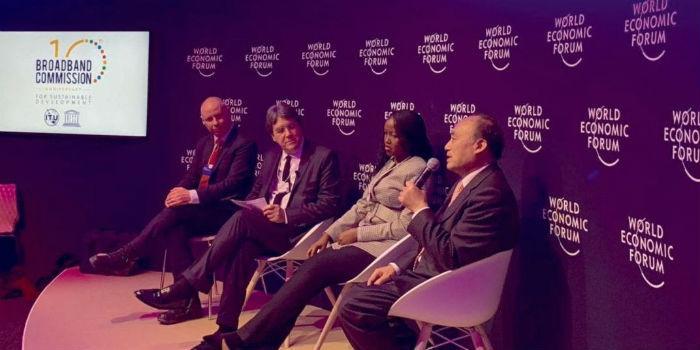
 International. UNESCO's Broadband Commission for Sustainable Development examined new funding models that would help accelerate "meaningful universal connectivity" on the sidelines of the World Economic Forum's Annual Meeting in Davos, Switzerland, the previous week.
Today, an estimated 3.6 billion people remain offline. Most of the disconnected live in less developed countries, where an average of only two out of ten people are online.
The Commissioners agreed that specific efforts are needed to reduce the cost of broadband, as well as innovative policies to finance the deployment of broadband infrastructure to unconnected populations. Collaboration among diverse stakeholders will be key to making universal and meaningful connectivity a reality for all.
"We are on the verge of a new era that requires fast, effective and innovative financial instruments to connect those who are not connected. The old ways can no longer work in this era and we can no longer allow anyone to be left behind," said Paula Ingabire. , Minister of ICT and Innovation, Republic of Rwanda, representing President Paul Kagame, who co-chairs the Commission.
"Expanding investment pathways in information and communication technology (ICT) infrastructure has always been one of my priorities," said ITU Secretary-General Houlin Zhao. "As we enter a new decade, the last decade to achieve the United Nations Sustainable Development Goals, we need new incentives and financial solutions to create enabling environments for ICT investment."
"Meaningful universal connectivity" encompasses broadband that is available, accessible, relevant, and affordable, but is also secure, reliable, user-empowering, and has a positive impact. It also advocates the need to move beyond "business as usual" policy prescriptions and drafts, and towards more collaborative models based on resource sharing and holistic approaches.
Commissioners and participants also examined ways to address the digital investment gap, policies and incentives for investors and other digital industry stakeholders, and what innovative financing models can be scaled up to expand infrastructure.
Among the featured models is the UNICEF school connectivity project, also known as the "GIGA" initiative. It aims to bring connectivity to every school in every village in the world to empower young people with the digital skills they need to thrive in the digital economy. The GIGA initiative is anchored in the findings of the Secretary-General's High-Level Panel on Digital Cooperation that state that by "2030 every adult should have affordable access to digital networks" and calls for "a broad multi-stakeholder alliance, involving the UN to create a platform for sharing digital public goods."