
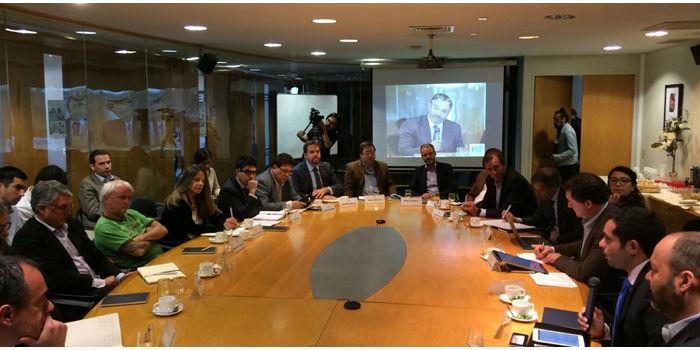
 Chile. The Faculty of Communications of the Catholic University and DirecTV held the second "UC Debate Table", around piracy and the different scenarios in which it is currently developed.
This instance seeks to open a space for conversation about this phenomenon that affects the entertainment industry as a whole, and will have representatives of regulatory authorities, parliamentarians, and non-governmental organizations, as well as a diverse representation of the industry, the technological and entertainment field.
This second meeting, after a first session dedicated to the entertainment industry, was dedicated to pay TV, an industry that, according to estimates, presents losses of around 70 million dollars per year due to the illegal trade of its products.
The debate was attended by Senator Guido Girardi; the director of the Department of Studies of the CNTV, María Dolores Souza; Jorge Carey, director of CHV; Claudio Ruiz, lawyer and Executive Director of the NGO Derechos Digitales; Nicolás Schubert, Chief of Staff Directorate-General for International Economic Relations (DIRECON); Eileen Frodden, lawyer of the International and Public Policy Department of the National Institute of Intellectual Property (INAPI), among others.
It is estimated that in Chile there are 300,000 set-top boxes dedicated to the illicit transmission of Pay-TV. This causes negative effects to users who are affected by the quality of the service, and millionaire losses every year through tax evasion.
According to figures from the Undersecretariat of Telecommunications (Subtel), in Chile illegal piracy remains a relevant problem for both the State and companies. If the growth of the pay TV industry was 10% subscribers between 2013 and 2014, in the period of 2015-2016 it is 3.5%.
While in a Latin American context, there are around 16 thousand portals or pirate pages that offer illegal content, through which, 300 million Latin Americans on a monthly basis watch television, internet and other audiovisual products irregularly, that is, they pirate the contents of authors or filmmakers throughout the continent.
The third meeting will deal with piracy that affects technology industries such as software and video game developers, as well as the permanent improvement by creating technology that blocks illicit trade and piracy.