
 Colombia. With the inclusion of OTTs, Digital Terrestrial Television and Broadcast IP transmission, television in Colombia has new challenges, one of them is to update the current laws and regulations of television in the country.
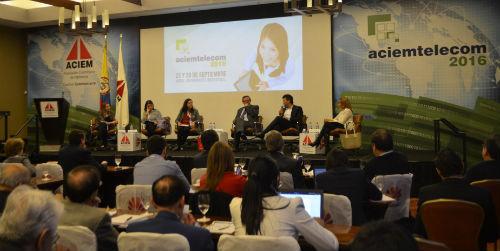
Aciemtelecom 2016 held on September 29 and 30 at the JW Marriott Hotel, sponsored by MinTic, ANTV, Huawei, Intergráficas and TEI Intelligent Solutions, opened a space to discuss the challenges, decisions and rules that should be adopted for the satisfaction of customers and in turn, the subsistence of the companies involved with the television service.
The panel "Legal and regulatory challenges of television in Colombia", was the stage in which the engineer Ernesto Orozco, representative of governorates before the JNTV participated together with María del Pilar Bahamón, advisor to the office of the MINISTER OF ICT, Natalia María Iregui, legal and institutional relations vice president of Directv Colombia, Natalia Guerra, director of regulation of Telefónica Colombia, and Catalina Porto, legal manager of Caracol Televisión. During the panel they discussed the urgency of reformulating a law that includes the promotion of the audiovisual content industry, updates the framework for the provision of public service, and promotes competition.
The panel, moderated by journalist Ricardo Galán, put on the table a restricted planning law that prevents the flexibility of the structural scheme of the country's television regulation and the asymmetries between the concessions. This pointed to the urgency of making decisions that balance the conditions of television servers. María del Pilar Bahamón, explained in her speech the possibility of migrating subscription television towards the regime of regulation of the provision of telecommunications networks and services, and in this way balancing the regime of compensation and regulatory burdens against the offer of audiovisual content on the Internet.
Ernesto Orozco, for his part, considered the need to promote television services, competition and reduce barriers to entry to the public television service. At the same time, he stressed the importance of open television not only staying in the opportunity offered by DTT, but also betting on the IP Broadcast system which offers to know more to its consumers and thus achieve a greater degree of satisfaction with the service.
In the opening speech of Antonio García Rozo, National President of the Colombian Association of Engineers – Aciem, organizer of the event, the theme of DTT also had a place. The executive assured that "the deployment of the Digital Terrestrial Television (DTT) network in Colombia, as has happened in other parts of the world, will transform the habits of citizens in terms of how to enjoy this public, broadcast and free service, thanks to the advantages that the implementation of the DVB - T2 standard will represent in terms of audio and video quality, the expansion of the content offer and a better efficient use of the spectrum".
Finally, the panel "Legal and regulatory challenges of television in Colombia" showed the urgency that exists to migrate to a new legal zone that, through a restructuring of regulatory laws, allows television to become a more plural, competitive and expanded medium.
This space allowed to take a look at the digital scenario from four central axes starting with politics and the economy, where the legal challenges of the sector and its economic impact, the excellent spectrum management that Colombia has had and the effects of the economy on the strategic sectors of the country were discussed.
The second thematic axis was the technology and impact of 5G on emerging countries, as well as the coverage of mobile networks in high-density cities. A third axis was developed around industry and engineering, experts in the field took a look at the innovative successful examples of the mobile world, the success stories with IoT technology in Colombia and the global approaches that arise from a digital country.
Finally, the fourth axis shifted towards television where the ANTV was the main protagonist in the face of the great decisions that are coming, likewise, BIG Data and the great change of the global television business were also issues of great importance.