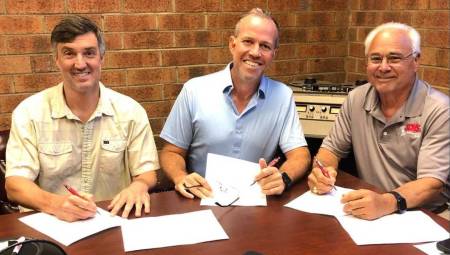

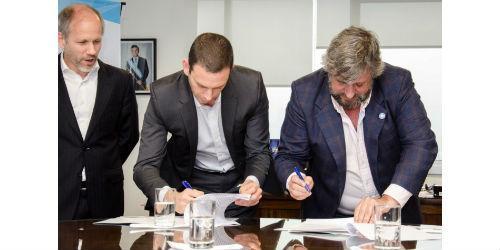
 Argentina. The President of Enacom, Miguel De Godoy, signed an agreement with the representatives of Microsoft from Argentina and Uruguay, Alejandro Anderlic, Director of Corporate Affairs; Diego Bekerman, General Manager; and Jorge Cella, Chief Technology Officer.
Within the framework of collaboration between Enacom and the US company, connectivity tests will be carried out in White Spaces Television (TV-WS) within the Argentine territory optimizing the use of unused radio spectrum. In this way, Microsoft will make educational content available throughout the country through training programs and computer tools that have already been put into operation in different parts of the world and that have had excellent results.
At the same time, Enacom will form an interdisciplinary work team to accompany the development of this project that will provide broadband connectivity in rural populations where the provision of certain services becomes difficult.
"From Enacom it is a priority to guarantee access and connectivity to all citizens; therefore, acting as intermediaries in this project is a great opportunity to advance in the reduction of the digital divide," said De Godoy. "This project is intimately related to the three main objectives set by President Macri and that is why we believe in the importance of working together. This is a contribution that has to do with our mission to provide technology to improve people's lives; so we are pleased with Enacom's initiative to make this something productive and impactful," said Diego Bekerman of Microsoft.
Providing connectivity using TV-WS is optimal given the geographical conditions of the national territory. In this sense, it takes advantage of the equipment of cognitive radios that dynamically record the radio spectrum in search of white spaces not used by the TV to provide internet.
TV-WS has to do with the efficient use of the radio spectrum, that is, it uses those frequencies attributed to television services (TV channels) in geographical spaces where they are not being used. TV stations use geographically distributed transmitters and repeaters to achieve the desired and permitted coverage. These stations are spatially separated to avoid overlaps and interference of channels, generating frequency white spaces or "White Spaces".
In those geographic spaces, where channels are free, a wireless data transmission technology, known as IEEE 802.22 or "Super WiFi," is used. It takes advantage of these TV frequencies, transmitting the Internet or other services with coverage radios.
This solution is a practical alternative that encourages the availability of broadband resources throughout the country, facilitating their deployment in rural areas, isolated or far from urban centers, and also allows optimal use of the radio spectrum without causing interference.