

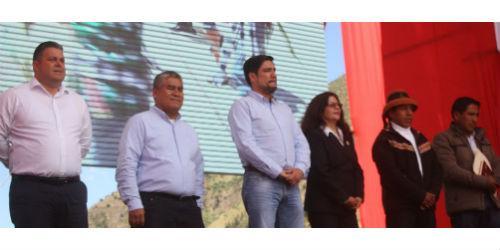
 Peru. The Ministry of Transport and Communications launched the National Fiber Optic Network – RDNFO – which will bring high-speed internet to the Apurimac region, connecting the capitals of the seven provinces of this department, for the benefit of more than 86 thousand people.
From the educational institution Erasmo Delgado Vivanco, in the district of Tambobamba, province of Cotabambas, the Vice Minister of Communications, Javier Coronado, accompanied by representatives of the Ministries of Health, Culture and Education; as well as the Deputy Minister of Transport, Henrry Zaira, checked the internet connectivity with simultaneous links with Lima and Apurimac.
In this sense, local officials and authorities witnessed a demonstration of the Telehealth service with a connection to the Tambobamba hospital, where medical personnel who cared for a pregnant woman, communicated and consulted with doctors from the Maternal Perinatal Institute – Maternity of Lima, in the capital.
A liaison was also made with the Gran Teatro Nacional de San Borja, Lima, which made it possible for spectators to witness a rehearsal by the National Symphony Orchestra; Likewise, an educational ICT application was demonstrated through a connection between two sections of the third year of secondary school of EI Erasmo Delgado of Tambobamba, with the Romeo Luna Victoria school of Lima.
In Apurímac, as part of the RDNFO project, more than US$ 12.7 million has been invested for the installation of more than 599 km of optical fiber, which allows the connection of the capitals of the seven provinces of the department: Abancay, Andahuaylas, Chalhuanca, Tambobamba, Chuquibambilla, Antabamba and Chincheros.
The RDNFO project in this region will be complemented by the Apurimac Regional Project, which will connect 73 district capitals, through the deployment of 1409 kilometers of fiber optics, for the benefit of 123,000 people.
The RDNFO is the most important telecommunications project in the history of the country, as it will integrate 22 regional capitals, 180 provincial capitals and 136 localities throughout the national territory.