
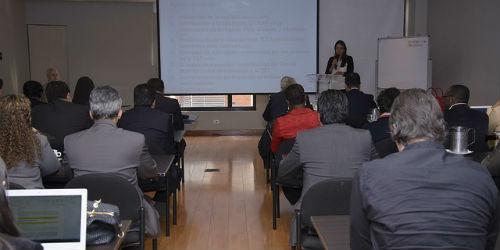
 Colombia. With a meeting chaired by the director of the National Television Authority, Ángela María Mora Soto and the members of the National Television Board, the cycle of three meetings scheduled in the process of implementing the DTT Roadmap in Colombia was completed.
Since 2013, the International Telecommunication Union ITU and the Development Bank of Latin America – CAF, two international cooperation entities, provided the Colombian State with an accompaniment, based on the experiences that have been had in countries in Africa, Europe and Asia.
For the director of the ANTV, Ángela María Mora Soto, "Over the course of a year we have received and socialized all the consultation documents, observations and concerns, not only of the Authority, but also of the members of the sector, with the aim of building together a roadmap that contains the visions of all the protagonists of the sector. What the National Television Board seeks is to generate spaces for participation."
For Julián Seseña, representative of the International Telecommunication Union – ITU, "the guide is not a manual, it is more a "menu", in which each country chooses and decides, according to its particularities, the guidelines that will facilitate the migration process".
Among the speakers at the last meeting were the interventions of Mauricio Agudelo, senior specialist for medium telecommunications and technology of the Development Bank of Latin America CAF, who presented the plan for the implementation of roadmaps in Latin America, where eight countries in the region were chosen, as well as the generalities that characterize digital public services.
For his part, Mauricio Samudio, advisor to the ANTV, highlighted some activities carried out by the entity and the state of progress of these, leaving between seeing the importance they have for the sector. "We have made important progress throughout the country in what has to do with the signal of private national channels, which reaches 80% and public and regional channels that reach 73%. Much remains to be done, but what we do have clear is that what has been done so far, has been executed correctly."
The final recommendation left by the experts is that it is very important to avoid that the deployment of DTT in the country is done in a disorderly manner, since they consider that synchrony and collaboration on the part of all those involved in the sector, will undoubtedly be key factors for a successful implementation and that allows to meet the estimated times.