
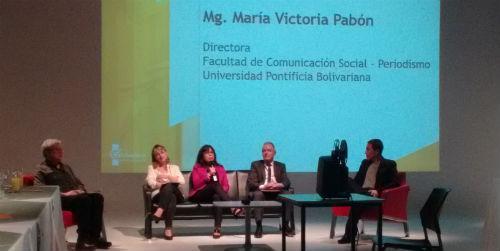
 Colombia. The Pontifical Bolivarian University, through the Faculty of Social Communication – Journalism, will offer its new Master's Degree in Documentary Film.
This new academic offer is the only one in Colombia and even in the Andean countries. With this new postgraduate course, the UPB seeks to consolidate a critical mass of master's degrees that can recognize and intervene in social reality through the different narrative possibilities and reflection on the image in its sociocultural context.
This master's program in Documentary Film will have a face-to-face methodology and will be offered in two modalities. One refers to research processes as part of the construction of academic knowledge and historical memory; and the other, of deepening, where the student will be able to develop and produce documentaries with the human and technological support of the Audiovisual Production Center of the Pontifical Bolivarian University.
The professor, critic and programmer of Spanish cinema, Antonio Weinrichter, invited to the presentation of the master's degree, stressed that documentary cinema is currently experiencing a boom that began in 2000, when it ceased to be a dense and heavy subject, adding new ways of narrating that have generated interest in young people. In addition, international film festivals began to take this into account, such as San Sebastian or Cannes, accompanied by the emergence of new festivals dedicated exclusively to documentary cinema.
With a duration of four semesters, the new master's degree in Documentary Cinema is aimed at facilitating an interdisciplinary work, so professionals from different areas of knowledge will be able to study this master's degree taking into account the basic training in audiovisual language necessary for the production of documentaries as projects that arise in the master's degree.
Some of the subjects that this master's degree will offer will be documentary history; theories and aesthetics of the documentary; history of Latin American documentary; script construction techniques; techniques of construction of the montage in the documentary, research tools in the documentary, among others. The master's degree will be supported by four lines of research: The history of documentary and its relationship with the local, the regional and the global. The documentary, the aesthetics and the problems of representation. Scientific dissemination and innovation in the digital age. Business and legal processes of production and circulation.
The historical moment in which Colombia finds itself with the nomination of the film, The Arm of the Snake as Best Foreign Language Film at the Oscars, poses great challenges for national production, given that year after year, many national filmmakers tried without success.
For the teachers Adriana Mora and Ana María López, coordinators of the Master's Degree, it is pertinent that today, more people are interested in conceptualizing and producing cinematographic pieces, and especially if it is documentary cinema, since scenarios such as the post-conflict will require the reconstruction of historical memory: "At this moment people interested in building stories and stories are needed to expand the horizons of meaning."