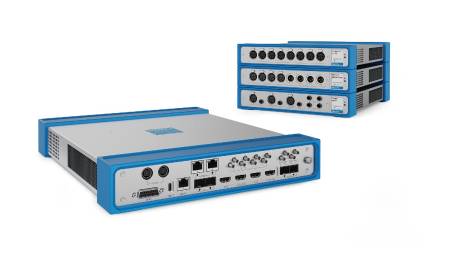

The DVB organization reported during the last NAB fair, in Las Vegas, that a recent Plug Fest held at the RAI Research Center in Turin (Italy), coordinated by the verification and validation group of the DVB Technical Module, it was a success. The goal was to validate the DVB-T2 specification through interoperability of standalone hardware implementations. A wide range of companies participated in the tests of six DVB-T2 modulators (DekTec, Rhode & Schwarz, ENENSYS Technologies, TeamCast, the BBC and SSBT) and five demodulators (DekTec, SIDSA, Panasonic, Sony, the BBC).
The consortium explained that the success of the interoperability trials represents an important achievement in advancing the specification since the first DVB-T2 hardware demonstrations in September 2008. The participating companies had to make considerable effort to have the equipment ready in time for the trials. The RAI currently transmits test signals with DVB-T2 from a tower located 5 km from the RAI Research Centre. The test signals carry four streams of HD in single PLP mode (256QAM, 3/4 FEC speed) reaching a total bit rate of 45 Mbit/s.
The first DVB-T2 services are expected to start airing later this year in the UK via the Freeview platform. The BBC and other british public broadcasters plan to launch at least three HD DTT services via DVB-T2 and MPEG-4, with a full commercial launch possibly in time for the 2010 World Cup.
Based on the DVB-T system, the DVB-T2 offers a capacity increase of 30-50% under equivalent reception conditions. Broadcasters using DVB-T2 will be able to deploy new multiplexes that could offer HDTV multichannel services and create new and innovative datacasting opportunities.