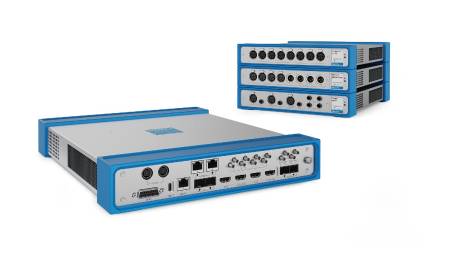

GFPAK is the latest removable media for recording in solid state, developed by Ikegami, and used in the new Toshiba tapeless video acquisition system, GFCAM. The system, composed of the HDS-V10 non-linear camcorder, the GFStation recorder and GFStation handheld station, use the GFPAK, a proprietary format, based on flash memory Semiconductor.
Toshiba's system will initially come out with 16GB GFPAK, 32GB and 64GB. Even though GFPAK is more expensive than GFPAK compact flash cards, offers greater benefits because you use a serial ATA interface, offering a performance of 1.5Gbps, considerably faster than rival systems.
Although it is a proprietary flash memory, only one is needed. Standard USB cable to plug it into the memory package. No you need any adapters.
Mark Capstick, General Manager of Ikegami Electronics UK, a company that has been working hand in hand with Toshiba commented: It's an open generic format, which uses MXF file format with MPEG-2 encoding, unlike of EditCam, which uses Avid's DNxHD encoding. Although works anyway with Avid, it will make it easier to ingest in third-party servers, he said.
Sam Shimura, GF Project Manager at Ikegami, believes that the greatest impact of the GF system will be on production of news, but to the extent that the cameras can record in high definition (at 50 or 100 Mbps), it can also be used in the general programming for the dissemination of HD programs.
The features of the HD/SD multi-format camcorder include 2/3-inch 2300-pixel AIT CCD with a new developed circuit; an MPEG-2 encoder from 4:2:2 to HL to record high-resolution images; S/N ratio of -58dB; light sensitivity of F11 / 2000 lumen; and administration of metadata via USB.
GFCAM, the new tapeless video acquisition system Toshiba, will be launched to the market soon.