
Mexico. Historically, the telecommunications sector in Mexico has suffered from the lack of effective competition with its marked adverse effects on the availability, affordability and quality of services offered to consumers.
There are currently high barriers to the development of competing operators other than the preponderant economic agent (AEP-T, América Móvil), which lead to adverse conditions for the exercise of investments for the deployment of infrastructure, the implementation of competitive offers, operational and financial viability, among others.
Revenue and Margin Reconcentration
A clear illustration of this systemic inability to tie the competitive terrain is precisely the upward trajectory traced by revenues and operating margins in favor of the AEP-T. The latter is especially evident in the mobile market in which Telcel holds a market share in revenue of 71.2% in the second quarter of 2021 (Q2-2021), similar to the level it registered when it was declared AEP-T in March 2014 (72.8%).
This upward trend is also visible in the generation of income from the sale of services, a component in which this operator registers a market share of 71.4% that although it has remained practically constant in recent years, is categorically higher than the level of 64.5% registered in the first quarter of 2017 (Q1-2017). While the rest of its traditional competitors (AT&T and Movistar), except for the set of Mobile Virtual Operators (MVNOs), draw a downward line in this indicator in the period analyzed.
In terms of margins, measured through EBITDA (earnings before interest, taxes, depreciation and amortization), the AEP-T registers a level of $29,961 million pesos (mdp) as of Q3-2021, 8.8% higher in its annual comparison and that contrasts significantly with its competitors by contributing almost all (97%) of the aggregate that results from adding this indicator of all mobile operators.
This circumstance is unfavorable for the execution of investments by the rest of the operators and puts at risk the economic viability of the segment as a whole in the medium and long term.
Deregulation to the AEP-T: Tariff Freedom and Pay-TV Entry
Recently, it was authorized to freely set prices to the AEP-T in the wholesale service of disaggregation of the local network in 52 municipalities of the country, without there being any sectoral indicator that pointed to more balanced conditions among competitors.
This act of deregulation gives direction to discriminatory and dilatory behavior on the part of the preponderant, in addition to a discretionary increase in prices of the service that could translate into a greater reconcentration of the market in income.
Similarly, the AEP-T boasts that it is about to obtain authorization at the end of this year to offer pay-TV service and transit a convergent offer of quadruple (fixed telephony, mobile, internet and pay TV) or even quintuple play (to include its video on demand platform over the Internet Claro Video). With this, it would open a deregulation route in which it would reach a sectoral share of up to three quarters measured in income.
Onerous Spectrum for 5G Deployment in Mexico
Another barrier to the development of competitors is the high cost of awarding and taking advantage of the radio spectrum, such that they have opted for the return of frequencies (this is the case of Telefónica Movistar and AT&T) and discouraged their participation in bidding processes.
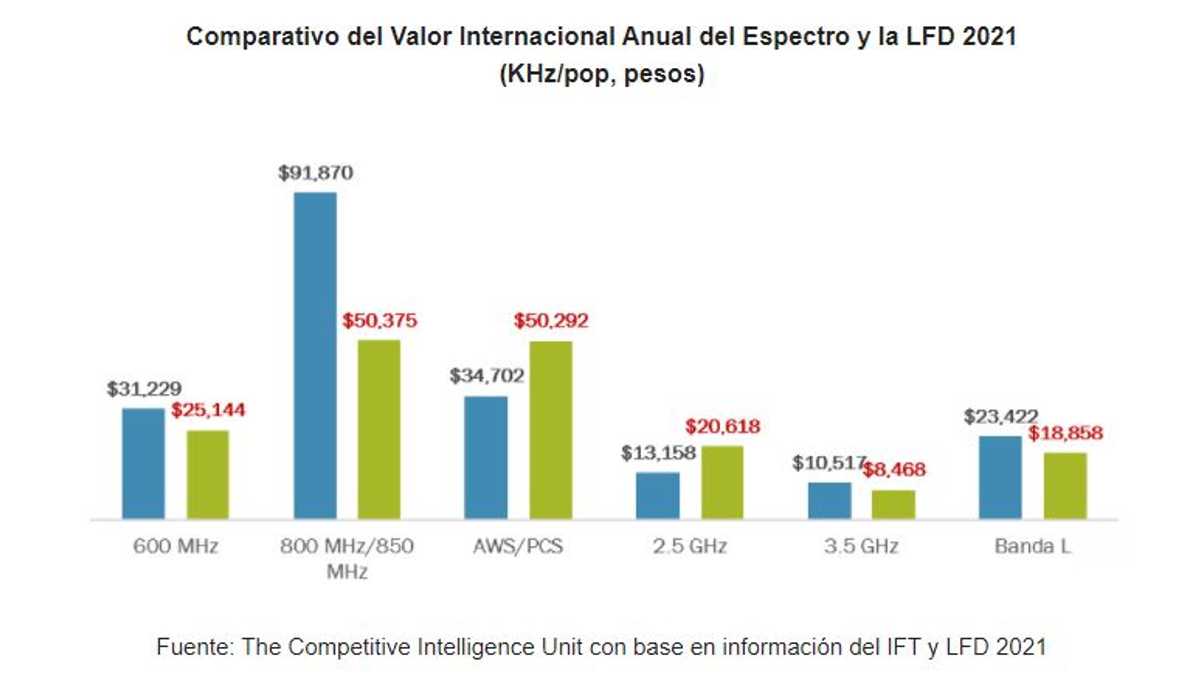
In an international perspective, according to the IFT, the value of spectrum in Mexico registers an overprice of up to 85% compared to the average of countries. While in the case of optimal bands for the provision of 5G mobile services (600 MHz, L-Band, 2.5 GHz and 3.5 GHz) the annual cost of KHz averages 93.3% of the international median, when in an optimal scenario it should be at a level of 30%, according to the amounts established in the Federal Law of Rights (LFD) of 2021.
As a proportion of their revenues, the competitors of the AEP-T (AT&T and Movistar) have to allocate a markedly higher proportion than this, 3.5 and 2.3 higher with ratios of 28.0% and 18.9% respectively each year, derived from the disparity in revenue generation and margins existing in the mobile market. It is these operators that make a greater effort to be able to compete on equal terms of coverage and quality of services than the AEP-T.
The sum of the elements described erects significant barriers to the deployment of infrastructure and the development of competition in the telecommunications sector and condemns the country to suboptimal conditions in the provision of services, with their consequent negative effects on consumer welfare.
Public policy and regulatory recommendations
Based on the scenario described, it is necessary to implement effective mechanisms that have brought different markets around the world closer to a competitive ecosystem between operators. The following recommendations are based on those issued by the Organization of American States (OAS) in the search to detonate full connectivity via effective competition in the countries that make it up.
In this regard, it is recommended:
- Define investment obligations for the AEP-T to encourage the deployment of infrastructure in areas without coverage and promote the transition to new generation networks.
- Return to the regime of termination of asymmetric 'zero' calls for competitors to boost competition via investments and quality of service by operators other than the AEP-T.
- Verify effective compliance with passive infrastructure sharing measures and disaggregation of the local network, implement sanctions otherwise.
- Proceed with the structural separation of the AEP-T as a remedy to prevent discriminatory conduct aimed at hindering the development of competing operators.
- Categorically deny the entry of the AEP-T into the Pay-TV market, due to the adverse effects of reconcentration and against effective competition.
- The measurement of the preponderance must include the revenue component, being an indicator of investment capacity, exercise of advertising resources, attraction of suppliers, market reconcentration, etc.
Implement a comprehensive fiscal policy for connectivity that contemplates the reduction of economic costs for the possession of radio spectrum for competing operators other than the AEP-T.
Analysis by The Competitive Intelligence Unit, CIU.