

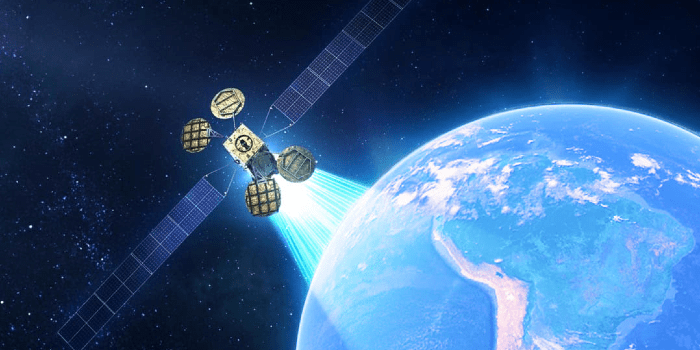
 Argentina. The state telecommunications company, Arsat, is working on the advancement of the project of the third geostationary satellite of its fleet, the ARSAT Second Generation 1, or ARSAT-SG1, formerly called ARSAT-3. It will be a high-performance satellite (HTS) to bring broadband connectivity throughout the territory of the Argentine Republic.
The company is in the process of negotiations with INVAP, a state-owned high-tech company in the province of Río Negro that will develop and supply the ARSAT 1 and ARSAT 2 satellites, for the signing of a contract for the construction and testing of ARSAT-SG1. This project was suspended for four years and was relaunched in February of this year with the management of the President of the Nation, Alberto Fernández.
ARSAT-SG1, in addition to being the first high-performance satellite, will also be the company's first satellite to operate a Ka-band payload and will have a data traffic capacity of more than 50 Gbps in Argentina. Unlike satellites with traditional capacity, payloads with the new HTS technology allow the reuse of frequencies with reduced coverage beams by multiplying the total capacity available on the satellite. ARSAT-SG1 will have more than 30 beams that will cover the entire Argentine mainland, the island of Tierra del Fuego and part of the countries bordering Argentina.
The capacity available in ARSAT-SG1 will allow ARSAT to provide reliable, high-quality satellite broadband to more than 200,000 homes in Argentina and neighboring countries at affordable prices. In addition, with this satellite it will be possible to expand the current 4G networks, and future 5G, of mobile communications operators in rural areas of low population density or where the deployment of terrestrial infrastructure is not convenient. Satellite broadband services are essential for the inhabitants of Argentine territory in rural areas or areas with low population density where there is no terrestrial infrastructure available or it is deficient for the supply of quality broadband to exercise their right of access to the Internet.
Arsat's third satellite will be based on the new platform developed by the GSATCOM joint venture formed in 2019 between INVAP and Turkish Aerospace Industries (TAI) of Turkey. This new platform incorporates the main global technological trends of the space industry for telecommunications, such as complete electric propulsion, both for the elevation of the satellite from the transfer orbit to the geostationary orbit, and for its maintenance in the location from where it carries out its operation.
Unlike the chemical propulsion used in the ARSAT-1 and ARSAT-2 satellites, the incorporation of electric propulsion allows a significant reduction in the mass of the satellite at the time of its launch and thus allocate proportionally more power and equipment to the payload for the same total mass. Our first two missions, launched into space on October 16, 2014 (ARSAT-1) and September 30, 2015 (ARSAT-2), had a launch weight of approximately 3,000 kg, of which almost half corresponded to chemical fuel. Both satellites are currently operating successfully with an occupancy rate of more than 85% and 88% respectively, and particularly in the case of ARSAT-2, exporting value-added services to other countries.
When using the electric propulsion platform, the ARSAT-SG1 will have an approximate weight of between 1,800 and 2,000 kg at the time of its launch, depending on the final performance requirements that are still in definition. Even with a lower weight than ARSAT 1 and 2, the electrical power available for the payload will be significantly higher than that of these satellites. On the other hand, like that of the satellites currently in operation, the design life of the ARSAT-SG1 will be 15 years.
The launch of the ARSAT-SG1 is scheduled to take place in the first half of 2023. The most convenient geostationary orbit for the final location of the satellite, among those assigned by the International Telecommunication Union (ITU), is currently being analyzed.
ARSAT-1 and ARSAT-2 were successfully launched by two Ariane-5 vehicles operated by the European company Arianespace, although by design they were compatible with other launchers available at the time. ARSAT-SG1 will also be designed for launch into orbit by various launchers, including some of those currently under development and will be operational by 2023.