
 Mexico. Streaming is the possibility of accessing audio, video or both content through the internet, ubiquitously and on demand, without the need to download them to the access device (Smartphone, PC, tablet, TV, etc.).
Today audiences have an abundant offer of streaming platforms and fierce competition to stay among their preferences.
Under this market dynamic, different business models have emerged that seek to monetize this direct-to-consumer (D2C) audiovisual provision, with marked efforts dedicated to the creation/acquisition of content, advertising of platforms/content/brands/products, attraction of creative talent, user experience, security, among other aspects.
In Mexico, the attraction of serving this market lies in the fact that the universe of Internet users who consume streaming content amounts to 44.3 million at the end of 2019, 14.8% more than a year ago. This means that just over 50% of internet users (52.1%) make up the audience of these platforms, a growing proportion that will definitely register an acceleration during the current confinement.
Financing of Platforms by Advertising
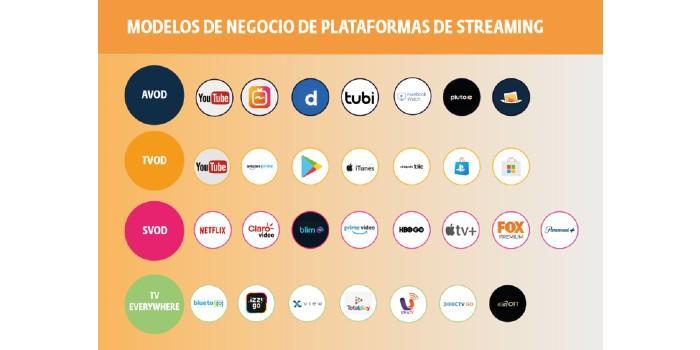
This is a business model that in English is called Advertising Video on Demand (AVOD), in which the user obtains "free" access to the contents, but these contain advertising inserts. It is a model similar to that followed in broadcast broadcasts (free-to-air TV), in which the provider earns income from placing ads for companies that wish to publicize their products to audiences.
The user does not have to pay a fee or per subscription. Under this monetization scheme we find YouTube (main and historical player for its volume of income and users), Dailymotion, Facebook Watch and IGTV, as the main platforms of technology companies.
But in this segment we can also find developments of media companies or content generators of recent incursion into the market as is the case of Pluto TV (ViacomCBS), Tubi (Fox Corporation and TV Azteca), as well as MiPocket (AMC Networks).
Monthly Subscription Platforms
This model has become popular in our country since the incursion of the incumbent and dominant player Netflix in 2011. Subscription Video on Demand (SVOD) platforms receive precisely this denomination by requiring a monthly or in some cases annual payment to access content without advertising.
In this scheme, the marked investment efforts for the generation of original and exclusive content stand out, as well as the growing atomization of the competitive structure to become a portion of a market that generated revenues of $ 17,032.6 million pesos (US $ 883.9 million dollars) in 2019, a figure 14.5% higher than the previous year, as well as registers a user accounting that amounts to 38.3 million at the same period.
In this segment we find long-standing players such as Netflix, who detonated the so-called 'streaming war' by venturing into the generation of content in 2012, platforms of Mexican telecommunications companies such as Blim TV (Grupo Televisa) and Claro Video (América Móvil), as well as efforts by entertainment giants such as HBO Go (WarnerMedia), Fox Premium (Disney) and the incoming Paramount+ (ViacomCBS).
Strategies of technology companies are also identified here when offering original content by subscription such as YouTube Premium and Amazon Prime Video. The latter seeks to expand its entry channels by incorporating for some months its Channels category that enables access to catalogs of other platforms, as well as by venturing as a transactional platform a few weeks ago. Currently, he is working on the launch of channels with linear and live programming, with content such as sports, news, movies, TV shows and special events.
Purchase/Rental of Content
The transactional model of video on demand or Transactional Video on Demand (TVOD) refers to the possibility for users to acquire temporarily (rent) or permanently (sale) the contents made available on digital platforms.
Pay per view (PPV) also enters this segment, which offers access to live content such as sports events, concerts, among others.
In this modality of content offer we find platforms such as Apple iTunes, Google Play, Cinépolis Klic, Microsoft Store and Playstation Store. As mentioned above, Amazon Prime Video's recent foray into this category was recorded and YouTube also participates in this market.
During the pandemic, promotions, discounts, advertising efforts and early releases of content on these platforms stand out to attract audiences and even detonate knowledge and preference for them.
Linear/Live Programming on Digital Platforms
A fourth model of access to content is that provided by restricted TV companies or convergent operators and programmers, by offering their users the possibility of watching the channels, the linear / live programming grid and / or video on demand content contracted through digital platforms available on mobile devices and others enabled for streaming.
Sometimes, you have the option to record the contents transmitted on these platforms to watch later from anywhere and at any time. They even enable a way of hiring catalogs of other players.
This access route is known as TV Everywhere (TVE) in English and requires the user to enter their subscription credentials to the operator to have access to these platforms.
In Mexico, several pay-TV operators have ventured into this segment, such that the vast majority have a TVE offer.
For example, Sky has Blue To Go, izzi with izzi go, we also find Xview from Megacable. Dish OTT/Mobile, Totalplay with its multi-device platform, the newcomer DIRECTV Go with a purely TVE and Ultra TV offer from Ultravision.
Early Access to Movie Premieres
In recent years, an increasingly recurrent strategy has been implemented by which large studios offer their productions on digital platforms days or weeks before their premiere in cinemas for amounts that even exceed the prices to permanently make the contents, once the window period (90 days) after the exhibition in theaters has ended.
This model is called premium video on demand (PVOD) which implies early access to theatrical releases.
This way of attracting audiences eager to be the first to see the content has been implemented by players such as WarnerMedia, Fox and NBCUniversal. The latter debuted the film "Trolls World Tour" on PVOD platforms last April due to the pandemic, which has attracted the attention of content companies for the revenue it obtained its exclusive premiere by these media.
It is anticipated that although more efforts are devoted to exploring this route of distribution of content directly to the consumer, it will not completely replace the theatrical release, since the exhibition continues to represent significant revenues in the productive chain of the industry. In addition, the experience in a movie theater is more enriched than the one you have in front of the screen or device available at home.
Although Netflix, WarnerMedia and Disney have begun to privilege the premiere of their original productions on their respective streaming platforms, a coexistence of the different models of access to content, traditional and digital, is predicted.
The nature of all these video content platforms is to enable a ubiquitous, on-demand, multi-device and even multi-screen access path directly to audiences, with outstanding efforts in the generation of new audiovisual products, advertising for the attraction / retention of users, user experience, among other areas.
The arrival of new players to the segments and the extension to other adjacent ones evidences not only the growing interest in participating in this industry, but also an upward trajectory in the demand and consumer preference of streaming content, as well as the specialization that begins to take place in this market.
We are facing a market that is characterized by its dynamic rate of growth in audiences and revenues, but also in its structure and competitive segmentation.
Text written by Radamés Camargo of The Competitive Intelligence Unit.