
 Mexico. Fixed telecommunications networks have proven to us these days their importance as a support for the transmission of vast volumes of voice, data and video traffic from a cluster of remote communication, entertainment, productivity and content platform applications.
Without these networks it would be impossible to work in our homes in this phase of preventive isolation to curb the spread of the coronavirus. Individuals, households, businesses and government increasingly rely on fixed connectivity to carry out their daily activities. Moreover, without it there would be no internet, as it would not be possible to interconnect the equipment and servers that integrate these networks.
The fixed telecommunications segment includes the provision of fixed telephony services (local, national and international long distance), fixed broadband, restricted television and its different packaging.
Access to fixed services in homes and businesses
Fixed telecommunications transmission is regaining the value we thought it had lost. When taking confinement, preventive or control measures, this means of communication affirms its importance as the main means of communication, from already registering increases in telephone traffic in countries where the coronavirus crisis has come to immobilize the daily life of the population.
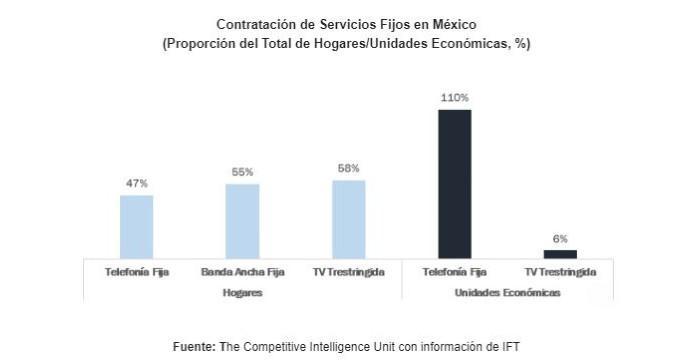
In our country, 47 out of every 100 households have fixed telephony to communicate, according to figures from the Federal Institute of Telecommunications (IFT) as of the third quarter of 2019. While, in the case of economic units, those who choose to attend their office these days may even have more than one fixed line, registering an access level of 110 lines per 100 companies.
This number results from accounting for 21.9 million fixed lines in Mexico.
This level of contracting is attributable to the packaging of services and their consequent savings for the residential and business segment, the intensive use by economic units and the launch of abundant offers in calls, which have led to the penetration of services and the accounting of fixed telephone lines registering a slightly upward level in the last biennium.
The market structure went from an absolute concentration of 86.6% in the holding of the incumbent-preponderant operator (América Móvil, Telmex-Telnor) to a level of 54.3% in the last decade, that is, Q3-2009 to Q3-2019.
For its part, Fixed Broadband, which gives and will continue to support teleworking in the coming days, registers a trajectory of increasing contracting between households, such that 5.5 out of 10 of the first have this connectivity service.
In the case of Pay-TV, economic units register a low penetration (6.1%) due to its nature as an entertainment service, while 58.0% of households have it.
Telephone traffic and data download speed on fixed networks
Although in its annual comparison, there was a 2.9% drop in the minutes of calls (local, national and international long distance) made in fixed networks, during the third quarter of 2019, a rebound is foreseeable during the first half of 2020, as a result of the outbreak and contagion of the coronavirus among the world population.
In absolute numbers, the minutes taken by mobile networks are 5.6 times those transmitted by fixed networks. This indicates a greater intensification in the use of mobile phones compared to traditional telephony, despite the introduction of offers with unlimited minutes to national and international destinations at low prices.
In stark contrast, the demand for greater capacities and data download speed in fixed networks means that the contracting of accesses with download speeds greater than 100 Mbps (megabits per second) already represent 4% of the total, 2 percentage points more than the previous year. The bulk of connections are in the speed range between 10 and 100 Mbps, registering a proportion of 89% of the total.
On the other hand, if we consider that, to a large extent, the transmission of calls and data from mobile services is carried out through fixed networks and that the non-satellite restricted television service benefits from their capacity, it is precisely for this reason that fixed telecommunications are essential for the industry as a whole.
These days, fixed networks will have to demonstrate their ability to support the growing number of communications and interactions made from home and even probably this health phenomenon will bring with it an increase in the contracting of these services.
This is the importance of fixed networks not only on a daily basis, but also in times of crisis due to the coronavirus.
Text written by Ernesto Piedras of The Competitive Intelligence Unit.