
 Mexico. Fixed telecommunications today enable access to a host of applications and services for communication, entertainment and content platforms.
At the same time, they contribute to the transmission of voice communications and Internet browsing on mobile networks. Moreover, without fixed telecommunications, there would be no internet, since all the equipment and servers that integrate these could not be interconnected.
Hence its fundamental role for telecommunications in Mexico.
This segment includes in addition to fixed telephony (local, national and international long distance), fixed broadband, restricted television and now also video on demand platforms over the internet or Over The Top (OTT).
Contracting of Fixed Services in Mexico
With the entry of mobile telecommunications, an absolute replacement was predicted against fixed telephony.
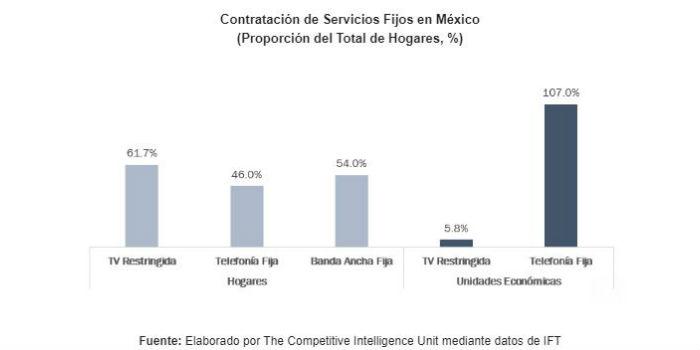
However, the numeralia of contracting and use in homes and companies in the country manifests the opposite, such that according to the IFT, 46 residential lines are counted per 100 households in Mexico in the second quarter of 2019 (20-2019), two percentage points (pp.) more than the previous semester. While, for the economic units of the country, this service is essential, so that they have more than one line, that is, there are 107 fixed lines for every 100 economic units.
In absolute terms, fixed telephone lines have oscillated in a range between 19 and 21 million in the last decade, to reach 21.4 million in Q2-2019.
From the unlimited offer at affordable prices in calls to indistinct numbers in the national territory and some outside it, by operators other than the incumbent-preponderant, the structure of the market went from holding 84.6% in holding the latter operator to 56.2% in the last decade, that is, Q2-2009 to Q2-2019.
The packaging of services, the intensive use by economic units and the launch of abundant offers in calls, have led to the penetration of services and the accounting of fixed telephone lines to register a slightly upward level in the last biennium.
For its part, Fixed Broadband registers a trajectory of increasing contracting between households and economic units, such that 5.4 out of 10 of the former have this connectivity service.
In the case of Pay-TV, economic units register a low penetration (5.8%) due to its nature as an entertainment service, while 61.7% of households have it.
Traffic and Download Speed on Fixed Networks
Just as the total number of fixed lines registers an upward trend in their contracting, the minutes of traffic (local, national and international long distance) taken in fixed networks have increased 36.2%, in the last year, between the second quarter of 2018 and the same period of 2019, while in the mobile case they increased on average 3.6%.
However, in absolute numbers, the minutes taken by mobile networks are six times higher than those transmitted by fixed networks. This indicates a greater intensification in the use of mobile phones compared to traditional telephony, despite the introduction of offers with unlimited minutes to national and international destinations at low prices.
Meanwhile, the upward dynamics recorded by fixed broadband in terms of access, preference and use, is attributable to the greater availability of the service, as well as the provision of greater transmission capacities and data download speed.
In such a way that, as of June 2019, 8.9 out of 10 connections are in the speed range between 10 and 100 Mbps (megabits per second), little more than the reason that connections between 2 and 9.99 Mbps reached in January 2013.
On the other hand, if we consider that to a large extent, the transmission of calls and data from mobile services are carried out through fixed networks and that the non-satellite restricted television service benefits from their capacity, it is precisely for this reason that fixed telecommunications are essential for the industry as a whole.
Here is the importance of access and increasing availability of fixed networks that provide proportional support to the increase in the demand for broadband data, the provision of mobile services, especially in its transition to 5G, the transmission of restricted television and the growing consumption of video over the Internet.
Text written by Carlos Hernández, from The Competitive Intelligence Unit.