
 Latin America. Elton John's rendition of the song "I'm Still Standing" for One World: Together At Home used DaVinci Resolve Studio in post-production. With more than two million views on YouTube alone, the entire project was carried out by a team of four people in just 20 hours.
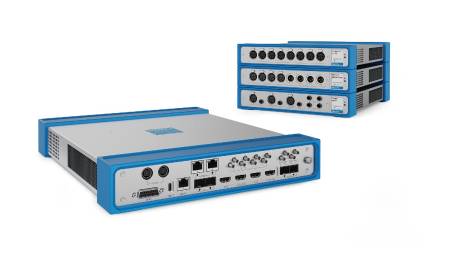
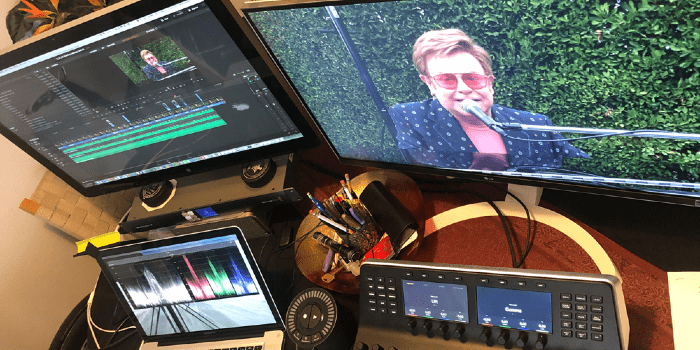
Producer and post-production specialist Chris Sobchack of Wraptastic Productions used DaVinci Resolve Studio along with a DaVinci Resolve Mini Panel, a Blackmagic eGPU unit and an UltraStudio 4K capture and playback device to edit, scan and process the audio in this remote shoot.
The footage was captured at the vehicle entrance of Elton John's own home with a camcorder, tablet and phone on a Movo portable stand, while post-production took place at Sobchack's own home in Los Angeles. It was very important to maintain the optimal visual quality and the clear and dignified sound of the performer and of this world event, despite the atypical circumstances of his production.
"Of course this was totally uncharted territory. To maintain minimal exposure, a crew member was on location during filming, alongside David Furnish, Elton's husband and CEO of Rocket Entertainment. David directed and shot Elton's performance in just two takes. Then, they immediately sent me the three video tracks and the individual recordings of the piano and voice," Sobchack explained.
Sobchack imported all the elements into the multimedia panel of DaVinci Resolve Studio, and considering that it had no timecode or clapper with which to guide itself, it used the audio waves of the Editing module and the tools of the Fairlight module to manually synchronize the three video tracks with the corresponding sound. Once finished, he added the WAV audio clips and repeated the process to synchronize the piano and voice tracks with the main images.
Sobchack and his wife Nicole Sobchack then worked together on editing the material. "I love having the ability to resize video and audio tracks independently, depending on what I'm doing at the moment," he said. "I needed to use the waveforms to manually synchronize the elements, which was very simple thanks to the key combination to zoom in and out of the timeline of the whole project."
The Fairlight module of DaVinci Resolve Studio was used to process all the audio and polish the manual synchronization of the elements. "I love the feature that allows you to forward or backward the audio, and to be able to see the different interfaces of all the add-ons, for example, iZotope's RX 7 and Waves, which allows you to have a visual idea of what is really happening," Sobchack added.
Sobchack then started with the color grading of the material, which he said was quite a challenge, considering that the colorimetry of the VCR was more logarithmic, while that of the tablet and phone was Rec. 709 with more intense colors. "I had to strike a balance in the middle to maintain continuity. As always, I used the catches and curtains in the gallery to polish the last details. I also had to use keyframes in the color of dynamic shots due to the changing aesthetics of the cameras in different lighting. We opted for exceptional, realistic skin tones that stand out from the screen and will also look good in the broadcast, regardless of what the show's overall colorist does."
"You really have to fulfill a lot of roles as a producer from start to finish, especially when you have to deliver the project so quickly. DaVinci Resolve Studio modules helped maintain order throughout the work dynamics, processing everything in an organized and efficient way. In addition, it is priceless to have a program that includes all the necessary tools, instead of having to go from one project to another, and having to join them to the latest. All this helped us to create a product very quickly and worthy of Sir Elton John," concluded Sobchack.