
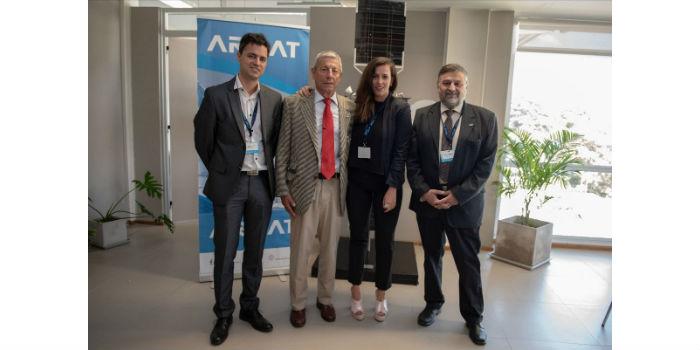
 Argentina. At the beginning of February, the first working meeting was held at the headquarters of ARSAT, the state satellite and telecommunications operator of the Argentine Republic, with INVAP, the main contractor of the two currently operational missions of ARSAT, to resume the development of the third geostationary telecommunications satellite that will be added to the company's fleet.
The opening of the meeting was also attended by the head of the Secretariat of Public Innovation of the Chief of the Cabinet of Ministers, Mr. Micaela Sánchez Malcolm and the UNDERSECRETARY of ICT, Mr. Martín Olmos.
ARSAT initially presented the status of the satellite networks requested by the Argentine Republic as a notifying administration to the International Telecommunication Union (ITU). Then the current deployment of satellite broadband service in hard-to-reach homes located in the northern part of the Andes mountain range and various mission definition alternatives for the next second-generation satellite were analyzed.
INVAP, for its part, reported on the advances in the new generation smallgeo platform with electric propulsion. The manufacturer also presented GSATCOM, a partnership it established in 2019 with Turkish Aerospace Industries (TAI), for the development of small geostationary communications missions with electric propulsion.
Pablo Tognetti, Chairman of the Board and General Manager of ARSAT, said: "The relaunch of the ARSAT Satellite Plan is part of a State policy that establishes universal access to the internet and information technologies as a right of all citizens. For that you have to cover the whole country with the lowest possible price. In that sense, our Federal Fiber Optic Network has a fundamental function, which has more than 30,000 operational kilometers."
"In Argentina there are many remote places that to make fiber optic lines is very expensive or takes too long, so there the most effective thing is to access with satellite connectivity. In this way, the third satellite of the Arsat Satellite Plan will be dedicated mainly to the Internet," he added.
For her part, Micaela Sánchez Malcolm, Secretary of Public Innovation, said: "All this also has to do with promoting productive development and providing quality tools, so that producers and families can progress in their place of origin without having to go to large urban centers."
Finally, the General Manager of INVAP, Vicente Campenni, highlighted: "With this launch meeting of ARSAT- Second Generation we are putting a fundamental milestone to the objectives of the country that are to make technology a tool for the development of the people".
INVAP, a state technology company owned by the Province of Río Negro, was in charge of designing and manufacturing the ARSAT-1 and ARSAT-2 satellites that were put into orbit by Arianespace's Ariane-5 launcher, on October 16, 2014 and September 30, 2015 respectively. Both satellites currently operate satisfactorily providing services for video distribution, Direct to Home Television (DTH) and VSAT (Very Small Aperture Terminal) with coverage in Argentina and the rest of the American continent.
The third satellite of arsat's geostationary fleet will be the first high-performance satellite (HTS) and will have among its main objectives to provide broadband over the Argentine territory to allow the people who inhabit it to exercise their basic human right to communication and information.