
 Latin America. Mobile technology operators and manufacturers continued to demonstrate during 2019 the potential of 5G networks in Latin America for use cases ranging from enhanced mobile broadband (eMBB) to Massive Internet of Things (MIoT). According to data released by 5G Americas, five 5G networks began operating during 2019.
The 5G network switched on in Uruguay in April 2019 uses the 28 GHz band, while in Puerto Rico and the U.S. Virgin Islands (December) an operator uses the 600 MHz band. Also in December, operators in Trinidad and Tobago and Suriname announced launches of 5G networks for services such as fixed-wireless access (FWA). In Aruba, meanwhile, a contract for the development of a 5G network was announced.
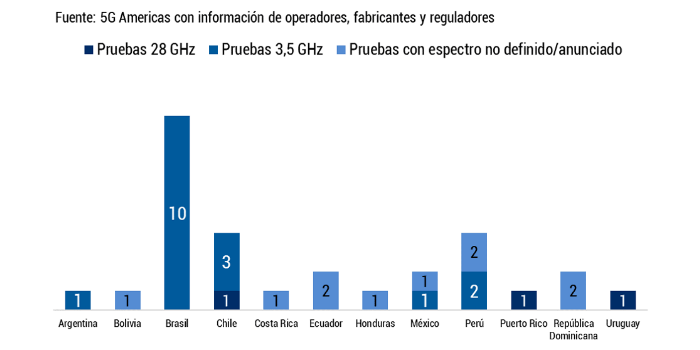
On the other hand, during 2019 at least 30 5G tests were run in 12 countries. Most of these trials occurred in the third quarter of 2019, mainly demonstrating the use of eMBB in smartphones. Augmented reality sessions, Internet of Things (IoT) applications for industry and smart cities, telehealth and fixed-wireless broadband were also tested.
The 5G Americas survey includes the tests publicly announced during 2019 in 20 countries in Latin America. It should be considered that there are 5G tests that are not publicly reported and that are part of the process of improving telecommunications networks derived from investments in network infrastructure.
The 5G technology tests surveyed by 5G Americas mainly used the 3.5 GHz band and to a lesser extent, the 28 GHz band.
Three countries concentrated the majority of the tests (18, equivalent to 60 percent of the total). In Brazil, 10 trials were reported, while Chile and Peru contributed 4 each. In Brazil and Peru, the tests used spectrum from the 3.5 GHz band, while in Chile that band and the 28 GHz band were included.
In markets such as Ecuador, Mexico and the Dominican Republic, some announcements of 5G tests were made, but the available information has not allowed to specify the frequencies used and the use cases experienced.
The region has seen announcements of 5G trials since 2016, in markets such as Argentina, Brazil, Colombia and Mexico. Therefore, a lower participation or absence of trials in the 2019 fiscal year does not necessarily indicate that in those markets there is an absence of 5G testing.
As is public knowledge, 5G technology will require low, medium and high band spectrum to serve a variety of connections and services. The 5G tests show the importance of having "roadmaps" that consider the harmonization of the spectrum at the international level of bands such as 3.5 GHz and 28 GHz, as well as mechanisms that allow their ordering to allow uses without interference.
5G spectrum in Latin America
At least five national administrations plan to allocate spectrum considered eligible for 5G within the next 18 months: Brazil, Chile, Ecuador, Mexico and Peru. The 3.5 GHz band is considered in these contests. In addition to the five countries in which 5G networks already operate, Chile, Mexico and Peru have blocks of the 3.5 GHz band that were concessioned for other services (fixed-wireless access) to telecommunications companies, in which they can be allowed to be used for new mobile services.