
 Latin America. 8K technology offers the highest resolution known in the market and has achieved wide acceptance among users, which is why it has developed a rapid and continuous growth, reaching recording devices, streaming platforms that offer videos in 8K and televisions such as Samsung's QLED 8K, which have technology that scales the quality of images with the help of Artificial Intelligence.
Under this scenario, more and more users are interested in finding the ideal TV to enjoy the content. If you're one of these people, you're probably wondering how pixels or inches interfere with your TV experience. Here are some recommendations:
Pixels per inch instead of pixels and inches
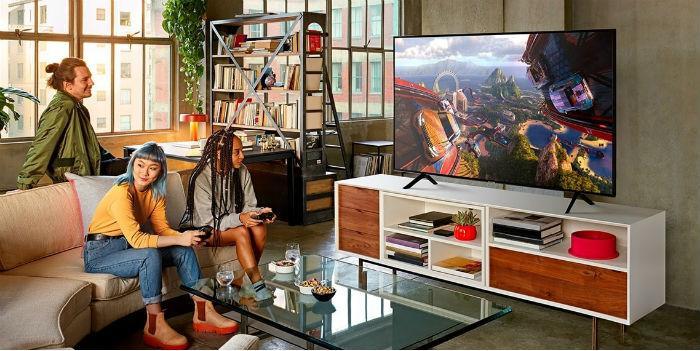
Although it is not such a used measure in the Peruvian market, the use of inches has been standardized to measure the size of televisions. Thus, when a TV is advertised as 82", like the QLED 8K in the photo below, it means that the diagonal is around 208 cm. Pixels, on the other hand, are the minimum units of light and color dots that a TV has.
In other words, inches talk about device size and pixels about resolution. However, both are related in terms of image quality, and there is a third unit of measurement called pixels per inch or dpi that helps us relate both figures.
On many occasions, users tend to think that a TV provides higher quality if it has a larger size, or, on the contrary, that the greater the number of pixels it will have more quality, and this is not entirely true, since, for example, the quality of a movie projected to 144 pixels on a cinema screen or a video with 8K resolution seen on a smartwatch would not be optimal.
Therefore, what should be considered to ensure the best experience on a TV is the number of pixels per inch, that is, the measure that indicates the pixel density in the size of a monitor.