
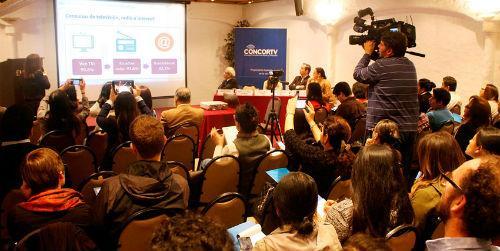
 Peru. The Advisory Council of Radio and Television – CONCORTV, an autonomous body that seeks to promote good practices in Peruvian radio and television, held today, October 20, the presentation of the "Quantitative Study on Television and Radio Consumption in Children and Adolescents", where the results of the survey applied to 9,148 children and adolescents from 18 cities in Peru are collected.
The presentation of the results was in charge of Marisol Castañeda, executive director of the Association of Social Communicators Calandria, an institution that carried out the study at the request of CONCORTV. There were also comments from María Gabriela Villalobos, save the Children's director for Peru and Ecuador; Alberto Priano, manager of TV Norte; and Daniela Meza, representative of the Consultative Council of Children and Adolescents (CCONNA) of Metropolitan Lima.
The event was also attended by the Deputy Minister of Communications of the Ministry of Transport and Communications – MTC, Carlos Valdez, who stressed that "knowing the consumption of TV and radio of children and adolescents is important to advance as a society, since they are the future of the country."
The results of the study included the following:
- TV continues to be the medium of greatest consumption in children and adolescents in 99.8%, followed by radio, which is listened to by 93.6%. Chimbote is the city where TV is most watched (62%).
- The programs preferred by respondents are: "This Is War" (13%), "Al Fondo Hay Sitio" (10%), and "Yo soy" (5%).
- 52.8% say they "want to be like the character they admire on TV." Among the most admired figures on the screen, they lead the characters of competition realities, Peruvian series and cartoons.
- If tv shows were to be rated 0 to 20, the lowest rating is for show/gossip shows, with an average score of 10.5.
- 73% point to the frequent presence of violence in the news and rude language in the reality competition (34%) of Peruvian TV.
- 46% indicate that on Peruvian TV children and adolescents appear as victims.
- 52.4% bought or have wished to acquire the products seen in television advertising.
- 40% say that at school they have not been taught to analyze and comment on what they see on TV.
For the full report, click here.