
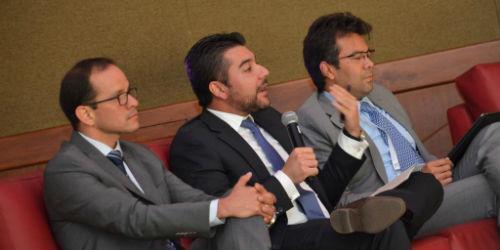
 Colombia. During the fifth installment of the forum of the Association of Operators of Information and Communications Technologies of Colombia, ASOTIC, Ernesto Orozco, member of the National Television Board, was one of the speakers at the opening panel called "The regulatory technological challenges of technological change and the need for market convergence", which was attended by Juan Pablo Vásquez, coordinator of market regulation of the CRC, Iván Antonio Mantilla, deputy ICT director of the DNP.
The discussion of this panel revolved around the entry into the scene of new competitors and the scope of regulatory bodies to intervene in the operation of distributors of content concentrated on the Internet.
Orozco said that "the real challenge for the regulatory exercise is to generate an environment that allows and promotes innovation in business models, as well as innovation in services and technological innovation," he also indicated that the role of regulation is, in addition to protecting the consumer, to allow the greatest possible capture of value from the innovation and competition capacity of the industry.
During his speech, the representative of the Governorates in the JNTV assured that appropriate regulatory positions should be adopted in the face of disruptive models, promotion of competition and reduction, when elimination is not possible, of regulatory asymmetries. "I will propose a compensation scheme that discourages underreporting and a regulation that allows flexibility and innovation in business models, technology and services."
He highlighted that in 2016 $166,000 million was allocated to public TV: 45% to infrastructure, 43% to content and 9% to RTVC operation. Finally, he assured that the main discussion is to determine whether the legal regulations are sufficient to address the new digital environment, to provide services without barriers to all citizens in non-discriminatory conditions, without discouraging investment.
From its role as manager of public policies, the DNP proposes to create an institutional framework that repeals the previous ones and standardizes the business on the Internet, uncrossing all the functions of the entities that currently intervene and that finally creates a national digital policy.
For this reason, in September the process of hiring a studio that rethinks the sector from scratch begins, including television in this new digital reality. On the other hand, it is important to remember the public function of television, to that extent community television licensees need help to transform their networks and digitize, thinking about implementing Big Data services that help in the control and surveillance of the digital world.
The recommendations of the DNP for the sector do not go exclusively in regulation, according to them, we must rethink the regulatory framework, which only thought of operators with a platform and are now multiplatform in multiservices, making the burdens more flexible for those who are already there and recording the new ones without affecting the neutrality of the internet.