
 The latest non-proprietary compression standard, the High Efficiency Video Codec (HEVC), also known as H.265, is expected to become the preferred video standard in the next decade.
Keith Wymbs
Like all previous generations of video compression technology, the HEVC standard promises to reduce the overall cost of broadcasting and storing video assets while maintaining or increasing the quality of the viewer experience.
This article primarily examines the technical and commercial implications of the adoption of the HEVC codec in content creation and in the broadcast market.
More efficient compression techniques
Without sacrificing video quality, HEVC can reduce the size of a video file or bitstream by up to 50%, compared to the AVC/H.264 standard or up to 75%, compared to MPEG-2 standards. The result is a reduction in video storage and transmission costs. Similarly, the new codec paves the way for spreading higher-definition content to provide the consumer with a higher quality experience.
The HEVC, designed for the advancement of the video compression industry, has the purpose of:
- Provide an average bitrate reduction of 50% for fixed video quality, compared to H.264
- Provide higher quality with the same bitrate
- Define a standard syntax to simplify deployment and maximize interoperability
- Continue to promote networking, i.e. mpeg transport streams
Expected bitrate compression at the time of standardization.
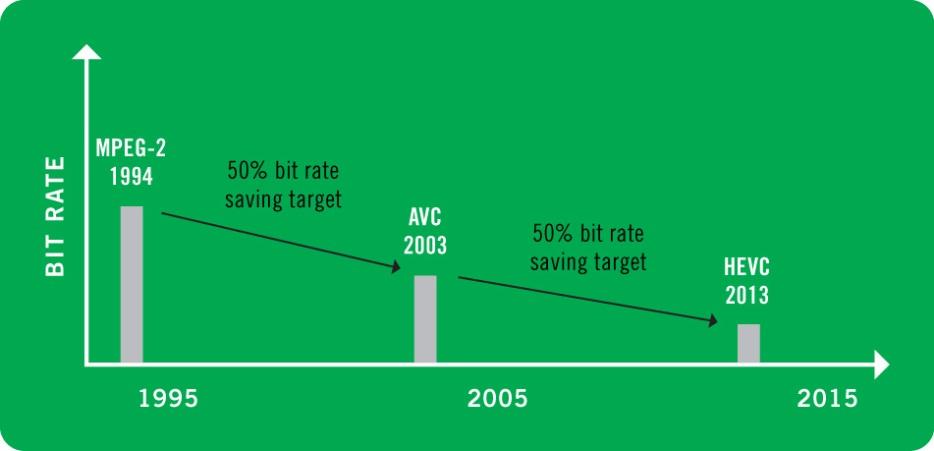
50% expected savings in bitrate
While the H.264 had seven profiles (defined sets of coding tools used to create a standards-compliant bitstream), the HEVC currently defines three: Main, Main 10, and Main Still Picture. Future extensions of the HEVC codec are expected to include increased bit depth, 4:2:2 and 4:4:4 color sampling, MVC (multi-view video encoding), and SVC (scalable video encoding).
The MAIN profile of the HEVC allows a bit depth of 8 bits per color, while Main 10 allows 8 bits or 10 bits per color. Due to the additional bit depth option, the Main 10 profile has the ability to deliver better video quality than the Main. Finally, the Main Still Picture profile allows you to encode a single still image with the same requirements of the Main profile.
The HEVC specification also defines 13 levels, which are sets of constraints that indicate the required performance of the decoder to play a bitstream of the specified profile. The levels are, in turn, divided into two levels: the Main, which includes levels 1 - 3.1, and the High, which includes levels 4 - 6.2 and is designed for very demanding applications. The levels of the HEVC share certain similarities with those of the H.264, with the fundamental difference of the addition of levels 6, 6.1 and 6.2, which define the requirements for video with 8K resolution.
What differentiates HEVC
The main objective of the new HEVC standard is to provide the necessary tools to transmit the smallest amount of information required for a given level of video quality.
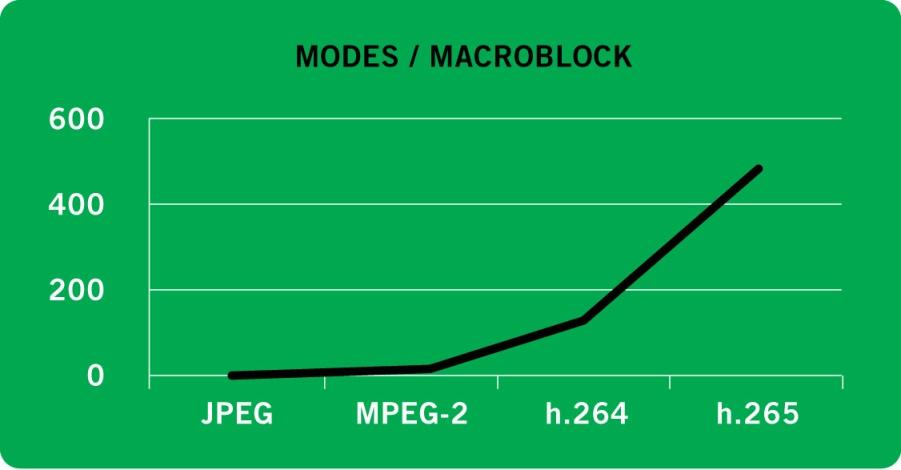
Modes/macroblock
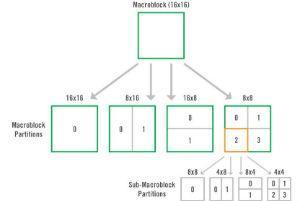
Although there are several differences between the H.264 and HEVC standards for encoding each macroblock, two of them are worth mentioning: the increase in intra prediction modes and a refined partition for inter prediction.
Intra prediction and coding: In the H.264 standard there are nine prediction modes in a 4 x 4 block for intra prediction within a given frame and nine prediction modes at the 8 x 8 level. It is lower at the 16 x 16 block level, where it is reduced to just four prediction modes. Intra prediction seeks to calculate the state of adjacent blocks in a direction that minimizes calculation error.
In the HEVC there is a similar technique, but the number of possible modes is 35 (according to the additional complexity of the codec). This involves the participation of an enormously high number of decision points in the analysis, as there are almost twice the number of spatial intraprediction sizes in the HEVC, compared to H.264, and almost four times the number of spatial intraprediction addresses.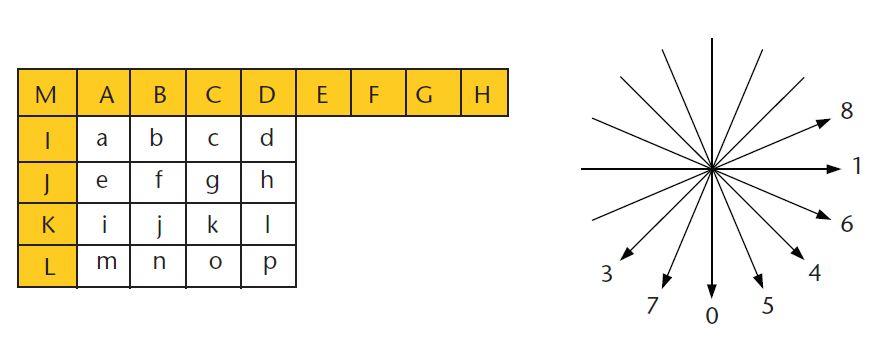
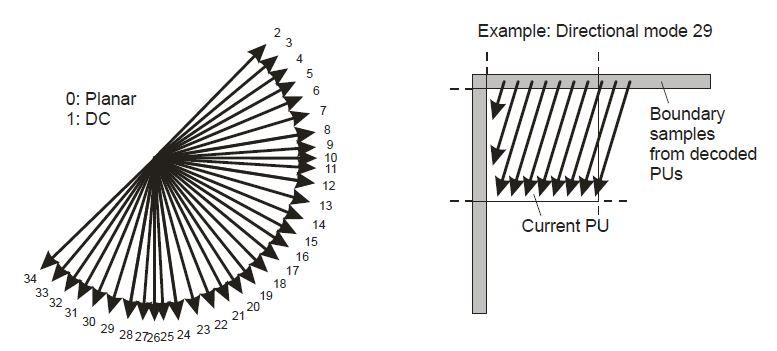
Comparison of prediction modes between H.264 and HEVC
Inter prediction and coding
The H.264 uses motion compensation from blocks, the size and shape of the blocks is adjustable to look for temporary redundancy in the frames of a video. Motion compensation is often considered the most demanding portion of the coding process. The ability to implement it intelligently within the decision space has a major impact on the efficiency of the codec. The HEVC takes this capability to another level.
The HEVC replaces the H.264's macroblock structure with a set of more efficient, but also complex, tree-structured blocks. Each block can be larger (up to 64 x 64) than the standard 16 x 16 macroblock, and can be efficiently split using a quadtree. This system allows the encoder great flexibility to use large partitions when they predict well and small partitions when more detailed predictions are needed.
This allows for greater efficiency in coding, as large prediction units (including block size in tree structure) can be coded at low cost when adapted to content. Similarly, when some parts of the block need more detailed predictions, these can also be described efficiently.
Impact on the application
There are several cases where the better quality in the bitrate ratio of the HEVC will have an impact on industry applications. Considering that broadcasting high-quality video demands huge network capacity, the following are some of the projected benefits:
- Use of more channels in satellite, cable and IPTV television networks
- Lower cost of broadcasting managed and unmanaged video.
- Greater reach for mobile and IPTV operators with bandwidth restrictions.
- Better quality of the experience of free streaming services (OTT) so that they are on the same level as traditional broadcasting.
In the mobile transmission market, the reduction of the HEVC bitrate of 30 – 50%, to achieve a quality comparable to H.264, is materialized in savings in the costs of broadcasting in networks. Mobile operators won't have to distribute as much data for a certain level of quality, reducing costs and making playback more reliable, provided that the device's hardware can seamlessly decode the HEVC.
The HEVC also adds to the trend towards high-resolution 4K and 8K Ultra HD video in the dominant market. Thanks to the fact that 4K resolution has four times the number of pixels than 1080p, the efficiency provided by HEVC makes 4K broadcasting much more viable.
Media companies with sizeable content libraries will also feel the positive impact of bitrate savings. Because HEVC halves file sizes, transitioning to the new codec will double storage capacity in the future.
HEVC and parallel processing
The HEVC has been designed with parallel processing improvements in mind. This processing represents advances in both encoding and decoding, some of which relate specifically to:
- Divisions (tiles).
- The looping block removal filter.
- Parallel wavefront processing.
Slices (tiles) allow an image to be fractionated into a matrix of rectangular regions that can be simultaneously decoded and encoded independently. They also allow random access to specific regions of an image from a video transfer.
In the case of the looping block removal filter, it has been defined in such a way that it is only applied to aligned edges in an 8 x 8 matrix in order to reduce the number of interactions between blocks and simplify parallel processing methodologies. Additionally, the processing order has been specified as horizontal filtering at vertical edges followed by vertical filtering at horizontal edges. This allows multiple parallel threads of block removal filter calculations to work simultaneously.
Finally, parallel wavefront processing (WPP) allows each slice to be divided into tree structure coding units (CTU) and each CTU unit to be decoded based on information from the preceding CTU unit. The first row is normally decoded, but each additional row requires decisions to be made in the previous row.
Ideal GPUs for HEVC
The techniques and algorithms used in the HEVC are considerably more complex than those of the H.264 and MPEG-2 standards. More decisions need to be made when encoding a certain video stream or file, and consequently more calculations need to be done when compressing video assets.
The computational intensity of the HEVC allows you to benefit from the processing performance obtained with graphics processing units (GPUs). Although HEVC tools are designed to improve parallel processing capabilities, the number of tools that have greater complexity is very large.
Elemental has estimated that coding with the HEVC standard will require up to ten times more processing power than encoding with the H.264. For example, with 500 different ways to encode each macroblock, the processing power requirements are considerably higher for heVC, compared to encoding with H.264.
The fact that spatial intra prediction sizes are doubled, the number of transformation sizes is doubled, the number of spatial intra prediction addresses is almost quadrupled, and the search space of inter prediction is increased, implies additional pressure for many existing hardware platforms and accentuates the value that powerful GPU-based video processing has for the commitment of media companies in the sense of achieving compatibility with the new codec.
Introducing ultra-resolution 4k and 8k content to the consumer market, along with finding compatibility with these resolutions, will pose additional challenges for most coding solutions on the market. Again, GPU units represent an advantage in this case, as these powerful processors are optimized to handle increases in resolution.
With a flexible software-based architecture, Elemental's video processing solutions offer HEVC support through a seamless software upgrade. Elemental has extensive experience in the development of video codecs, from open specifications to full implementation using general-purpose programmable architectures (GPU and CPU).
By facilitating the transition to HEVC within existing MPEG-2 and H.264 infrastructures, upgradeable solutions such as Elemental's can incorporate new compression methods much faster than existing fixed hardware encoding and decoding platforms such as ASICs and DSPs.
Elemental expects that before the end of the decade, HEVC will be widely adopted in various applications, such as video transfer and broadcasting, satellite video, cable video, IPTV, video surveillance, corporate video and video games.
Keith Wymbs is vice president of marketing for Elemental.