
 When using OTT platforms to reach the public, the missing element in the equation is video production. Here artificial intelligence and artificial vision come into play.
By Gal Oz*
We've been hearing for a long time how artificial intelligence and computer vision are going to change the world. From autonomous cars and trading robots to virtual personal assistants, there is no doubt that the future has arrived and that artificial intelligence is revolutionizing our way of life. If you want to see it with your own eyes, you just have to ask Google Photos to show you photos of "wine tags" or "babies".
Very soon, these advances could dominate entire sectors. The combination of advances in OTT platforms, artificial intelligence and artificial vision will revolutionize sports production forever.
More than 220 million sporting events are not broadcast
At present, sports production is an expensive and complex task. A typical sports broadcast involves cameras and operators, microphones scattered throughout the field, commentators, mobile units, editors and much more. Only the most important leagues in the world can cope with the cost of production, and therefore the broadcasts are mainly made through "traditional" sports channels and networks. This is why only 1% of the events with the most followers are broadcast.
The results of our research show that there are more than 200 million sporting events that are not broadcast; among them, 132 million basketball and football games.
More than 150 million players are not being televised: women's sports, minor leagues, youth leagues, adapted sports and sports with fewer followers than football, basketball, hockey, baseball and American football. When was the last time you found a handball match of the women's second division on TV?
OTT platforms created the opportunity, but it wasn't enough
OTT platforms have created the opportunity to access fans independently, without needing to convince traditional broadcasters that there is a large enough audience. YouTube Live, Facebook Live, Livestream, Periscope and many more platforms allow you to broadcast live events over the Internet and on mobile devices.
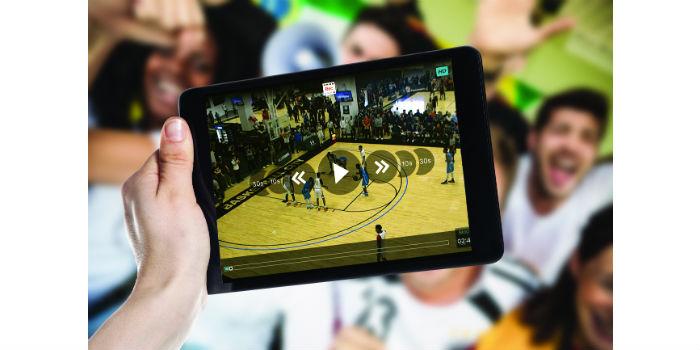
In fact, mobile devices are the most used to watch broadcasts of minority sports. According to a recent report by Ooyala, almost 60% of fans watch sports broadcasts on their smartphones. In the case of minority sports, 70% of viewers use their mobile devices to watch them, which makes OTT platforms the most used.
In theory, all you need is a camera or a mobile phone with an internet connection, and you're good to go. Any spectator will be able to watch the match of that minority league. Logically, this infrastructure is not enough. A sporting event recorded by an amateur "camera operator" with a mobile device is, being generous, boring.
As viewers of sports broadcasts, we are used to a certain level of production with ambient sound, live commentators, multi-camera zoom, replays, statistics and much more. Watching hours and hours of live video broadcast through a single camera of a fan who is in the sports venue is not much fun, no matter who plays and how interesting the game is.
Automated sports production
When using OTT platforms to reach the public, the missing element in the equation is video production. Here artificial intelligence and artificial vision come into play. For sports production to be available to everyone, the solution must be extremely simple, affordable and achieve a level of production similar to what we can find in traditional broadcasts.
This creates challenges in two ways: capture (i.e. cameras and microphones) and direction. For the revolution to be real, both elements must be fully automated, there must be neither camera operator nor director.
Camera Automation
A traditional camera setup involves multiple cameras covering panoramic shots and close-ups of the action. For the viewing experience to be engaging, the technology must simulate the human camera operator and his fluidity of movement.
This challenge can be solved in different ways:
• Mechanical or robotic camera: one way to achieve this effect is to use a mechanical or robotic camera. This technology follows the action by moving the camera and enlarging the image to present a closer perspective. In most cases, camera movements do not come naturally to the human eye; In addition, it is very difficult to identify the action and move the camera at the right time to capture it.
• Several high-resolution cameras: Another, more effective solution is to have several high-resolution cameras that capture different sections of the playing field and then join the image obtained by each of them to create a panoramic view of the entire field. The technology uses advanced auto-tracking algorithms to track game action within high-resolution panoramic capture. This creates magnification, tilt shift, and other effects to simulate those of a camera operator. By integrating a microphone into the camera, ambient audio sound can complement the video.
Director based on artificial intelligence
For automated production, the main challenge is to mimic the decisions of a human director. Each sport has its own rules, both on the pitch and in the management studio. The artificial intelligence algorithm has to figure out where the action is, as it's not enough just to follow the ball. For example, in baseball, the ball is not the only interesting element. If the video focuses exclusively on it, viewers might not see that a base has been stolen.
In other sports, such as basketball or soccer, the movement of the ball is often unpredictable. An unexpected pass or a quick dribble can cause the camera to stop controlling the action in a tenth of a second. The algorithm must include knowledge about the rules and types of behavior of the sport in question: a generic solution for all sports does not work.
Automated production
The combination of high-resolution capture through multiple cameras and an AI-based director enables fully automated production that is natural and professional. The solution should include professional sports broadcast features, such as instant replays, more interesting match moments, rankings, statistics, real-time commentators and much more, but fully automated. Along with the revolution of OTT platforms, this technology opens the doors to new opportunities for leagues and matches that have never been broadcast.
*Gal Oz is CTO and co-founder of Pixellot.