
 The last few years have been very busy for display technology. We went from plasma to LCD, now the boom is for LED screens, which while they continue to gain market, began the development of their replacement: OLEDs.
By Beatriz Pineda*
As its acronym in English defines it, OLED (Organic Light Emitting Diode) is an organic light-emitting diode that contains films of organic components (chemical components, in gaseous, liquid or solid form whose molecules contain carbon) that when electrically stimulated emits light by itself.
Such films, depending on the type of manufacture, can be made up of small molecules or polymers. The former are composed of at least two atoms while polymers or macromolecules are composed by the repetition of structural units.
One of the great advantages of OLEDs is that they can generate brighter, sharper images, consuming less energy than conventional LED light-emitting diodes or liquid crystal displays.
A little history
Until just a few years ago organic materials were considered as insulators, but in the 50s laboratory tests showed that certain organic components could carry current.
In this same decade the first observations of electroluminescence in organic materials were produced by A. Bernanose et al., at the University nancy in France.
In 1977 Heeger, Mac Diarmid and Shirakawa discovered a high conductivity in iodine-doped polyacetylene, who were later awarded the Nobel Prize in chemistry in 2000 for "the discovery and development of conductivity in organic polymers."
The first diode device was reported in 1987 by Tang et al., of the Eastman Kodak company who developed bilayer devices based on molecular films deposited on steam, consisting of a layer of transport of holes and an emitting layer that generated electroluminescence.
Finally in 1990 J. H. Burroughes et al., at the Cavendish laboratory in Cambridge, reported high efficiency in green light-emitting polymers using 100-nanometer-thick sheets.
Structure of the OLED
The basic OLED structure is composed of several extremely thin layers of various materials. The 6 basic layers are described below:
Substrate
This layer can be made of glass or transparent plastic and is responsible for supporting the device.
Anode
The anode extracts electrons (inserts holes) when a current flows through the device.
Gap Transport Layer (HTL)
This layer is responsible for the transport of holes (or holes) from the anode.
Emission Layer (EML)
When electrons and holes recombine, they transfer energy to the molecules of the emission layer who are excited by emitting a light of the characteristic color of their component.
Electron Transport Layer (ETL)
Its function is very similar to that of the HTL layer and is responsible for transporting electrons from the cathode.
Cathode
The cathode may or may not be transparent depending on the type of OLED, it injects electrons when a current flows through the device.
Types of OLEDs
Passive Matrix OLED (Pmoled)
In this type of OLED the cathode and anode are formed by perpendicular stripes. Since the organic layer lies between these stripes, light is emitted at the intersections (pixels), by applying voltage at the horizontal and vertical points of the matrix.
This type of OLED is easy to manufacture but consumes more energy than the alternative system, for this reason they are ideal for small (1" to 3") and alphanumeric screens.
Active Matrix OLED (Amoled)
Complete layers of cathode and anode are used, the TFT (Thin Film Transistor) matrix is located above the anode. In this arrangement, the TFTs are responsible for determining which pixels should be turned on or off.
One of its great advantages is that it consumes less energy than Pmoleds and has higher refresh rates, for this reason it is used in the manufacture of large screens (televisions, PC monitors, electronic signage, billboards).
Transparent OLED (Toled)
In this type of device all layers are composed of transparent or semi-transparent materials, allowing the emission of bidirectional light through the cathode and anode.
Foldable or flexible OLED (PLED)
Thanks to the properties of OLED components, plastic substrates or flexible and ultra-thin sheets can be used in their manufacture, which make them lighter and more durable.
Sony has been working in this area developing screens that can be used in a number of applications such as manufacturing televisions, cell phones, etc.
Soled
It is formed by stacking OLED emitting layers to achieve the light of the desired color. This type of OLED will allow us to replace conventional lighting systems such as fluorescent lamps since brighter lights can be generated in a more efficient and uniform way, highly reducing energy consumption.
Types of OLED structures
Lower Emission OLED
The light generated by the emitting layer travels inversely, in the direction of the TFT circuitry, which partially blocks the light output. Its manufacture is relatively simple and consequently more economical, for this reason conventional OLED designs use the lower emission.
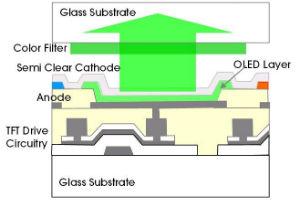
Superior Emission OLED
Unlike the previous case in this structure the cathode is formed of a transparent material and the anode can be opaque and / or refractive allowing the light to travel frontally drastically expanding the luminous area. Sony's design uses this type of structure as it maximizes both image brightness and energy efficiency.
In addition to adopting superior emission, Sony developed its own Super Top Emission™ OLED technology that incorporates a suite of technologies such as micro cavities and color filters into the OLED structure.
Currently there are several products on the market that incorporate OLED screens, some of them: the TV (XEL-1) and in the area of professional monitoring the PVM 740. In addition to the new 25 and 17-inch Broadcast monitors (BVM-E250 and BVM-E170) manufactured by Sony.
There are many advantages of OLED technology, thanks to the characteristics of its components each pixel can be completely turned off allowing the reproduction of extremely deep blacks, in addition the contrast ratio of an OLED is excellent.
The switching time of the OLED is so fast that refresh rates of 120 Hz and 240 Hz are no longer necessary to suppress motion blur. For these and many other reasons OLED is the future in display display display technology.
OLED technology will undoubtedly become the next generation of flat screens and is the key in the development of a wide variety of applications with ultra-thin and flexible screens, such as the development of smart clothing, lighting systems, cars with windshields that allow the visualization of speed controls, GPS, Phone, etc., this and much more will be possible thanks to the great qualities of OLED technology.
*Product Manager
Sony Broadcast & Professional Latin America (BPLA)