
After several years and through an unprecedented financial effort the company has been able to upgrade the old and reliable mobile unit: D1 architecture, new cameras, great effects capacity and a clear migration route to DTV. And a few days later a new customer arrives at our door... a character who wants us to give him digital video of 320x200 pixels. Live, via WEB. Do we follow the wrong route?
It is impossible to struggle with the realities of the market: The Internet has become the first viable support for developing VOD (Video-on-Demand) applications. Thanks to current streaming media technology, a stable clientele is being formed for digital audio and video streams that thousands of content providers make available to surfers. These are images of a terrible quality according to the standards of our industry... but apparently that doesn't matter much to the "digitized" public.
And a logical consequence is that content providers intend to mark their offer by making their own productions. It is about moving to real WebCasting operations that reproduce the commercial models of free-to-air television: The success of the business is in obtaining the rights to broadcast events that attract an audience.
There is demand, then, for what might be called mobile units for WebCasting. And there is an offer of conventional production systems. Obviously, mobile units specially designed for this type of application are also appearing, but for many of us the important question is how we can do to provide WebCasting services with existing equipment.
Option 1: No change
The route that may be most attractive to the conventional operator is the first: Leave your equipment as it is. If the problem is approached with engineering criteria, the only real change that needs to be made is in the last-mile solution: Instead of delivering your signal to a television channel, hand it over to an associate who is in charge of the coding and publication of the material. And this "delivery" can be done by conventional means: microwaves, fiber optics or other types of links. This model is so flexible that it can even support transmissions to a camera (read "cheaper"). All this seems perfect: Zero investment, new business opportunities and everything under control... seemingly.
Apparently for a very simple reason: How long will it be before the character in charge of streaming realizes that the best thing for him is to take control of the business and outsource production services? You may decide that instead of producing it is better to buy a ready signal from our competitors. And from here comes the second option...
Option 2: Black boxes
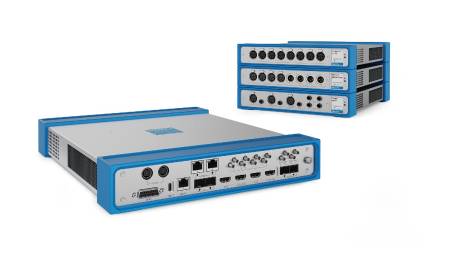
During 2000, several streaming systems appeared on the market that simply receive baseband signals from one end and deliver digital video streams from the other. These are compact and easy to use equipment, but they have two big problems. The first is that they require a digital connection with good bandwidth to be able to deliver the encoded digital video. And the second is that they are not very flexible: Generally, they handle a limited repertoire of codecs, and updating or modifying them can be somewhat wasteful.
However, such a unit may be attractive for permanent or semi-permanent installations, or for cases where there is an infrastructure that facilitates its connection in the region it is intended to cover. For example, in urban areas where there is an extensive fibre optic network, or where telephone companies offer E1 connections on demand. In any case, this is an interesting option insofar as it gives autonomy to the conventional producer and does not require large investments.
Such equipment can then become an attractive solution to the extent that it functions as a simple converter at the end of the production chain, delivers good quality results and is easy to operate. But you have to carefully evaluate your technical requirements to avoid surprises...
Option 3: Dedicated facilities
Some integrator companies are offering special mobile units for webcasting. Generally these vehicles are located at the ends of the spectrum: Either they are large trailers that include a coding room with servers, dedicated hardware and redundant facilities or they are small trucks that have only the basic equipment to solve the production of material and include a good repertoire of technical resources for streaming. Especially expensive resources to the extent that they must be prepared for the rigors of a mobile installation. Following this route involves large acquisitions or modifications and acquiring the know-how of the streaming industry, but it also provides maximum flexibility.
You decide...
Is this route (or any of the above) viable for you? That depends on the volume of demand and the availability of bandwidth and endpoints in your region. A very important factor that must be taken into account is that in many cases the production of material for WebCasting asks for rather flat material: Few movements, simple backgrounds, a minimum of effects.
The production values of your mobile unit may be incompatible with the style required by current bandwidth limitations. That is why many integrators prefer to use prosumer type equipment, following the idea that it is not worth generating broadcast quality signals and then compressing them mercilessly.
It must be considered that webcasting businesses usually have two parts: The first step is the direct streaming of the material, with the limitations of real-time coding (limited quality, for example). And the second is a post-production process: It is necessary to edit and recode the material in various formats and quality levels in order to generate suitable versions for all users.
Whatever your decision, it's a good idea for your company to explore the streaming market. Seasoned entrepreneurs know that the success of the business lies in offering integral solutions under one roof... and if your customers want streaming it's better not to let them go elsewhere.