
The reality is that the current annual rights regime is one of the most expensive in the world and has eroded the tax base, discouraged spectrum holding, and slowed down investment.
By Gonzalo Rojon*
The recently published methodological bulletin of the newly arrived Telecommunications Regulatory Commission (CRT) presents a new measurement of the relative cost of the radio spectrum in Mexico.
In its recent analysis, The CIU highlights that the new calculation reveals that Mexico's position within a sample of countries is virtually reduced and points out that the country is "below average."
This new measurement does nothing more than distort reality and does not reflect a real reduction in the cost of spectrum, as the CRT would have us believe.
Additionally, it hides the fact that several critical bands continue to have an adjusted overprice with 2025 values that are significantly more expensive compared to international benchmarks.
Overpricing Manifest: Evidence by Bands and Market Effects
Although the CRT maintains that the country's general average is competitive in terms of spectrum prices, the disaggregated data reveal another story.
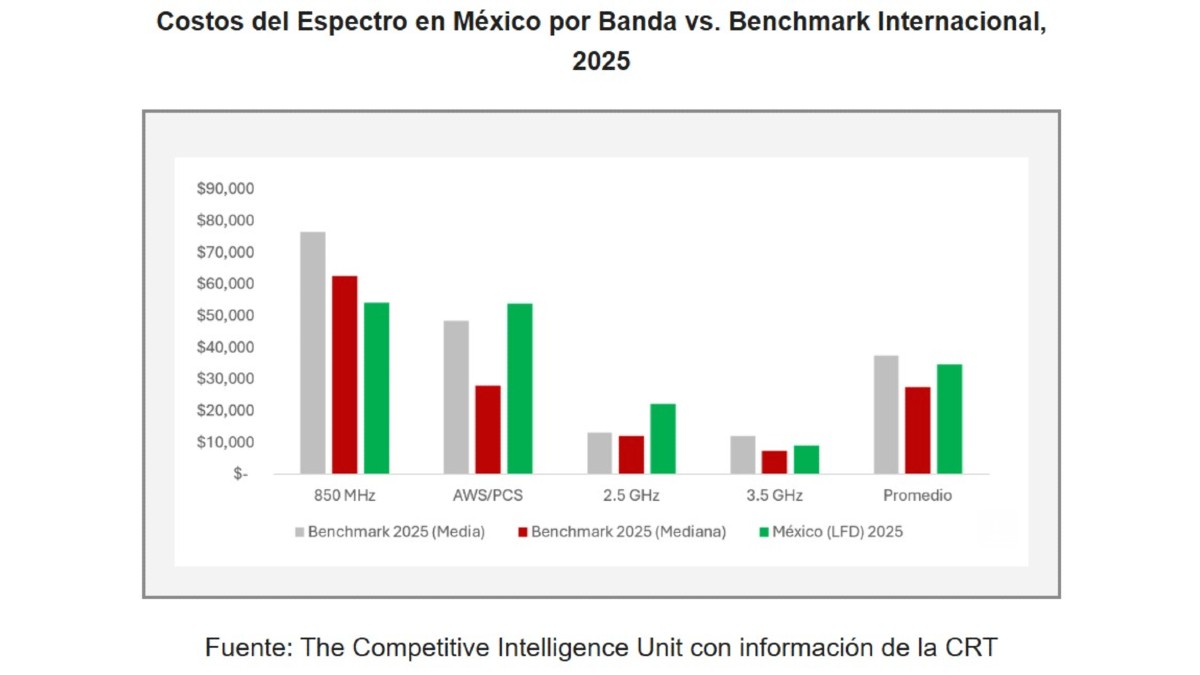
In the most used bands for 4G and 5G, such as AWS and 2.5 GHz, the cost per MHz-annual population exceeds the international benchmark by more than 90%, even the 3.5 GHz comes to register a surcharge when compared to the median.
This overpricing has resulted in financial pressure for operators, who face high tax burdens in a context of reduced margins and the need for network expansion.
One of the adverse effects of this supposedly cheaper spectrum regime is the return of frequencies by operators (Movistar in its entirety and AT&T partially). Likewise, tax collection has fallen – from $19,980 million pesos in 2019 to $16,776 million pesos in 2024 – and the incentive to participate in tenders, such as the IFT-10 of 2021, is non-existent.
Far from being an instrument of sectoral promotion, the current regime of annual rights has eroded the tax base, discouraged the holding of spectrum and slowed down investment.
The CRT bulletin does not refer to what the industry as a whole has raised its voice in recent days, which indicates that, if the current rates are maintained, there will be only one agent, the preponderant in telecommunications, which will be able to maintain its spectrum, and it is unknown if it will go for more, under the current levels.
Sample Limitations and Comparative Biases
As José Otero points out in his column published in El Economista, the international sample used by the CRT is heterogeneous, biased and not very transparent, as it mixes countries with different regions, bandwidths, duration of licenses and coverage obligations.
In addition, some comparative values are based on one-time payments against net present values (NPV) of the total cost, while in some cases the 'glove' and annual payments are accounted for, which does not allow for real economic equivalence.
The CRT's analysis that pretends to appear well-intentioned and reliable about the cost of spectrum does not capture the structural reality of the tax regime: Mexico does not have the cheapest spectrum, but one of the most expensive due to its effective use, as has historically been documented by the GSMA, the OECD, the defunct IFT and various analysts and academics in the sector.
A bulletin pointing out the opposite is not going to change the reality that has been manifest for several decades in Mexico.
In short, it does not matter if you compare it with the average or the median, or which sample you choose: spectrum in Mexico is still expensive. Operators return frequencies, revenue falls, and new tenders are not attractive.
Without a profound review of the tax regime, with a dual strategy of nominal reduction of annual rights and discounts for investments, the country will continue to lose not only fiscal resources, but also opportunities to achieve a full digital transformation, abandon the technological lag and close the persistent connectivity gap.
Mirage of cheap spectrum in Mexico
In recent days, the conversation in the telecom sector has been re-ignited. The newly arrived Telecommunications Regulatory Commission (CRT) released a bulletin to celebrate that the cost of the radio spectrum in Mexico would have decreased in relative terms compared to an international sample. According to his reading, the country would now be below average. For those who know the market, this statement is more of a mirage than a reality.
Spectrum is the essential input that allows our cell phones to connect, mobile internet to work and competition to exist. If this input is expensive, limited, or poorly managed, the result is simple. Less investment, less coverage and slower and more expensive services. That is why it is striking that the CRT seeks to install a perception of improvement when the experience of the sector points in the opposite direction.
The measurement presented tries to soften the historical diagnosis that has accompanied Mexico for years: having one of the highest spectrum tax regimes in the world. It is true that a graph can move positions depending on the sample, the average or the median that is chosen. However, what does not change is the reality that operators face when paying. When they are reviewed band by band, the mirage dissipates.
The key bands for 4G and 5G, such as AWS and 2.5 GHz, continue with a level of overpricing that can exceed 90 percent compared to international benchmarks. Even the 3.5 GHz band is still above the global median. Talking about cheap spectrum with these numbers does not correspond to the reality of the market or to the visible effects in recent years.
The effects are visible and have a name and surname. Movistar returned all its frequencies. AT&T returned a relevant part. Government revenue for spectrum fell from almost 19,980 million pesos in 2019 to 16,776 million in 2024. In addition, the 2021 IFT-10 tender attracted virtually no players. If spectrum were as accessible and as attractive as CRT suggests, operators would not be abandoning it and the State would not be collecting less.
Added to this is a methodological problem. The comparison chosen by the CRT mixes countries with regions, different license terms, coverage obligations and payment modalities that distort any conclusion. In some cases, one-time payments are compared against present value calculations, and in others, initial payments are added to annual payments. With these ingredients, it was only a matter of time before the recipe produced a convenient result.
Reality does not change with a newsletter. Mexico continues to have an expensive spectrum in terms of effective use. As long as this scheme continues, the digital divide will persist, innovation will slow down, and the quality of services will advance at a slower pace than the world.
If we want a country that is connected, competitive and ready for the digital future, it takes more than a good speech. A fiscal reform of the spectrum that combines reduction of rights and investment incentives is indispensable. Fewer mirages and more long-term decisions.