
 In the classroom, the scaffolding is provided by the teacher. In a participatory culture, the entire community takes some responsibility to help newbies find their way (Henry Jenkins).
By Luis Fernando Gutiérrez Cano and Luis Jorge Orcasitas Pacheco
With the influence of digital technologies, especially the Internet, contemporary society is immersed in a phase of constant and rapid transformations in the ways of approaching the various stages of knowledge; In this sense, we must emphasize that mobile telecommunications networks are developed around people and things, and application services were definitively integrated into mobile devices such as Smartphones and Tablets, among others (Massarolo-Mesquita, 2013).
Therefore, the teaching-learning processes have not been alien to these changes and from various instances the role that these technologies can play within a context where communication and information flows are overwhelming is debated; teachers and students, two of the main agents of the education sector, coexist daily with an infinity of tools and narrative structures that, gradually, have been changing pedagogical approaches and displacing the traditional ways of approaching theories of learning.
It is no longer strange to find; for example, a video that is produced for a class of 15 people and is used only one day, after being published on the network can reach circulation among millions of people.
The changes in teaching are so significant that at different stages of the educational process questions are already being raised about the application of what Jenkins has called media convergence, participatory culture and collective intelligence.
Media convergence is understood as the flow of content across multiple media platforms; participatory culture as participants interacting according to a new set of rules that no one fully understands; and collective intelligence as an alternative source of media power. We are learning to use that power through our everyday interactions within the culture of convergence (Jenkins, 2006).
Hence we see how lately transmedia narratives or transmedia strorytellings, are glimpsed, for some time, as one of the forms that can be effective in contexts mediated by computational, informative and communicative technologies, ICT, from what many theorists have called as connectivism, that is, the idea that information is in the network for all, but the information is used in an individualized way (Renó, 2014).
There are issues of great concern, such as those that have to do with the contents in the educational processes within the ecology of communication.
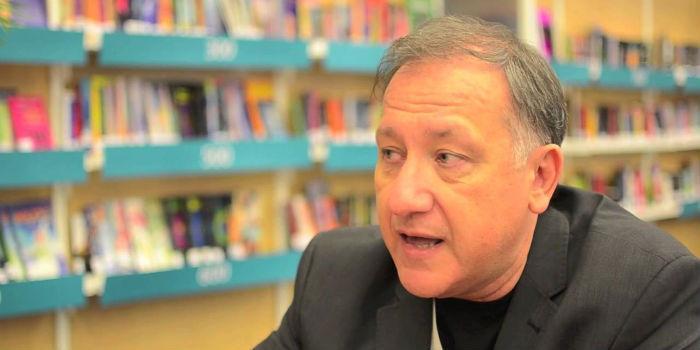
For greater clarity, we capture the concepts of Professor Carlos Alberto Scolari, communication researcher, expert in digital media, interfaces and communication ecology and one of the main Ibero-American theorists on issues related to transmedia communication.
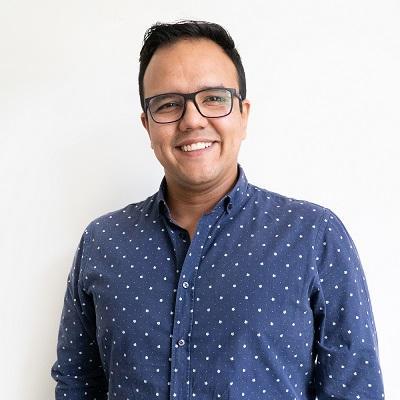
Carlos Scolari is Professor of the Department of Communication at the Universitat Pompeu Fabra (Barcelona). He holds a PhD in Applied Linguistics and Languages of Communication from the Università Cattolica di Milano. He has been coordinator of the Official Master's Degree in Interactive Digital Communication and the Grup de Recerca d'Interaccions Digitals (GRID) of the University of VIC.
As communication teachers, it is of our utmost interest to apply the concepts of transmedia communication in teaching-learning processes, not only from the section of social communication, but also in other areas of knowledge. In a Latin American context, what type of content can be included in the curriculum for application in the topics of communication and that the students of these programs acquire skills in transmedia processes?
Carlos Scolari: Transmedia (NT) narratives should be approached from a double theoretical-practical perspective. On the one hand, these new forms of expanded storytelling where users participate constitute a central phenomenon in contemporary media ecology; from a theoretical perspective, NTs challenge disciplines such as the political economy of communication, anthropology or semiotics and narratology.
With this I am saying that NTs are a transdisciplinary object that can be worked on in different theoretical and methodological subjects. On the other hand, the design and implementation of transmedia communication strategies, whether in the field of fiction, journalism, documentary or institutional communication, should be included as a workshop or integration space, especially at the end of the studies.
In the communication careers we have workshops in writing, design, photography, audiovisual or interactive production. Well, after all those specific workshops should create a Transmedia Narratives Workshop where that knowledge is articulated around a single communication strategy. It would be the cherry on the cake, the final finishing touch of a theoretical-practical training process.
In relation to the above, what strategy can be followed to facilitate, that in these teaching-learning processes, transmedia concepts can be transversal throughout the curriculum and that teachers and counselors can effectively apply the theories and meanings of the transmedia in their classes?
Carlos Scolari: The study and reflection on nts, as I said, can be approached from different points of view: just as professors of political economy can work on aspects of user participation (are they accomplices of large corporations – as the theorists of "digital labour" maintain – or do they generate spaces of rupture and cultural replication, as proposed by Henry Jenkins), in the chairs of semiotics or narrative you can investigate narrative structures, texts generated by fans or strategies of narrative expansion / compression.
In a subject dedicated to the study of audiences; for example, consumption can be analyzed beyond broadcasting, the transformation of the consumer into a "prosumer" or the crisis of the traditional audience measurement model.
Thanks to the evolution of ICT, applied to educational processes, some "classic" teaching methodologies have been transformed; What strategies can be followed to link these students in an appropriate way in the processes of transmedia learning?, Is it feasible to develop playful processes through methodologies that link the theoretical, the narrative, the practical and, why not, the game?
Carlos Scolari: If we consider transmedia narratives as a pedagogical model, in that case training should stop being so book-centric: a transmedia education should work with all kinds of languages and media, from comics to video games, through cinema or video clips. On the other hand, it would be necessary to move from "user-generated content" to "student-generated content".
Usually, the texts that students produce are lost once they were evaluated: they are texts with a high "planned obsolescence". We should design strategies that allow us to recover these texts within the teaching-learning processes. Why can't a student "rework" a text made the previous year by another student? Universities are currently giant textual machines that generate products destined for disappearance. It is necessary to recover even a part of that textual mass.
Finally, rather than aiming at the "playful" – sometimes teachers insist that "more fun classes should be done"... – I prefer to bet on the concept of "experience". That is, to turn each class or meeting with students into a collective learning experience, where everyone contributes and comes out with something new.
With regard to research and teaching-learning processes, given the evolution of transmedia communication phenomena, what do you think are the main phenomena that audiovisual filmmakers, teachers, researchers and students must face today from the production of content, but also from the academic point of view?
Carlos Scolari: The most important thing, and this affects researchers, professors, students and professionals, is to start "thinking about transmedia". If we position ourselves in the place of the researcher or teacher, it is increasingly clear that we cannot understand the communication ecosystem if we analyze "radio", "television" or "social networks". We need holistic, transversal approaches that relate what is happening in the different media and actors of communication.
On the other hand, both professionals and students – that is, future professionals – must "think about transmedia" for a simple reason: it is increasingly difficult to survive by producing content for a single medium. This happens to large corporations but also to small businesses and individual professionals. NTs are consolidated as a strategy to deal with the atomization of audiences, and therefore are a good alternative to counteract that fragmentation and generate a viable business model.
Finally, where are transmedia communication processes headed today, what would be the limits of the concept and what would be the future of it, taking into account that the advance of technologies continues with an overwhelming pace?
Carlos Scolari: NTs are born in fiction and are already expressing themselves more and more in the field of journalism or documentary. Advertising and brands, on the other hand, always had a transmedia spirit that today must be extended to cover the productions of users.
I am sure that with transmedia the same thing will happen as with the "multimedia" of the 1990s: at a certain point ALL productions will be transmedia. It will be assumed that any project or communication strategy will be told through different means with the collaboration of users. At some point, in a few years, the concept will disappear because all communication, to a greater or lesser extent, will be transmedia.
Active participation of young people
It is clear that transmedia or NT content should also be used to encourage a critical reading of the media; similarly, as Jenkins (2006) puts it, "that these new narratives are also useful to encourage the active participation of young people as citizens"; and to tend so that they do not limit themselves to consuming for the sake of consuming, but also participate in the production, selection and distribution of media messages; in short, the academic system must reliably assess the benefits that the processes of media convergence can provide in students, whatever the educational level, through stimuli, robust enough, so that a collaborative construction of knowledge is given to them and also have the certainty that in this new media ecosystem, emerging forms of participatory culture, allied to content platforms, connect users and things to the world of stories (Massarolo-Mesquita, 2013).