
Mexico. The Competitive Intelligence Unit, The CIU, presented its most recent analysis on subscription audio streaming projected at the end of 2025.
During 2025, digital audio consumption maintained its upward trajectory among Internet users in Mexico. By the end of the year, it is estimated that 77.4 million internet users will have listened to music, podcasts or audiobooks through digital platforms in Mexico, a figure that represents 80.1% of Internet users.
Within this universe, 42.9 million make some type of payment to access audio content, to reach 14.3 million accounts with an active paid subscription, equivalent to 13.8% of total internet users.
These figures confirm that audio streaming has established itself as one of the most widely adopted digital services in the country, driven by growing technological adoption, algorithmic personalization and the diversification of the content catalog.
Artificial Intelligence and Audio Personalization
The audio streaming market has become an essential pillar of the digital economy and the Cultural and Creative Industries (CCIs). Platforms are constantly evolving to deliver immersive experiences that integrate generative artificial intelligence (AI), advanced music discovery tools, and hybrid subscription models.
During 2025, applications strengthened their commitment to automated curation, personalized recommendations, and segmentation by moods or contexts of use, which has boosted user interaction and loyalty.
At the same time, the rise of podcasts, audiobooks and original content has diversified the ecosystem and expanded the offer beyond music, while spatial audio and hi-fi (Hi-Fi) are consolidated as attributes of differentiation and added value.
Moderate Growth in Paid Subscriptions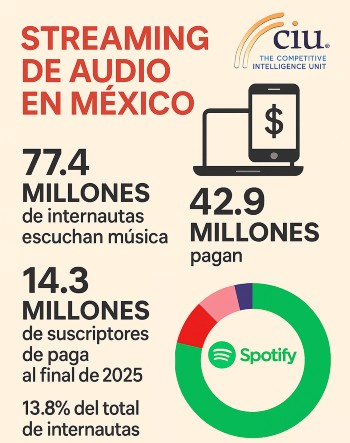 In terms of subscriptions, the growth of the payment model was moderate but sustained. The number of subscribers reached 14.3 million, a figure that represents an annual increase of 2.9%.
This increase is explained by the improvement in audio quality, the availability of exclusive content, family and student plans, and integration with other digital services.
However, account sharing continues to be a common practice: 34% of users report sharing their access with family or friends, a phenomenon that reflects both the search for savings and the high adoption of the service in connected homes.
Spotify Maintains Lead, but Increases Competition
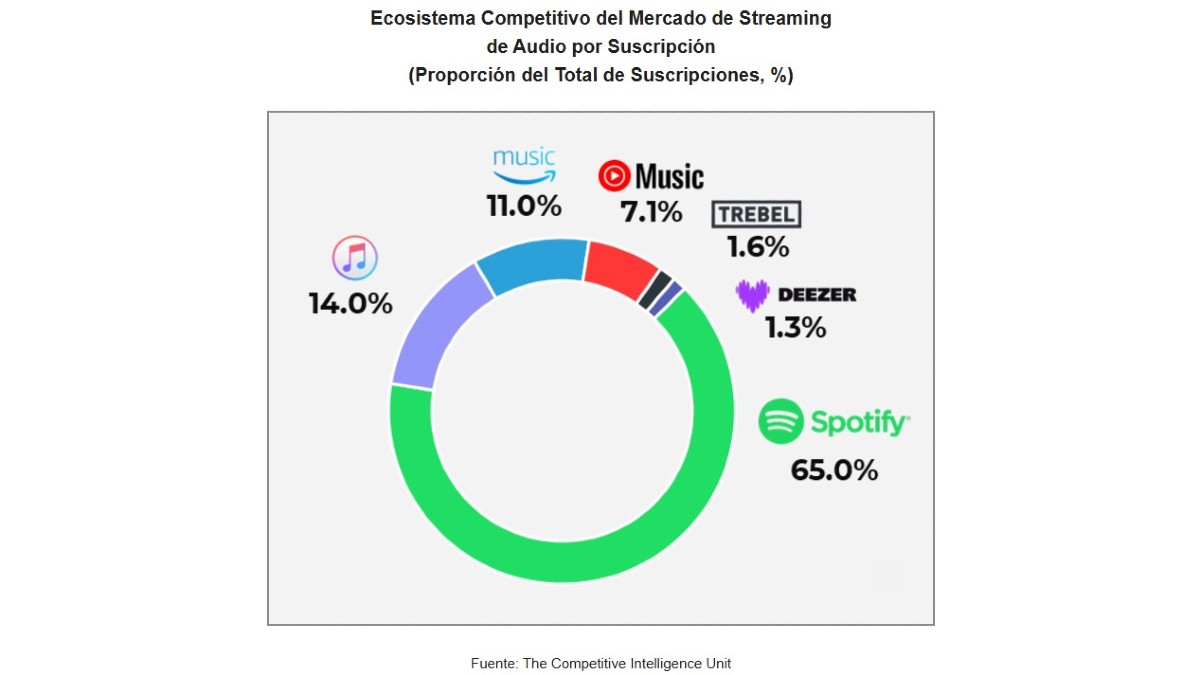
Spotify maintains an undisputed leadership in the Mexican market, with a 65.0% share of paid subscriptions. However, the platform continues to register a loss of market share compared to the previous year, when it accounted for 70.8% of the total.
This adjustment responds to the advance of competitors such as Apple Music, which reaches 14.0% of the market, Amazon Music (11.0%) and YouTube Music (7.1%), in addition to Trebel (1.6%) and Deezer (1.3%).
The diversification of the market has been driven by strategies that combine competitive prices, integration with digital ecosystems, original content, better audio quality and alliances with device manufacturers or video platforms.
Thus, the competitive ecosystem registers a greater segmentation among players, with diversified preferences of users who are looking for a better experience, more content and linkage with other services.
New Ways to Discovery and Monetization
Globally, audio streaming has entered a stage of technological maturity, with AI-based personalization, algorithmically generated music creation, and monetization through interactive experiences setting the tone.
In Mexico, these trends are added to the combination of music consumption with social discovery on platforms such as TikTok or Instagram, enhancing the visibility of local and independent artists. The boundary between entertainment, discovery and digital commerce is blurring, and audio is consolidated as a strategic vehicle for connecting brands, creators and audiences.
Audio streaming in Mexico is shaping up for a new phase of technological symbiosis and value expansion. The application of AI in the production, recommendation and distribution of content, coupled with the diversification of business models and the continuous improvement of the user experience, will continue to drive its relevance and preference as an essential service in the digital ecosystem.
Analysis by Radamés Camargo of The Competitive Intelligence Unit, The CIU.