
Mexico. In the fast-paced world of information and communication technology (ICT), female participation is critical to building an equitable and innovative digital future.
Although significant progress has been made, significant gaps persist that limit women's access, use, and professional development in this sector. Analyzing these differences allows us to understand the challenges and focus efforts to achieve true inclusion.
Mobile Connectivity and Spending Gaps: Starting Point
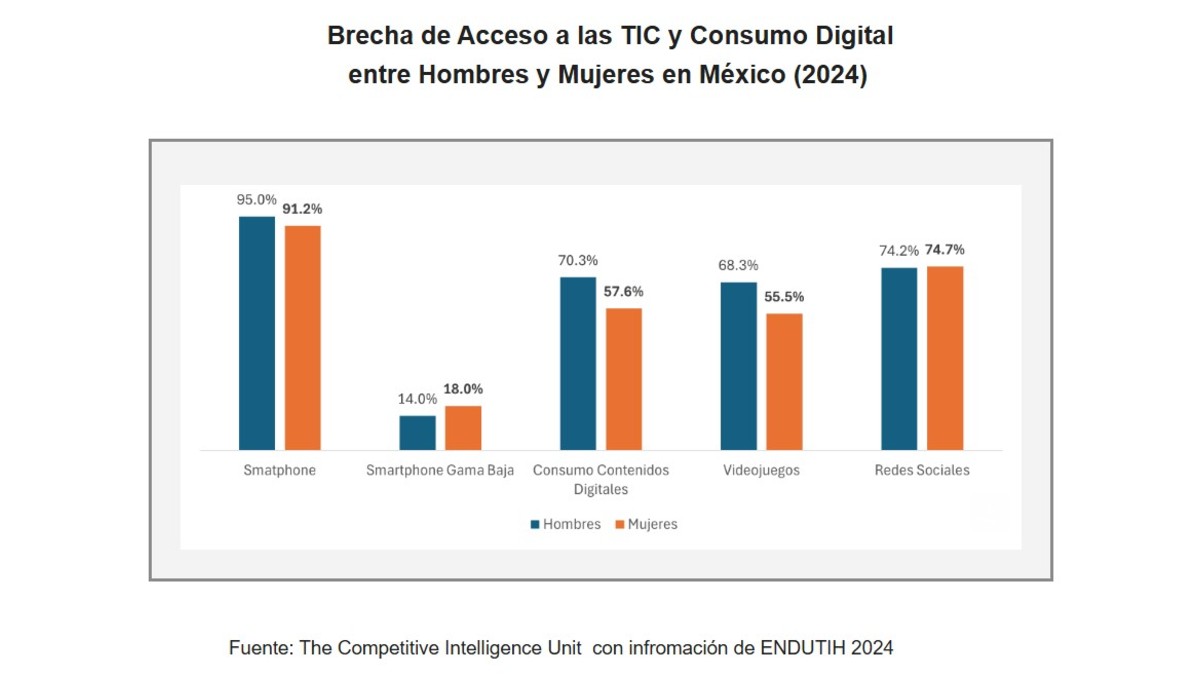
Mobile connectivity registers an almost universal adoption, although there is a slight gender gap: 95.0% of men with a cell phone own a smart device compared to 91.2% of women.
Although this difference seems small, it is statistically significant and can generate a multiplier effect, reducing access to digital opportunities in the long term, considering the importance of these devices today.
This gap also manifests itself in average spending. At the end of 2024, men invested around $5,513 pesos in smartphones, while women spend $5,103 pesos.
This difference is also reflected in the contracting of mobile services, such that men spend an average of $145 pesos per month, compared to $136 pesos for women.
This could suggest that women, due to economic priorities or tighter budgets, opt for lower-cost equipment or plans, potentially limiting access to advanced functionalities. In reality, 18% of women choose low-end cell phones, in contrast to 14% of men.
Digital Content Consumption: Streaming, Video Games and Social Networks
The differences in the consumption of digital content are more pronounced. There is a significant gap in the use of audio and video streaming platforms.
In 2024, 70.3% of men were registered on these platforms by subscription, while in women the proportion falls to 57.6%, a difference of almost 13 percentage points.
This reveals that, despite having the device, women's participation in the consumption of paid or registered digital entertainment is considerably lower. This could be due to socioeconomic or cultural factors, or even the perception about the relevance or safety of these platforms.
Access to video games is shrinking. In 2016, 60% of men gambled, compared to 41% of women. By 2024, both percentages grew: 68.3% for men and 55.5% for women. Although there is an improvement, the gap persists.
The most interesting thing is the choice of platform. Mobile is the preferred platform for female gamers: 91% of them play on their smartphone, compared to 72% of men. By contrast, consoles are predominantly male, with 40% of men playing on them, compared to just 6% of women.
This suggests that smartphone accessibility has been key to including more women in gaming, as it is a device they already own and handle with ease.
In contrast, social networks present a different panorama
Here, women show greater adoption, with 74.7% of women using networks, compared to 74.2% of men according to numbers reported by the National Survey on the Availability and Use of Information Technologies in Households (ENDUTIH) 2024 by INEGI.
This is because women often use networks for a more relational and community-building purpose. Traditionally, they are the ones who nurture family and social connections the most, and networks are perfect for this. They seek out and create support groups, communities of interest, and spaces for self-expression and activism.
Women in STEM: Barriers, Progress, and Impact
The landscape of women in Science, Technology, Engineering and Mathematics (STEM) is crucial for the future of ICT. Currently, only 28 out of every 100 STEM professionals are women, according to the Mexican Institute for Competitiveness (IMCO).
The barriers are historical and complex, ranging from gender stereotypes and an environment in childhood classrooms that does not always encourage girls, to a lack of female role models and deficiencies in vocational guidance. The influence of classmates, family and teachers plays an enormous role.
Closing this gap is not just a matter of equity; it is an economic and social emergency. The inclusion of more women in STEM could significantly increase countries' GDP. The diversity of thought and perspectives that women bring leads to much more innovative solutions, and a larger talent pool means stronger growth for companies and the country.
In Mexico, there are vital initiatives such as Women Who Code, the AMITI Women in Technology (WIT) committee, and Women in Tech (MET), which seek not only to attract more women to these careers, but also to improve their working conditions and make their achievements visible.
Closing the Gaps Into the Future
In short, the digital future of Mexico, and of any country, depends crucially on the full inclusion of women in ICTs. It is imperative to continue working to close the gaps in access, use and participation.
Inspiring girls from early education with role models such as Ada Lovelace, a pioneer in programming, or Marie Curie, a two-time Nobel laureate, is essential. We must build inclusive work environments that promote their growth. Because, ultimately, by empowering women in tech, we're not only moving toward equity, but we're driving innovation and productivity across the country.
Text written by Fernando Esquivel of The Competitive Intelligence Unit, The CIU.