
Brazil. In the last year, Korean dramas (K-Dramas) have positioned themselves as one of the fastest growing genres in Brazil. Currently, 19% of households with internet access in the country express interest in this type of content.
According to data from Fabric, this preference increased by 30% between the fourth quarter of 2023 and the same period of 2024, in contrast to other popular genres that presented declines: comedy (-5%), adventure (-8%) and animation (-9%).
Brazil has the most extensive audiovisual catalog in Latin America, with more than 183K titles available. Although only 1% corresponds to productions from South Korea, Brazil ranks seventh worldwide in number of Korean titles available (1.7K) and second in Latin America, after Mexico (1.9K). This content is mainly distributed through subscription models (43%), followed by free options with or without ads (37%) and subscription with ads (13%).
A gender, driven by women and supported by multiple platforms
The audience profile reveals that women largely drive the popularity of K-dramas in Brazil: their preference (26%) doubles that of men (11%). This trend is also reflected in content expectations within major platforms.
Disney+ leads in terms of overall preference for K-Dramas among its subscribers (31%), and is also the platform with the highest proportion of women interested (37%). Max users also have a high affinity for K-dramas (29%), with a marked female inclination (39%). Despite this, 15% of all users of both platforms indicate that they would like to see more content of this type.
On Netflix, 27% of users express interest in K-Dramas (women 34%). Although this platform has a significant investment in original Korean content, 12% of its users consider that there is a lack of content of this type, a percentage that rises to 15% among women (and 18% when specifically consulted for "doramas").
For its part, Prime Video ties in general preference level (27%), even equaling Japanese anime on the platform. 15% of subscribers believe that the offer of K-Dramas is insufficient, and this percentage rises to 22% among women.
The comparison shows that the demand for K-Dramas in Brazil is transversal to multiple platforms, and is not concentrated only in those with a higher volume of titles. Disney+ and Max stand out both for the high general preference and for the weight of the female audience, while Netflix and Prime Video, although they have equally interested audiences, face a more marked perception of insufficient supply. This data reinforces the need for platforms to tailor their catalogs not only based on quantity, but also on the demographic profile and expectations of their subscribers.
Featured titles and platform engagement
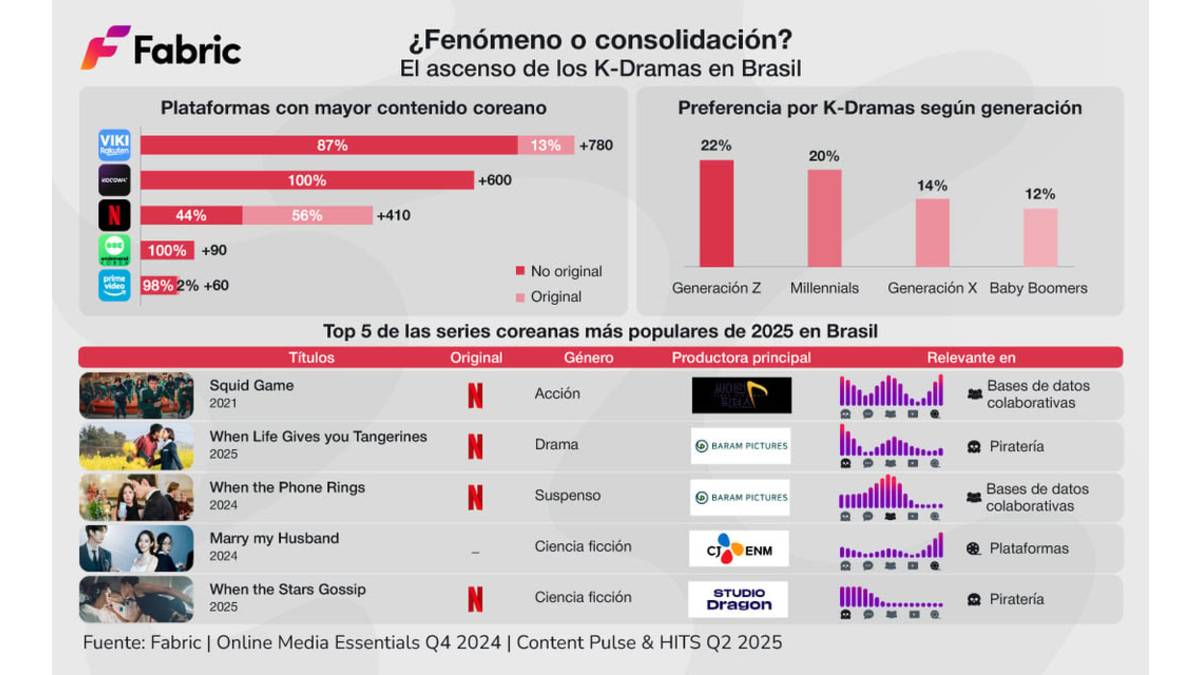
The growth in demand is also reflected in the popularity of specific titles. Among the most prominent K-Dramas in Brazil during 2025 are Squid Game (2021), boosted by the launch of its second season; When Life Gives You Tangerines, released in 2025; and When the Phone Rings (2024). Most of these productions are Netflix originals, which is the platform with the highest penetration in the country (58%) and one of the platforms that invests the most in original Korean content.
However, when looking at the big picture, there are other specialized platforms that play an important role in offering Korean content. Rakuten Viki leads in the number of titles from this country available in Brazil (+780), followed by KOCOWA+ (+600), Netflix (+410), OnDemandKorea (+90) and Prime Video (+60). Despite the fact that Netflix has a smaller number of titles compared to specialized platforms, 56% of its Korean catalog includes original productions.
On the other hand, although the number of Korean titles available in Brazil has progressively decreased since 2020, the public's affinity has increased. So far in 2025, more than 20 Korean titles have already been released, of which 50% correspond to Netflix originals. Devil May Cry (Netflix), The Trauma Code: Heroes on Call (Netflix), and When the Stars Gossip (Netflix) are some of the original releases available to watch.
Korean titles have managed to consolidate themselves as content of interest to the local audience. This context of low supply and high demand highlights the need to align programming with the real preferences of the public. Having accurate and up-to-date information on audience behavior becomes essential to optimize catalogs, anticipate trends, and improve efficiency in content distribution.