
Mexico. The adoption of 5G technology in Mexico represents a horizon of digital transformation with multiple challenges and opportunities for the country's economic development.
In the coming years, 5G is expected to drive innovation in key sectors and industries, improving connectivity and opening the door to advanced applications. In addition, it will facilitate services such as telemedicine, distance education and industrial automation, contributing to a more efficient, dynamic and competitive economy.
Among the advantages of 5G are its high data transmission speed, low latency and greater capacity to connect a large number of devices simultaneously, which is crucial for the development of the Internet of Things (IoT), Industry 4.0 and Smart Cities.
However, the challenges include upgrading infrastructure and ensuring equitable access, ensuring that the benefits of this technology reach the entire population and industries. With strategic planning and collaboration between government, industry, and academia, Mexico can overcome these obstacles and harness the potential of 5G to drive its development in the digital age.
Conditions for 5G Adoption
The adoption and mass deployment of 5G technology in Mexico is a complex process that, in addition to taking time, must meet certain fundamental requirements. Coverage is the most essential link, since, without an extensive and robust network, the benefits associated with 5G technology cannot be taken advantage of. This requires the availability of radio spectrum and significant investment in infrastructure to ensure that both urban and rural areas have access to the grid.
Second, the availability and adoption of 5G devices is another crucial aspect; If the costs are too high, adoption will be slow and limited to certain sectors of society. Therefore, it is important that the prices of services and devices are accessible to a wide range of consumers.
Finally, an attractive commercial offer can incentivize consumers to make the transition to 5G technology, by offering plans and services that highlight the advantages of this new technology, such as increased speed and connection capacity.
These elements, combined with a well-designed market strategy and conducive regulation, can accelerate the adoption of 5G in Mexico and allow the country to take full advantage of the opportunities offered by this technology.
The following is a brief general analysis of the state of the three conditions referred to in the country.
State of 5G Adoption in Mexico
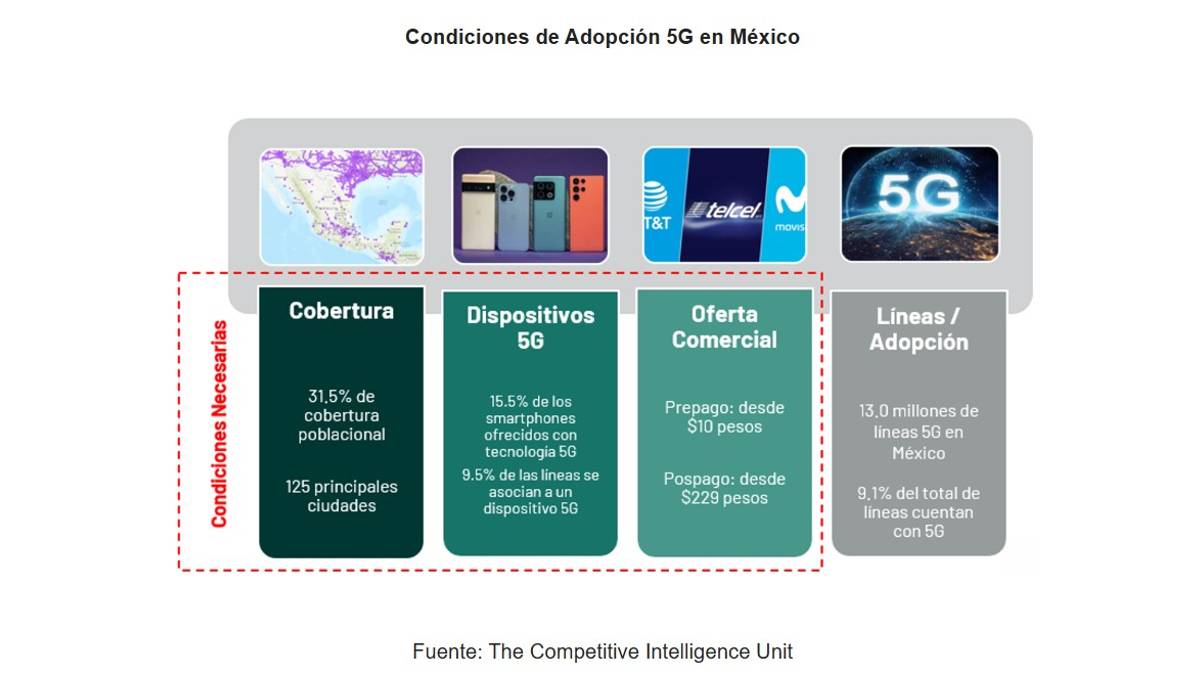
On the one hand, 5G coverage in Mexico is led by Telcel, which currently offers the largest coverage with a presence in 125 cities, reaching nearly 40 million inhabitants. AT&T continues on the list with 5G availability in 47 cities, while Movistar has this network in 38 cities. With this, a population coverage of access to 5G networks of 31.5% is estimated.
This indicates that there is still a significant way to go to realize full adoption of 5G, which would enable more people, businesses, and industries to leverage and benefit from its capabilities.
Regarding the availability and accessibility of 5G-capable devices, it is worth noting that in Mexico only 15.5% of the new devices offered in mobile operators' stores are compatible with 5G.
5G smartphones began to be marketed at the end of 2021, initially in the high-end segment, but the innovation and cost reduction of this technology has led to greater accessibility, which has resulted in an increase in the acquisition of these devices. The cheapest equipment on the market with 5G technology is priced at $3,250 pesos and is marketed by Movistar, while the lowest-priced devices offered by Telcel and AT&T are around $4,239 and $4,998 pesos, respectively.
On the other hand, competition between operators can play a decisive role in the creation of attractive commercial offers that drive the deployment and adoption of the new technological generation.
Telcel and Movistar have taken the lead by not imposing restrictions on their users, enabling both prepaid and postpaid customers to access the 5G network, with plans starting at $229 and $279 pesos respectively. On the other hand, AT&T allows the use of the 5G network to postpaid users with plans that start at $299 pesos.
In the case of Mobile Virtual Network Operators (MVNOs), the vast majority are still without the possibility of offering 5G services, a circumstance derived from dependence on the networks of traditional operators and the incipient transition to new generation networks.
As of the first quarter of 2024, it is estimated that 13.0 million mobile lines are associated not only with smartphones with the capacity to use the 5G network, but also have a commercial plan that enables them to take advantage of it. This implies that 5G adoption is recorded of 9.1% of the total mobile lines in the country, a scarce reason when compared to the aforementioned links.
Additionally, it is worth highlighting that the knowledge and conviction of consumers, companies and governments about the advantages and capabilities of the 5G network is another factor that affects its deployment and adoption. In this regard, currently only 58.2% of mobile users in Mexico are aware of the benefits of the 5G network. This information can be decisive for users to choose to migrate to plans that include 5G, especially if they are offered perceptible comparisons with previous generations of mobile technology.
In summary, the keys to driving 5G adoption in Mexico are: stimulating investment and deployment of infrastructure for network development, the availability and affordability of mid- and low-end smartphones compatible with this technological generation, as well as the creation of a competitive environment that incentivizes operators to offer superior capabilities, attractive and accessible plans for all segments of the population and business verticals.
All of the above, combined with an effective strategy of awareness and taking advantage of the advantages of the 5G network, could significantly accelerate the transition to this new era of mobile connectivity.
Analysis by Fabrizio Vargas of The Ciu.