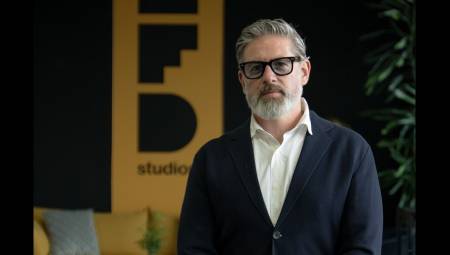

One of the most interesting characters at this year's annual convention of the AES (Audio Engineering Society) in Paris was Günter Theile, Head of the Department of Audio Systems at the IRT – Institut für Rundfunkteknik of Germany. Mr. Theile has been a researcher dedicated to the subject of stereophony since the seventies.
We will return in this article to some elements of stereophonic perception (TV & Video Set. Oct 1999) to try to understand the proposals that Mr. Theile raises in his research.
As we had indicated on that occasion, the basic stereophonic reproduction is done with two identical speakers. The auditor shall be located in the third corner of an equilateral triangle formed with the two speakers. If we send 100% correlated (identical) audio information to the two speakers, the auditor will perceive a centered image of the sound source (FS). This FS will be called virtual or phantom compared to a real image that would correspond to a sound source locatable exactly as coming from the speakers and not from between them.
Phantom sound sources are one of Mr. Theile's research topics. He wondered what a phantom FS really is: "first of all with two speakers and looking at what was produced on the sides, keeping the front listening axis very well and with my ears in front."
Some researchers propose in their works a theory of localization by "addition", that is, the sum of intensities of the same signal leaving through the two speakers, will be located in the middle of the two if the intensities are equal. If we send the same signal to the left speaker but lighter, the phantom FS will move to the right and vice versa. The sound source will actually be located on the right or left speaker when the difference in intensities (/I) between the signals varies between 14 and 24 dB, depending on the authors and the signals used (for a voice signal/I=15 to 17 dB).
According to Thiele, this theory is completely false "because if one measures, for example, phantom FS signals compared to real FS signals, they have nothing to do with it. If the ghost FS moves nothing changes in terms of timbre, it moves but the perception is not natural."
Another way to move an FS is to use signals identical in intensity but out of phase in time (/T) by means of a variable delay. If the right signal is delayed by a few milliseconds with respect to the left, we will perceive that the centered image moves towards the left speaker and vice versa.
There is the possibility of "compensating" a displacement of the image generated by a / I, involving a / T, and thus bring the lateralized image towards the center.
When we make a recording in "polymicrophony" (other authors call it directed monophony) to obtain a stereo mix, a location of the musical instruments is often made, creating them as ghost or real FS, by means of the "panning" (PAN) of each channel on the console. This methodology takes advantage of differences in intensities / I (panoramic potentiometer).
Mr. Theile did not initially carry out tests regarding the quality of phantom FS, from the point of view of stereophonic capture systems (Polymicrophony, XY, AB, MS, etc.), "I was, above all, more concerned about the phenomenon of phantom FS that is independent of the capture techniques. We worked with generated sounds or voices in mono and without effects because we were mainly interested in what was happening in terms of reproduction. Then, we do dedicate ourselves to understanding the microphone technique," he said.
The quality of stereo perception is closely related to the quality of the speakers and their ability to correctly reproduce ghost FS. Speakers must be identical in their electroacoustic and mechanical characteristics. As we have seen previously (TV&Video Nov/Dec 1999), the sound playback device does not work in isolation and its performance depends on the acoustic environment in which the sound is played. The location of ghost FS can be altered depending on where the speakers are located.
Günter Theile made measurements in two types of acoustic conditions. First, in a room that is not reverberant and with correlated signals. Then, he did tests in a recording studio that produced reflections of the sound that helped localization. "We found with this process that a contribution of reflective energy could be used to help the localization process. When the location of the speakers is good, the ghost FS are of better quality." This is exactly the statement of Theile's theory: a model of association."
If we take into account the latest developments in digital radio and television, DVDs, etc., we can say that we will increasingly approach multichannel sound reproduction systems at our fingertips. The economical construction of small, high-performance speakers for all types of uses becomes imperative. "You can't get a good idea of the balance of a 5.1 (Dolby Digital) mix if you reduce it to stereo and then hear it through headphones," Theile observed.
The "surround" monitoring system has achieved a new breakthrough with the proposal of Studer and his console with "pans" that are not only of intensity (/ I) but also take into account the principles of natural perception in stereo. That is, the time differences (/T). Thiele proposes a system with delays for the support microphones associated with a pickup system based on a main stereo pair. Obviously, the support microphones (located on instruments at weak sound pressure) will be "panned" to locate them in the stereophonic base between the two monitors. They will have a not very high level because the idea will be to reinforce a little. Sound engineers have always said that this kind of solution alters the depth effect.
The idea would be that the signal coming from the support microphone is delayed in such a way that the result is not a compensation between the microphones due to a difference in intensity. "There will then be a compensatory delay plus a delay for the resulting initial depth of the venue, which means that I should not only use the same 'panning' of intensity, but also use the same transfer function of the microphones," Theile added.
The transfer functions refer in this case to the restitution of the parameters of lateral location and depth of a sound source in front of support microphones or multimicron capture of proximity.
The "panning" and intensity and the use of delays allows us to even give more level to a support microphone without altering the perception of depth. Günter Theile presented the results of these studies in the Journal AES in 1991. Studer proposed a system that offers the possibility of locating a sound source between two speakers with a certain depth perception.
Günter Theile continues his investigations at his headquarters in Munich. Current works deal with a system of hearing aids that take into account the movements of the listener's head both vertically and horizontally. The movements of the listener's head determine dynamic changes, of "interaural" time differences (between the two ears).