
 Chile. With a debate on pluralism, the autonomy of public media and editorial independence, one of the sessions of the VII International Forum of Public Media in Latin America, "Public media and their audiences: Challenges of convergence and development", was held in the TVN auditorium on June 9 and 10.
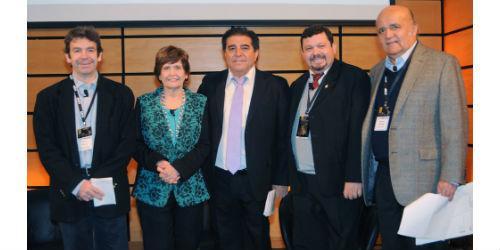
The national journalism award and director of the Institute of Communication and Image of the University of Chile, María Olivia Monckeberg; together with the academic of the University of Quilmes of Argentina, Martín Becerra; Edward Bogado, Director of Education and Communication of the Secretariat of Information and Communication of Paraguay; and under the moderation of Genaro Arriagada, counselor of the National Television Council, they participated in one of the panels of the day.
"There is a perfect storm in the sense that all the conditions have been in place for TVN to have the problems it has had. Public TV must consider not only its programming, but also its financing is very important. The current injection to TVN must be seen as a debt for everything that has not been given in recent times, "said María Olivia Monckeberg.
"Latin America is the most unequal region on the planet, which has resulted in us being really weak in access to different resources such as information and entertainment. In most countries there is a concentration of media ownership and there is no real commitment from the State to the financing of public media," said the trans-Andean academic Martín Becerra.
The president of the National Television Council, Oscar Reyes announced the results of the survey on "Public Media, seen by their Publics": "Public media, and above all, public television, must be committed to the quality of information that is disseminated in democracies. 72% of viewers believe that public TV should promote cultural and educational programs, and 60% of respondents say they currently watch this type of program, "said the president of CNTV.
The Forum, which had both national and international panelists from Argentina, Brazil, Colombia, Costa Rica, the United States, Mexico, Paraguay, Peru and Uruguay, debating in six different tables, addresses issues such as new business models and financing of public media in a convergent environment, multiplatform strategies against digital TV and convergence, the editorial independence and operational autonomy of public media in the region, audiovisual production policies aimed at children and the experience of applying specific impact and quality indicators for public media.
Among the prominent panelists who have debated at the VII International Forum on Public Media were Edison Lanza, Special Rapporteur for Freedom of Expression - who gave a keynote speech - Pascual Gerstenfeld, director of the Statistics Division of ECLAC; Javiera Olivares, president of the Association of Journalists of Chile; Ricardo Solari, president of Televisión Nacional de Chile; John Jairo Ocampo, RTVC Manager, Public Media System of Colombia; Paula Gálvez, vice president of the association of audiovisual filmmakers of community channels in Chile and André Barbosa, Superintendent of Institutional Relations, EBC of Brazil. In addition to the CNTV advisors, Andrés Egaña, Esperanza Silva, Genaro Arriagada and María Elena Hermosilla.
The meeting opened with a keynote speech by the Minister Secretary General of the Government, Marcelo Díaz, on public media and the social role of TVN.