
Latin America. Global audiovisual consumption is at a significant inflection point. Traditional audience measurement through traditional linear media and channels is already insufficient to capture viewers' actual habits and preferences.
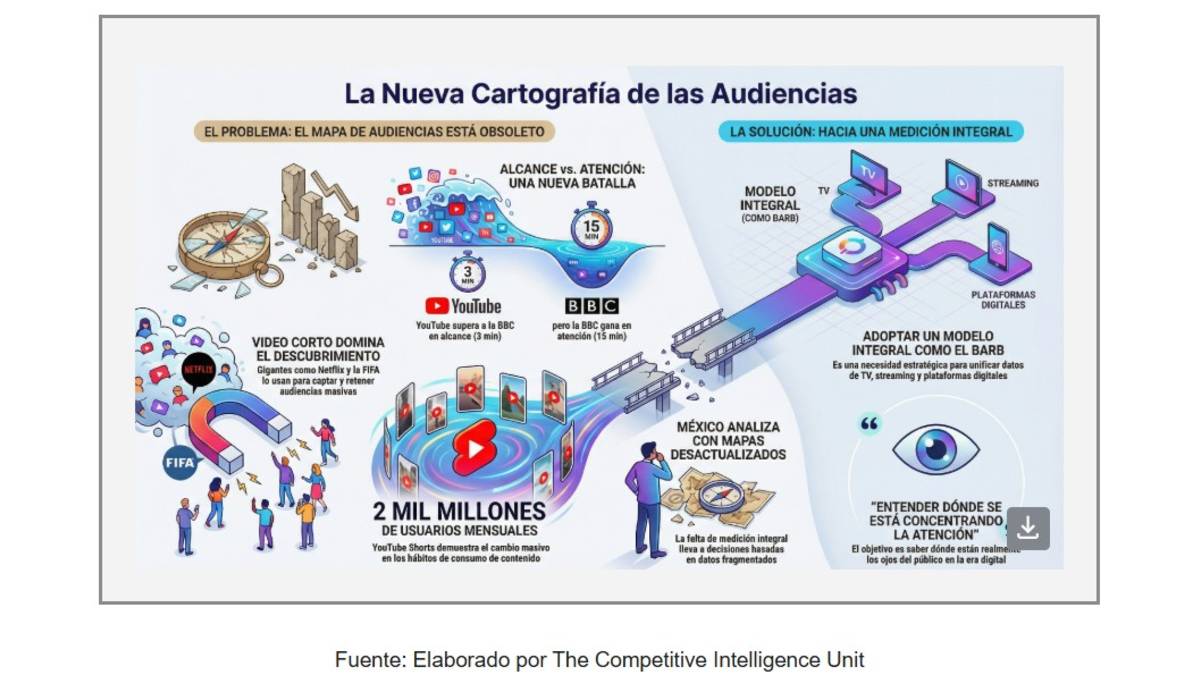
Proof of this is the statistics released by the British audience measurement body BARB (Broadcasters' Audience Research Board), which show that in December 2025 YouTube registered a reach of 51.9 million people, surpassing the BBC with 50.8 million, with the metric of at least 3 minutes of viewing.
This data is relevant not only because of the emergence of the digital platform, but also because the BARB integrates audience from multiple devices (television, phones, tablets and computers) into its metrics to reflect the real reach of the services in a multiplatform environment.
Screen(s) Migration and New Audience Metrics
This phenomenon of migration of multi-screen audiences has also triggered the debate about what a meaningful audience metric should be.
In this regard, the BBC has pointed out that, if a stricter metric is used, such as the threshold of 15 minutes of continuous viewing, which captures the consumption of long-form content, the results are different. Under this measurement, the BBC would reach 47 million viewers, compared to the 40.8 million that YouTube would have in the same period.
This difference highlights that absolute reach metrics (such as 3 minutes) favor platforms with high traffic volume or fragmented consumption, such as YouTube, while higher thresholds highlight engagement with long-form content, traditionally associated with programming from broadcasters such as the BBC.
BBC and YouTube: From Competitors to Allies
Beyond the fact that YouTube has surpassed the BBC in some reach metrics, the public broadcaster itself has recognized this paradigm shift. Recently, the BBC announced a deal to produce and distribute content directly on YouTube, seeking to connect with younger and more fragmented audiences.
This agreement aims to attract audiences that have decreased their linear consumption and have migrated to more accessible and immediate digital content, and recognizes that being present on platforms with an increasing reach is strategic to maintain relevance.
Short Videos: A New Way to Discovery Content
Consuming short videos has become how users explore, discover, and consume audiovisual content. YouTube Shorts registers an accounting of more than 2 billion monthly active users, while TikTok concentrates a significant reason for the consumption of content in this format.
These patterns have even motivated long-form content platforms, such as Netflix, with a potential reach that exceeds one billion people, to integrate short videos into their interface to facilitate the discovery of titles, adapt to the most immediate consumption habits, as well as capture the attention and retention of audiences.
The centrality of short video is not limited to entertainment in general. A striking example is the exclusivity agreement reached by FIFA with TikTok for the distribution of World Cup content. This, in full recognition that the sporting event with the greatest reach on the planet generates conversation and relevance through clips of a few seconds consumed on mobile devices.
Millions of views, interactions, and attention minutes that are not reflected in traditional rating measurements, but that concentrate advertising value, cultural influence, and engagement. This case clearly demonstrates the limits of conventional metrics to capture the true reach of content in the digital age.
Measuring Audiences Where Your Eyes Really Are
Changes in consumer habits highlight the urgent need for audience measurement that takes into account all digital platforms and content formats. Traditional methods, focused on linear TV or subscription metrics, no longer capture the complexity of today's AV ecosystem.
The BARB model in the United Kingdom is one of the closest examples to this comprehensive measurement, because it integrates television audience and digital platforms, allowing the migration of care to be measured more accurately.
Likewise, the comparison between 3-minute and 15-minute metrics demonstrates how different attention thresholds can substantially change the reading of data, especially when it comes to long-form content versus short and fragmented formats.
Mexico: Pending Comprehensive Measurement
In Mexico, the absence of a measurement that unifies data from television, streaming platforms, and digital content limits the understanding of how consumption preferences have evolved. Without comparable, cross-cutting metrics, ad spend, content production, and public policy decisions are based on bits of information that don't capture audience habits.
Moving towards a scheme similar to that of the BARB would allow us to more accurately measure the migration of audiences, the real weight of the short video and the redistribution of value in the audiovisual chain. It's not just about counting screens, platforms, and subscriptions, it's about understanding where attention is being focused.
YouTube's crossover of the BBC in audiences, the adoption of short video by Netflix and FIFA's commitment to TikTok show that the cartography of audiences has already changed. Insisting on metrics designed for an environment that no longer exists means underestimating the real reach of content and losing visibility into where the market is moving.
For Mexico, the challenge is clear. Without a comprehensive and modern measurement, we will continue to analyze the ecosystem with obsolete maps. The adoption of comprehensive audience measurement such as the one proposed by the BARB is not a simple suggestion, but a strategic necessity to understand where the eyes of the public really are and how the way of watching content evolves in the digital age.
Analysis published by The CIU.