
 For Latin American businesses, energy management goes beyond saving equipment when lightning strikes, it means reducing downtime in production.
By: Greg Larson*
For different reasons, electronic components in Latin America are at an especially high risk of damage. On the one hand, lightning abounds in the region, which is compounded simply by the fact that buildings usually have copper lines operating between them. In addition, building codes in the region are not always obeyed or enforced.
The chances of a non-existent land jumping to neutral are almost 50/50. For consumers and their high-tech home theater components, this has turned out to be a permanent problem. However, business has a lot more at stake. Lightning can not only ruin your expensive equipment, but it can produce downtime in the company, which implies a decrease in production and its corresponding drop in revenue.
Traditionally, businesses have had emergency plans in place to minimize downtime as a result of natural or man-made disasters and these plans are increasingly designed to prevent the company from coming to a complete standstill. In the coastal regions of Latin America, where environmental conditions are the most severe, this is not always the case.
During the rainy season, lightning usually strikes in the evenings and many factories and their customers literally shut down their equipment and close businesses by the end of the workday.
There is also a lack of awareness when it comes to energy management and how to keep factories running at all times. After working in this region since 1988, training building owners is nothing new to me. Generally, companies turn to me when the damage is already done, looking for a solution to avoid another event of the same type. Below I will give you three examples of companies that experienced loss of equipment and downtime due to lightning and how they avoided future mishaps with proper energy management.
Kellogg's, Guatemala City
As the world's leading manufacturer of ready-to-eat cereals, Kellogg's is confident that its manufacturing plants never stop operating, even in areas prone to lightning strikes. Eight years ago, I advised Kellogg's Latin American plant on protection against voltage surges. At the time, the company was not interested and argued that its buildings had wonderful grounding systems and that they also had a UPS to protect the equipment.
When the rainy season began that year, lightning struck an old radio antenna between two buildings on the plant. The lightning struck and was lifted by the telephone extensions. It all started with the telephone system and was affecting all the facilities. Ten computers with their modems were destroyed as the voltage surge traveled through the data lines. After the computers, the switches followed, destroying 25 of them before proceeding with the laser printers. From there it was spread to the server room and five servers and the UPS were totally damaged. Electrical outlets followed through the copper wires and finally ended the discharge with the destruction of the plant's color televisions and microwaves that were in the kitchen.
Although replacing office equipment proved truly expensive, the biggest expenses came from downtime. The plant was shut down for two weeks, which had a huge impact on the company's balance sheets. Kellogg's called me at the time and asked for 100% high voltage protection. He implemented a plan that cost about $45,000, but the company's budget was tight and the plan had to be forgotten.
I received a second call from that company after another storm hit. Lightning struck again and equipment that had recently been replaced in the server room was destroyed, resulting in other downtimes in the company's production. The company decided to invest minimally in high voltage protection in critical areas and continues to gradually improve the protection system. The strategy worked and since that time there have been no more closures of the plant due to storms.
Aceros de Guatemala, Escuintla-Guatemala
Aceros de Guatemala is a metal recycling company off the coast of Guatemala, which produces energy from scrap recycling and sells it back to the government. However, in the lightning-prone area the company is in, production usually had to stop in the past. Every time a storm hit, Aceros had to disconnect his equipment, which meant the loss of 12 hours of work and a lot of loss of income.
"During my first two rainy seasons as head of the IT department, I learned about lightning problems in our region in the worst way," says Julio García, IT Manager at Aceros de Guatemala. "One Monday morning when I arrived at the office, four of the computers had been damaged. They were not disconnected from the wall outlets; the damage was produced through the LAN line. From that moment, when we saw that the sky was getting cloudy, we ran to disconnect everything in the office, both the AC and the LAN lines."
10 years ago, Aceros contacted me when he saw in the newspaper an advertisement for a Panamax energy management system. After discussing the company's situation and attending a seminar on energy management, they decided to spend $2,000 a month (for 5 months) before the lightning season began to protect the company's servers and phone systems.
When the lightning season began, the company was still nervous and management kept calling me to ask if I was sure they shouldn't disconnect the equipment. With the sound of thunder on the other end of the phone, I assured them that their equipment would be fine. So Aceros decided not to disconnect its equipment anymore and, from that moment, it did not have to stop its production anymore because of lightning. To ensure that things are preserved this way, whenever the company buys new equipment, it also acquires its protection system.
"Once we made all the arrangements regarding power management, it became the company's policy not to reinstall any piece of equipment without proper protection for both AC and data lines," Garcia adds. "We remain very concerned about lightning storms, but we can continue to work without damaging our electronic equipment."
Pantaleon, Escuintla, Guatemala
Pantaleon is the largest sugar farm in Central America. The company is unique in its awareness of the benefits that high-voltage protection brings and even made its own protectors for a while, but they just weren't working well for them. At the Pantaleon location, the company is exposed to lightning 80% of the year. Beyond the damaged equipment, there were several occasions when employees were affected with voltage surges when they were talking on the phone. The situation got to the point that they had to completely stop the work.
The company contacted me to ask me about their problem. Pantaleon had a tight budget, but had annual allocations for the replacement of damaged equipment. I convinced the company that instead of spending its entire budget on replacing damaged equipment, it could spend part of that budget on a protection system to avoid equipment damage in the first place, and have the benefit of not having to stop its operations. The company agreed and the arrangements worked perfectly, so much so that Pantaleon implemented as a rule that employees could not work on any equipment that was not connected to an energy conditioner.
The ABCs of protection
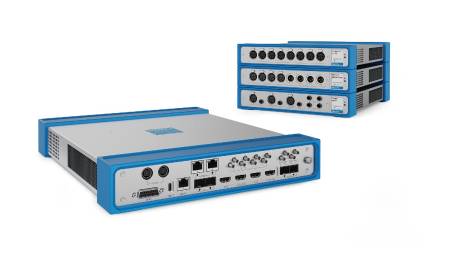
A. Provide protection to primary electronic devices that are most important to you, such as servers or workstations. The device shown in the figure can be located next to the equipment and includes outputs for telephone and Ethernet.
B. Shared devices such as servers, phone systems, audio and video distribution systems, routers and switches are easily destroyed by increased voltage in the data line. That's because there are many lines of data with different levels of resistance. When there is an increase in voltage, the equipment suffers from these differences in the data line lands, thus destroying the equipment.
C. A service entry protector is the first step in the conditioning of AC lines and data lines, as these enter buildings. This type of device is the first in the line of defense to protect major devices and sensitive electronic circuits.
*Greg Larson, based in Guatemala, is Panamax - Furman's account manager for the United States and caribbean. He is responsible for supplying the company's advanced technology for demanding customers in the Latin American region who require high-tech power conditioners for home theaters and other advanced applications. Larson began his career in energy management with Panamax in 1988, as Panamax's first international distributor in Guatemala. Since then, it has not stopped expanding its functions within Panamax/Furman.