
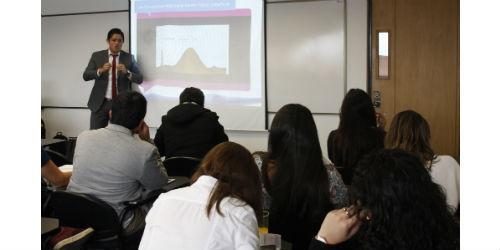
 Colombia. The National Spectrum Agency, ANE, developed the third day of training on the spectrum in various cities of the country. The engineer Camilo Zamora, Deputy Director of Management and Planning, in charge of providing this training to the general public, shared with us on October 26 his observations within the day held at the Externado de Colombia University.
Luis Pinto: What is the objective of doing these trainings?
Carlos Zamora: It is a function of the ANE to promote knowledge of issues related to the Radio Spectrum in society, in the general public and these days are part of a strategy to promote knowledge about it, where the ANE seeks to explain basic concepts at all social levels, that is why we have taken this talk to more than 11 thousand people in the country.
Luis Pinto: In your speech you talked about the possibility of releasing the 600 MHz band, what is the position of the ANE in this regard?
Carlos Zamora: We are studying that this possibility will occur in the future, after the analog blackout, we are looking at what use can be given, in this sense there are two possible uses already foreseen, one is television broadcasting of course and the other, its use by mobile operators with 5G.
At this moment we are going to study everything, demand for services, possibility of interference, etc., to be able to study it properly, is that we are promoting this release of the 600 band, under a high-level agreement or an attribution that is what is technically known in the WRC, for now the release will be a step that is taken later.
Colombia was represented by Engineer Zamora at World Radiocommunication Conferences (WRCs), which are held every three or four years and his task is to review and, if necessary, amend the Radio Regulations, which is the international treaty governing the use of the radio frequency spectrum and the orbits of geostationary and non-geostationary satellites.
The amendments are made on the basis of an agenda determined by the ITU Council, which takes into account the recommendations made within previous world radiocommunication conferences.
The International Telecommunication Union (ITU) is the specialized telecommunications agency of the United Nations (UN), responsible for regulating telecommunications at the international level between the different administrations and operating companies.
As Zamora said, these talks are part of a strategy that the ANE has, on which we would have to know its bases and objectives, for which the entity is ready to give more specialized and directed talks, if a particular group requires it, the spectrum despite being finite does not seem so with the appearance of new and better technological advances, so its administration must be and is very dynamic. Talking about 5G when we are still implementing 4G, is normal and the ANE understands it. For 5G, it is first necessary to see the definition of an official standard that defines the parameters of this new mobile technology and then enter the phase of the construction of prototypes and field tests. The last step would be the commercial launch of the technology.
In the Latin American panorama we see that Argentina already seeks to release the 600 MHz band for mobile services, The National Communications Agency (ENACOM) has already authorized the use of the 12.2 to 12.7 GHz band for the provision of the Subscription Broadcasting Service through Radio Link and the Fixed Service of Data Transmission and Added Value, within this spectrum, the systems of the Complementary Service of Encoded Television (SCTVC) that currently operate in the band 698 – 806 MHz (700 MHz band) will be moved.
Within the resolution 2531 of the organism, a period of two years is stipulated for similar services that are located between 512 – 698 MHz migrate to the 12 GHz bands. The standard seeks the cleanliness of the 600 MHz band. And operators that provide TV services on that spectrum will have two years to migrate, once released, that band will be available for mobile services. Mexico for its part is also analyzing using the 600 MHz band for mobile services in 2018, Colombia seems to be going for the same...
Text written by Luis Pinto, advisor of the magazine TVyVideo+Radio.